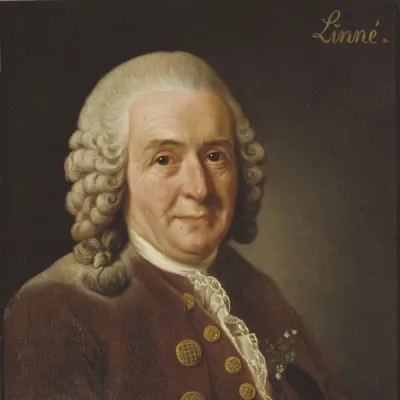
Carl Linnaeus
Human Design Chart
Biography
Linnaeus was the son of a curate and was born in Råshult, in the countryside of Småland, southern Sweden. He received most of his higher education at Uppsala University and began giving lectures in botany there in 1730. He lived abroad between 1735 and 1738, where he studied and also published the first edition of his Systema Naturae in the Netherlands. He then returned to Sweden where he became professor of medicine and botany at Uppsala. In the 1740s, he was sent on several journeys through Sweden to find and classify plants and animals. In the 1750s and 1760s, he continued to collect and classify animals, plants, and minerals, while publishing several volumes. By the time of his death in 1778, he was one of the most acclaimed scientists in Europe.
Linnaeus has been called Princeps botanicorum (Prince of Botanists) and "The Pliny of the North". He is also considered one of the founders of modern ecology.
In botany, the abbreviation L. is used to indicate Linnaeus as the authority for a species' name. In zoology, the abbreviation Linnaeus is generally used; the abbreviations L.
What does Manifesting Generator 2/5 mean for Carl Linnaeus?
Carl Linnaeus is a Manifesting Generator in Human Design – an energy type that combines the sacral power of the Generator with the manifestation ability of the Manifestor. Manifesting Generators are multi-talented and often work on several things simultaneously.
The Manifesting Generator's strategy is to respond to impulses, inform others, and then act. Unlike pure Generators, they can skip steps and take shortcuts – this isn't a mistake but part of their design.
When Carl Linnaeus lives in alignment with their design, they experience deep satisfaction and fulfillment. The not-self theme is frustration and anger – frustration when the sacral energy is blocked, and anger when the manifestation power can't flow freely.
Carl Linnaeus has Sacral Authority. The Sacral Center responds with a clear physical reaction – an "uh-huh" (yes) or "un-un" (no). This gut response is spontaneous, direct, and reliable. The key is responding to the right question or impulse.
Carl Linnaeus carries the profile 2/5 – Hermit / Heretic. The 2nd line represents the Natural: a natural talent that is often unconscious and only activated when called out by others. The 5th line represents the Hero and Savior: others project expectations and hopes onto this line, which can deliver practical solutions for universal problems.
The incarnation cross "Right Angle Cross of the Sleeping Phoenix 2" describes the overarching life purpose and direction of Carl Linnaeus in Human Design. It consists of the four gate activations of Sun and Earth (personality and design) and only becomes felt when one lives their strategy and authority.
Carl has a Single Definition.
4 of 9 centers are defined: G Center, Throat Center, Sacral Center and Root Center. The 5 open centers (Head Center, Ajna Center, Heart Center, Emotional Center and Splenic Center) absorb energy from the environment.
The circuit emphasis lies on: Individual (Knowing, Integration): 3 channels, Collective (Sensing): 1 channel. The focus in the "Individual" area stands for unique self-expression and mutation.
4 Defined Channels
Incarnation Cross - Right Angle Cross of the Sleeping Phoenix 2
Solar Return
The Solar Return shows the moment when the sun returns to its exact birth position - your personal solar year.
Life Cycles
Discover the life cycles with a detailed triple view (birth chart, cycle chart, composite).
Human Design Profile
- Strategy
- To respond - wait for something to respond to
- Authority
- Sacral Authority
- Profile
- 2/5 - Hermit / Heretic
- Definition
- Single Definition
- Incarnation Cross
- Right Angle Cross of the Sleeping Phoenix 2
- Date of Birth
- 24.05.1707 00:26
- Place of Birth
- Röshult, Sweden
Frequently Asked Questions
What Human Design type is Carl Linnaeus?
What Human Design profile does Carl Linnaeus have?
How does Carl Linnaeus best make decisions?
When and where was Carl Linnaeus born?
What is Carl Linnaeus's incarnation cross?
Discover your own Human Design
Are you also a Manifesting Generator? Find out in a personal reading how to unfold your multi-talents and direct your energy wisely.
More Personalities
Back to overviewAldair

Alizée

Angeli

Arletty

Artus

Balthus