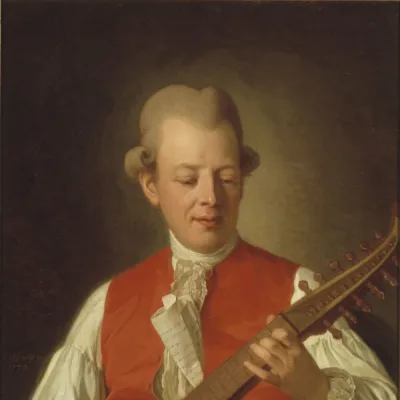
Carl Michael Bellman
Human Design Chart
Biography
He died on 11 February 1795 in Stockholm, Sweden.
Carl Michael Bellman — Manifesting Generator with Profile 2/4
Manifesting Generator 2/4 — Design at a Glance
Carl Michael Bellman's Human Design profile indicated a tendency towards hybrid dynamics: the constant power of a Generator combined with the lightning-fast action capability of a Manifestor. As a manifesting Generator, he had a defined Sacral Center that provided him with inexhaustible energy. However, unlike a pure Generator, he could skip steps by connecting to the Motor Centers and rapidly pull things into his life.
This speed carried risks, though. Often Carl Michael Bellman acted too quickly, skipped necessary intermediate steps, and later had to backtrack to fill in gaps—a process that easily led to frustration, aligning with his Type's theme of non-self. Additionally, he tended to take on multiple impulses simultaneously and start projects in parallel. Without inner confirmation, this creative enthusiasm quickly turned negative.
The solution lay in the strategy of responding. Instead of initiating himself, Carl Michael Bellman waited for external impulses. Only when his Sacral Center responded with a clear "Yes"—a sign of deep agreement—did he begin to act. Regular checks of this internal resonance were crucial. When these principles were followed, he found deep satisfaction in creation. The demand to focus on one thing did not suit him; instead, his energy flourished in a playful mode that used variety and parallel work as sources of his fulfillment.
Emotional Authority
Carl Michael Bellman's design revealed a tendency towards emotional depth and readiness to fluctuate. He appeared as someone whose inner compass needle was strongly influenced by the current mood state. His defined Solar Plexus Center carried emotional authority – a mechanism that always took precedence regardless of other defined centers. This meant that his perception of the world was always colored by the prevailing emotional wave: at one moment he could be enthusiastic about something, and in the next see the same situation negatively.
This emotional wave generated a constant up-and-down movement. His immediate feeling was only a snapshot, not a secured truth value. Spontaneous decisions stemming directly from this first emotional reaction carried the risk of proving misleading or disadvantageous. For Carl Michael Bellman, patience was therefore key to clarity. He needed time to let a decision mature – often through multiple "sleeping on it." Only when intense feelings subsided and an emotional distance was gained did calmness set in. This process filter served to separate transient moods from the deeper, more comprehensive understanding, which was particularly crucial for long-term life decisions.
The 2/4 Profile — Hermit / Opportunist
Carl Michael Bellman's design established a tendency towards a pendulum rhythm that swung between the strict need for withdrawal and the desire to connect with his familiar network. As a person with Profile 2/4, he found himself in constant tension: Line 2, embodied by Gate 30 in the Sun, demanded practicality, pragmatism, and selectivity. This aspect required protecting his own "cave" to transform inner longings into productive experience without wasting energy. Only in withdrawal could he create clarity and ignite his own flame.
At the same time, Line 4, represented by Gate 14, sought security through practical intelligence and opportunism within a stable framework. Here it was about using power and abilities to build a solid foundation. For Carl Michael Bellman, the key to success lay in clearly communicating this shift: he had to make it clear when he needed company and when he wanted solitude. Once his need for alone time was satisfied, he returned from isolation to reflect on the knowledge of his network and develop brilliant ideas from it. This cycle of isolated reflection and targeted engagement within his familiar circle fundamentally shaped his life strategy.
Split Definition — Defined & Open Centers
Carl Michael Bellman's Human Design profile indicates a tendency towards constant vitality and emotional depth. As a Generator, he had a defined Sacral Center, which gave him an enormous source of power that could only be activated through reaction to life; initiation would inevitably lead to resistance for him. His inner authority lay in the defined Solar Plexus Center: He needed to wait out the emotional wave to gain clarity, as decisions made from emotional impulses often proved incorrect.
This mechanism worked together with his defined Spleen and Root Centers. The Spleen Center provided spontaneous intuition in the present moment, while the Root Center supplied constant stress pressure that propelled him forward. His defined Throat Center allowed for reliable communication, which however had to always come from the correct sources—Sacral or Solar Plexus—to be authentic.
At the same time, Carl Michael Bellman was shaped by open centers situational contexts. The open Head and Ajna Centers meant a lack of mental inspiration; he tended to identify with others' questions or seek answers that were not his own. The open G Center lacked a firm identity; he mirrored his environment and often sought direction through external validation. Finally, the open Heart Center led him to lack a constant will, making him vulnerable to pressure to prove himself through promises or competition, which could plunge him into spirals of self-doubt if he did not listen to his sacral response.
Channels for insight, powerful manifestation and meaningful struggle.
Carl Michael Bellman revealed himself through a powerful and often insatiable activity, which was however marked by a deep internal conflict between impulsive drive and emotional longing. His design featured the Channel of Charisma 34-20, which channeled raw physiological energy from the Sacral Center directly into the expressive capacity in the Throat Center. This connection created a fast, almost immediate manifestation power that pushed him to be constantly active; sitting still was difficult for him. Without inner guidance through sacral reaction, this energy threatened to break out chaotically or lead to obsession. Parallel to this, the Channel of Life Struggle 38-28 operated, connecting Root energy with the intuitive assessment of the Spleen Center. This gave him a stubborn determination to fight against external forces in order to maintain his individual integrity and personal sense – even if this provoked conflicts with the status quo.
In contrast, the Channel of Recognition 30-41 was present in consciousness, an interplay of Root drive and Solar Plexus emotions. Here emerged an intense emotional drive for new experiences, driven by restlessness and the fantasy of what "could be." This emotional wave further heated the desire for change but required patience to gain clarity before taking action. The tension lay in that his automatic, charismatic capacity for action (design) was often faster than the reflective, experience-seeking intention (personality). Bellman had to learn to direct his high energy through inner resonance rather than being blindly led by emotional longing for the new or stubborn struggle drive. Only then could he use his vital power constructively instead of succumbing to internal stress or destructive restlessness.
Individual Circuitry — Circuit Signature
Carl Michael Bellman's Human Design configuration created a tension between individual identity discovery and emotional meaning-making. He was shown to be someone who charted new paths while processing past experiences. This configuration arose from his Shared Definition: two energetically separate groups existed in parallel.
The first group connected the Throat with the Sacral Center. Here, the Charisma Channel (20-34) was active. It allowed him to draw power from reactions to life and express this strength through appropriate actions in the present moment. This supported his assertiveness and the expression of his highest individuality.
The second group included Spleen, Root, and Solar Plexus Centers. The Life Struggle Channel (28-38) connected the Spleen and Root Centers here, strengthening his drive to mutate away from the known and follow his unique path. Simultaneously, the Recognition Channel (30-41), which linked the Solar Plexus and Root Centers, encouraged sharing felt insights from the past with the collective to learn together.
These two circuits – Knowledge and Meaning-Making Circuits – were not directly connected in Carl Michael Bellman's design. Instead, they shaped two parallel streams: a pulsing drive for new knowledge and individual transformation on one hand, and a cyclical emotional reflection of the past on the other. His design challenged him to navigate these different energies without experiencing them as a single flow.
Right Angle Cross of Contagion 1
Carl Michael Bellman's design indicated a tendency towards a deep, often unconscious connection to collective patterns or energetic fields. He was someone who was influenced by his mere presence or the absorption of information from the environment. This configuration came from the Right Infection Cross 1. It was less about an active radiation and more about a passive reception and transmission of energetic impulses. Bellman had the ability to integrate into groups or systems, absorbing or channeling their energy. The mechanics of this cross emphasized subtle influence through environmental stimuli. His lifestyle was marked by his unconscious uptake and further propagation of impulses from the collective. It was a process of integration into existing structures where his own energy merged with that of the group. Bellman acted primarily as a conduit for the currents of his environment rather than an initiator of change. This passive reception significantly shaped his interactions and inner experience. The Right Infection Cross 1 thus described a specific resonance with the social fabric in which he was embedded.
Saturn Return · Uranus Opposition · Chiron Return — Life Cycles
Carl Michael Bellman's middle age was marked by profound cyclical turning points that structured both his private bonds and public success. In 1777, at 37 years old, he married Lovisa Frederica Grönlund, who gave him four sons. This step fell within the period of his Uranus opposition, a point where the desire for individual freedom often meets the responsibility of stable commitments, thereby forcing or affirming new life structures.
Another crucial chapter began in 1790 when he was fifty years old and published his main work, "Fredmans epistlar." This marked his Chiron Return, a fulfillment cycle in which one's Incarnation Cross unfolds and the inner meaning of life becomes visible. If Carl Michael Bellman had previously lived according to his strategy and authority, this phase emerged as a flowering period where his specific contribution to the world matured and was recognized. The publication of his work was thus not a random success but the concrete effect of an internal maturation process that represented the peak of his personal unfolding.
Manifesting Generator · Emotional Authority — Synthesis
Carl Michael Bellman embodied a dynamic tension between inner sensitivity and outer expression. His design as an Manifesting Generator, fueled by defined sacral energy and Throat Center, points to someone who could act quickly in their actions but was also marked by deep emotional currents (emotional authority). This combination allowed him to act from the present moment while recognizing the need for decisions to ripen and await his inner truth. The profile as a natural talent and networker underscores this ability to gather creative energy in isolation as well as strengthen it through social interaction – an interplay between withdrawal and community. The connection of Root and Solar Plexus Centers indicates strong internal power, yet always connected with awareness of emotional processes.
A central paradox in Bellman's chart lies in the tension between the drive for rapid manifestation (Manifesting Generator) and the need for emotional clarity (emotional authority). He possessed the ability to quickly initiate things but found true satisfaction only when these actions aligned with his inner truth. This led to a constant interplay between impulsive action and the need for reflection, a balancing act between the speed of the mind and the depth of the heart.
3 Defined Channels
Incarnation Cross - Right Angle Cross of Contagion 1
Solar Return
The Solar Return shows the moment when the sun returns to its exact birth position - your personal solar year.
Life Cycles
Discover the life cycles with a detailed triple view (birth chart, cycle chart, composite).
Human Design Profile
- Strategy
- To respond - wait for something to respond to
- Authority
- Emotional Authority
- Profile
- 2/4 - Hermit / Opportunist
- Definition
- Split Definition
- Incarnation Cross
- Right Angle Cross of Contagion 1
- Date of Birth
- 15.02.1740 09:00
- Place of Birth
- Stockholm, Sweden
Frequently Asked Questions
What is Carl Michael Bellman's Human Design type?
Which Profile did Carl Michael Bellman have?
What Authority did Carl Michael Bellman have?
What incarnation cross did Carl Michael Bellman have?
When was Carl Michael Bellman born?
Discover your own Human Design
Are you also a Manifesting Generator? Find out in a personal reading how to unfold your multi-talents and direct your energy wisely.
More Personalities
Back to overviewAaliyah

Aldair
Alexia

Alizée

Angèle

Angeli