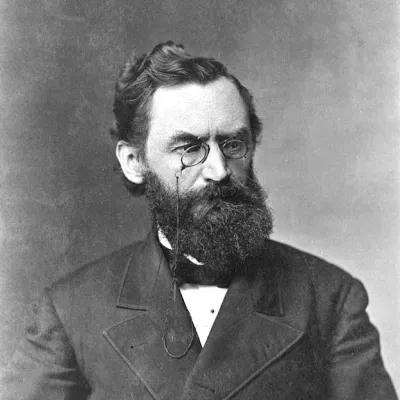
Carl Schurz
Human Design Chart
Biography
Schurz died 14 May 1906 in New York.
Carl Schurz as a Reflector 1/3 in Human Design
Reflector 1/3 — Design at a Glance
Carl Schurz revealed himself as a person without firmly anchored personal energies. His design was characterized by fully undefined centers, making him a sensitive mirror of his environment. He not only absorbed the moods of other people but also perceived subtle currents in nature and cosmic cycles. This configuration required a specific lifestyle: he could not make important decisions impulsively but had to wait for at least one moon cycle to gain clarity.
By following this strategy, he was able to move freely without identifying with external influences. This allowed him to observe the world from a unique perspective and be surprised by life itself. The reward for this patience was a feeling of joyful surprise about the course of events. If he lived against his design – for example, through hasty actions or constant attempts to adapt to others' expectations – deep disappointment would arise instead. This affected both his self-image as well as his perception of the general state of the world. His nature was designed to reflect the energy of his time rather than generate it from an inner source.
No Inner Authority
Carl Schurz lacked internal authority, a configuration that made him a special exception. Since his design did not have either a physical or mental decision-making center, he could not rely on a firm internal signal. Instead, Carl Schurz found his orientation through exchanges with other people. In these dialogues, latent potentials were activated in his open centers through energetic interactions and provided him with specific information. This high resonance capability allowed him to view issues from many different perspectives and express them in various ways.
The evaluation of these diverse impressions was a complex process that required time. Carl Schurz had to take the time to recognize the thread and distinguish what made sense and what truly belonged to him. Through this structuring, he developed his specific intelligence: filtering out the essential from a mass of information. This formed his capital for success as a Projector. A key element in his life was choosing an environment where he felt comfortable. There he met the right people with whom he could exchange ideas confidently. Over time, this process deepened his sense of what was right for him and replaced the lack of internal authority with a fine-tuning mechanism based on his surroundings.
The 1/3 Profile — Investigator / Martyr
Carl Schurz showed himself to be someone who strictly linked theoretical knowledge with practical application. His design as a Researcher/Experimentor (Profile 1/3) shaped an attitude where learning and action were inseparable. The first line emphasized the gathering of evidence and logical refutation of doubts; Carl Schurz sought solid answers before acting. Yet, the third line pushed him to experiment – through trial and error. This dynamic meant that self-earned insights were crucial for his judgment. If he deemed something good, he had previously examined it both intellectually and practically.
An internal conflict existed in that fear of insufficient knowledge (Line 1) sometimes delayed action. At the same time, Carl Schurz felt trapped by rigid patterns and sought escape through imagination. He could not stand still; the rhythm of experimenting was imperative. Doubts had to be logically resolved, calmness helped with uncertainties. His life path involved constant testing: formulating theory, then testing it, analyzing errors, and reorienting. This method created a high credibility in his judgments – they were based on lived experience and rigorous verification.
No Definition — Defined & Open Centers
Carl Schurz appeared as someone who acted without internal fixation on identity or willpower. His design contained no defined centers; all nine areas were open. This shaped an extreme receptivity to the environment: He absorbed mental questions (open Head Center), emotional waves (open Solar Plexus) and stress pressure (open Root). Without his own constant energy sources, he tended to get entangled in other people's thoughts or interpret their emotions as his own. The open Throat drew attention through spontaneity, while the open G-Center meant that direction and love were initiated from outside – not sought after himself. Instead of chasing answers, he was dependent on absorbing inspiration and wisdom from his surroundings. His open Heart Center made him vulnerable to the pressure to prove himself, which he avoided by refraining from making promises. The open Sacral led to energy being available in bursts and learning to respect exhaustion. The undefined Spleen warned against impulsive decisions out of fear. Carl Schurz did not live from inner drive but as a mirror: He reflected the intelligence, emotions, and energies of those around him. His strength lay in perceiving these external influences without identifying with them and trusting his internal authority rather than succumbing to mental or emotional urges.
Channels & Gates
Carl Schurz appeared as someone whose inner drive was strongly shaped by the tension between mental uncertainty and a desire for practical experience. His design indicated a tendency not to fear doubt but to use it as a motor for improving uncertain patterns. Gate 63, the Gate of Doubt, urged him to understand things and answer security-seeking questions; doubt drove the mental process forward and brought satisfaction through resolving these uncertainties. This impulse stood in mirror-symmetrical relation to Gate 64 in the Council, the transition to clarity. Gate 64 caused confusion before its completion and served to interpret past experiences and form concepts from them. This combination revealed secret wishes of the collective sound circle: transforming mental uncertainty into figurative insights through the left eye at Gate 11.
In addition to this cognitive dynamics, Gate 35 required change and progress through interaction. It compelled Carl Schurz to make new experiences and derive advice from them; true satisfaction arose later through the meaning of experience. This gate stood in direct contact with the Solar Plexus Center and allowed strong emotional reactions to transition processes. Furthermore, Gate 5 functioned as the fundamental rhythm of all life processes, emphasizing the need to move within one's essence and follow fixed habits to build energy. The pattern perfection through this gate led to clarity in the energy channel and enabled the proper use of power. Carl Schurz thus lived in a field of reflective doubt, seeking temporal clarity, and rhythmic habit building that structured his interactions with the world.
Circuit Signature
Carl Schurz appeared as someone whose inner experience was marked by fundamental openness and indeterminacy. His design showed no defined centers or connecting channels – a configuration known in Human Design mechanics as 'No Definition'. This did not mean he lacked substance, but rather that he acted energetically like a mirror: free from firmly anchored internal programs that would have inevitably determined his behavior or perception.
Without these rigid structures, Carl Schurz was particularly receptive to the energies of his environment and the people with whom he interacted. He could empathize with others and adopt their perspectives without his own pre-established filters. This flexibility allowed him to adapt to changing situations since he was not blocked by conflicting internal streams. Instead, he often shocked others by his ability to understand and reflect multiple viewpoints simultaneously.
The absence of defined centers created a challenge: Carl Schurz had to learn to distinguish between his own essence and the energies taken on from others. Without inner anchors, he could easily be overwhelmed by external influences if he did not consciously seek his own center. His life was thus an ongoing process of experimentation and reflection, marked by the need to decide anew in every moment which energy he would accept as valid for himself. This openness made him a sensitive observer of human dynamics, but he always had to remain vigilant to avoid being swept away by others' expectations.
Right Angle Cross of Consciousness 1
Carl Schurz exhibited an internal tension arising from the conflict between his conscious self-image and his unconscious nature. His design featured the right Consciousness Cross 1, a configuration indicating a fundamental difference between his own perception and the actual mechanics of his being. This structure suggested that he often saw himself differently than how his deeper energy manifested, leading to constant inner scrutiny. The challenge was not to interpret this discrepancy as a flaw but rather as a source for deeper understanding. Instead of seeking external validation, he had to learn to accept his own nature even when it contradicted his conscious ideal. This created a dynamic internal movement where consciousness continually negotiated with the unconscious. It wasn't about perfection but integrating these two poles. Carl Schurz lived this tension by embracing the process of self-discovery rather than striving for a static identity. The mechanics of this cross promoted curiosity towards his inner workings, rather than being overwhelmed by differences. Thus, the discrepancy became the engine for personal growth and the ability to navigate complex internal states without self-judgment.
Saturn Return · Uranus Opposition · Chiron Return · 2nd Saturn Return — Life Cycles
Carl Schurz emerged as someone challenged in midlife phases through external crises or sudden shifts to strengthen his inner structure. This dynamic stemmed from the Uranus Opposition, a cycle often beginning around age 40 that dissolves old habits to allow new, more stable forms. Carl Schurz did not use this energy for chaotic rebellion but for targeted positioning. In 1869 at age 40, he was elected to the United States Senate. This success marked the peak of his transformation phase: External unrest transformed into political authority and structural anchoring.
Later came the Chiron Return cycle around ages 48-50, where one's individual life purpose – if following their strategy – unfolds concretely in daily life and becomes meaningful. It was not about healing wounds but the blossoming of personal destiny. Carl Schurz experienced this unfolding in 1877 with his leadership at the Department of the Interior under President Rutherford B. Hayes. This role was more than career progression; it was a material expression of his incarnation cross: Responsibility for inner structures and order became visible reality. His design linked external change to inner purpose by using political power as means to realize personal meaning.
Reflector · No Inner Authority — Synthesis
Carl Schurz lived as a Reflector, deeply influenced by the environment and natural cycles without defined centers (Reflector type). He intensely perceived his surroundings' energy and reflected it back (Profile 1/3), driven by a constant desire for knowledge and experimentation through doubt (Gate 63) and mental processes to understand and improve patterns. The lack of inner authority necessitated orienting himself in exchange with others and learning from experiences – a process continually exposing him to new impulses and granting surprise when finding suitable environments.
A central paradox in his design lay in the tension between his ability for deep reflection and vulnerability to mental confusion (open Head Center). While he developed a fine sense of other people's energies through openness, he was also prone to getting lost in doubt and mental monologues. This led to a search for clarity and security that could never be fully achieved – instead characterized by constant perspective weighing and learning from trial and error, evident in documented successes (Uranus Opposition, Chiron Return).
Incarnation Cross - Right Angle Cross of Consciousness 1
Solar Return
The Solar Return shows the moment when the sun returns to its exact birth position - your personal solar year.
Life Cycles
Discover the life cycles with a detailed triple view (birth chart, cycle chart, composite).
Human Design Profile
- Type
- Reflector
- Strategy
- Wait a lunar cycle (approx. 28 days)
- Authority
- No inner authority - learn more
- Profile
- 1/3 - Investigator / Martyr
- Definition
- No Definition
- Incarnation Cross
- Right Angle Cross of Consciousness 1
- Date of Birth
- 02.03.1829 13:00
- Place of Birth
- Liblar, GER
Frequently Asked Questions
What was Carl Schurz's Human Design type?
What Profile did Carl Schurz have in his Human Design?
Which Authority determined Carl Schurz's decisions?
What incarnation cross did Carl Schurz carry?
When was Carl Schurz born?
Discover your own Human Design
Are you also a Reflector? Find out in a personal reading how to find the right environment and understand your unique mirror effect.
More Personalities
Back to overviewBaekhyun

Jihyo

Laurent-Eynac
Starhawk

Jan Simon van der Aa
Rune Aanderaa