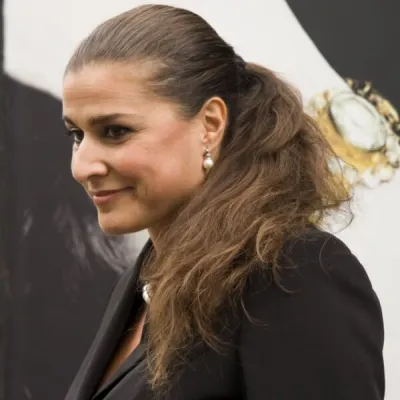
Cecilia Bartoli
Human Design Chart
Biography
Bartoli's parents were both professional singers and gave her her first music lessons. Her first public performance was at age eight as the shepherd boy in Tosca. Bartoli later studied at the Conservatorio di Santa Cecilia in Rome.
In contrast to most opera singers, Bartoli came to prominence in her early twenties, unusual in a profession where vocal maturity is typically not achieved until the thirties. She made her professional opera début in 1987 at the Arena di Verona. The following year she undertook the role of Rosina in Rossini's The Barber of Seville at the Cologne Opera, the Schwetzingen Festival and the Zurich Opera earning rave reviews. She was soon invited by Herbert von Karajan to sing at the Salzburg Festival, and she worked with von Karajan on Bach's Mass in B minor. At this time, she also came to Daniel Barenboim's attention when he saw her performing on a French television tribute to Maria Callas.
Human Design Analysis: Cecilia Bartoli as Manifestor 2/5
Manifestor 2/5 — Design at a Glance
Cecilia Bartoli emerged as a pioneer with a vision of imperial proportions. Her design inclined her not to wade through the muck of daily struggles herself but rather to guide others towards achieving their goals through clear instructions and an overarching perspective. Like an emperor expanding his realm without personally engaging in battle, she acted as a leader aiming to steer the world into a new future.
However, this immense scale inevitably led to misunderstandings and polarization. As her thoughts often reached further than those around her, she inspired enthusiasm in some while others rejected or even hated her visions. This conflict between the love of admirers and the resistance of critics formed the central pain point of her existence.
The key to inner peace lay in informing others. By clarifying her intentions and visions early on, she could find the right supporters and minimize friction. Following this communication strategy rewarded her system with a sense of calm and balance; deviating from it and acting without prior clarity generated deep, lasting anger within her. Her design thus demanded taking initiative through information to transform external resistance into constructive support.
Emotional Authority
Cecilia Bartoli demonstrated a decision-making structure that did not rely on spontaneous impulses but rather depended on emotional maturity and temporal distance. For her, waiting was not a sign of hesitation but an essential mechanism for truth-seeking. Her inner authority resided in the defined Solar Plexus Center, meaning that her feelings were the decisive factor for her life – regardless of which other centers were active in her design. This emotional authority is subject to natural waves of highs and lows; current moods often only temporarily color perception of the world. An initial burst of enthusiasm or a momentary rejection thus did not represent an ultimate truth but merely a first impression. Quick reactions to these fleeting feelings would have destabilized her design. Instead, patience and conscious 'sleeping on' decisions were required. Only by refraining from immediate action could the emotional wave subside, thereby creating necessary distance from initial intensity. Once these intense emotions subsided, deep clarity and calmness emerged. This process of emotional condensation was indispensable for long-term direction-setting as it ensured that her choice was guided not by a passing mood but by her true inner resonance.
The 2/5 Profile — Hermit / Heretic
Cecilia Bartoli's design inclined her to strictly prioritize her energy: she had to actively decide what she would engage with, rather than automatically responding to every request. Without this conscious selection, exhaustion threatened from ignoring her need for withdrawal.
This pattern arises from Profile 2/5 (Natural Talent/Hero and Saviour). Line 2 (Hermit Line) means that she needed much time alone to gather inner clarity. Simultaneously, Line 5 indicated others seeking solutions and expecting immediate help with problems. The image of a monk in the cave constantly asked for advice aptly describes this conflict. She should use her 'alone time' to discover what she wants to stand up for.
The mechanics also show phases of ebb and flow (Gate 35, Line 2). Creativity depended on this energy; blocked, it felt brutal. There was a strong need for change and fear of stagnation. During crises, Gate 63 (Line 5) posed important questions. Doubt was valuable only if practical answers were generated. Immaturity led to empty rituals. She had to learn to ask the right questions to eliminate doubt and find precise solutions without forgetting herself.
Split Definition — Defined & Open Centers
Cecilia Bartoli revealed herself as someone who suffered from constant inner mental noise – a persistent pressure to question and form concepts. This design showed a tendency towards continuous inspiration, but it could not be directly translated into action because the Head Center and Ajna Center do not have their own engines. Instead, her defined Throat Center served as an outlet: thoughts were reliably communicated once they were formulated.
The real challenge lay in the tension between this mental pressure and the emotional authority of the defined Solar Plexus Center. While Head and Ajna demanded immediate answers, the Solar Plexus required patience: decisions had to mature through the emotional wave until clarity emerged. Actions or statements driven by impulsive restlessness led to frustration; true effectiveness was only shown when waiting for the right moment.
At the same time, Cecilia Bartoli was receptive to external influences in other areas. Her open G Center meant no fixed identity but adaptability to her environment – she tended to question whether the current place or circle reflected the right direction. The open Heart Center made her vulnerable to the pressure of proving her worth through sheer willpower, even though this energy was not consistently available. Similarly, her open Sacral and Root Centers absorbed foreign vitality and stress from the environment, which could lead to exhaustion without conscious boundaries. Her wisdom lay in allowing mental pressure to serve as inspiration for others rather than exhausting herself with it, and using the emotional depth of Solar Plexus as a compass instead of chasing immediate solutions.
Channels for emotional depth, change and mental patterns.
Cecilia Bartoli exhibited a fundamental orientation driven by an emotional search for newness and change. This driving force resulted from her Sun in Gate 35 (Change), the absolute focus of her design. This impulse pushed her to resist logical restrictions and move things towards new experiences, often because the feeling of unfamiliarity was perceived as inadequacy.
This urge was made effective by the Channel of Transience 36-35. As an emotional manifesting channel, it connected Gate Crisis (36) with Gate Change (35). It created a restless longing to explore the depth of feelings. Cecilia Bartoli learned through experience and sought adventures to expand her gene pool. Her wisdom emerged from this emotional journey; she had to learn to accept her vibrations and trust the moment rather than grasp for logical constancy.
Social interactions with her were strongly mood-dependent, characterized by the Channel of Openness 22-12. This channel connected Gate Openness (22) with Gate Caution (12). Her ability to emotionally articulate and warm others depended on the ebb and flow of her inner wave. When she was in the mood for it, she could deeply touch and transform others through her voice; if forced against her rhythm, however, harshness or withdrawal showed up. The caution of Gate 12 regulated this openness so that she only interacted with people who offered the greatest mutative potential.
Mentally, the Channel of Abstraction 64-47 accompanied her experiences. It connected Gate Confusion (64) with Gate Understanding (47). This led to a constant mental digestion of images and possibilities in search of meaning. Although this sometimes caused inner unrest, it enabled her to develop unique perspectives and stories from her experiences that she could then share. Here the mind served not as authority but as a tool for finding meaning after experience.
Background gates like Gate 5 (Rhythm), Gate 63 (Doubt) or Gate 11 (visual memory) formed the context of her life processes, but stood behind her dominant emotional-dynamic orientation.
Collective Circuitry — Circuit Signature
Cecilia Bartoli showed a pulsating acoustic energy for developing a unique identity. Her design connected in the Knowledge Circuit the Throat and Solar Plexus Center through the Channel of Openness. This created a direct flow between emotional wave and expression: feelings from the Solar Plexus were immediately vocalized or physically articulated without filters. This configuration promoted an authentic, individual presence guided by emotional intuition.
Parallel to this, the Meaning-Finding Circuit worked with two separate segments. One part connected Head and Ajna Center (Abstraction), allowing for quick visual ideation from the unconscious. The other part again connected Throat and Solar Plexus Center through the Channel of Transience. This emphasized the cyclical nature of her emotional processing: experiences from the past were reflected and shared in wave-like phases.
Although both circuits use the Throat-Solar Plexus band, the Shared Definition did not create direct connections between groups. The energy streams remained parallel: on one side, acoustic identity finding in the present moment; on the other, visual sense-making from the past. Cecilia Bartoli used this structure to transport emotional depth through immediate expression as well as reflective, cyclical processing. The mechanics emphasized sharing experiences with the collective, where the emotional wave pulsed (Knowledge) or plummeted (Meaning-Finding).
Right Angle Cross of Consciousness 2
Cecilia Bartoli was marked by a profound and often unconscious motivation that structured her perception and interaction with the world at a fundamental level. This attitude stemmed from the archetypal influence of the Right Cross of Consciousness, a specific energetic configuration that operates not as a superficial trait but as a subtle background factor. It continuously influenced the flow of consciousness and energy in her design.
Since there are no concrete external events to substantiate this mechanism, the description focuses on this inner dynamic. The cross functioned as an ever-present companion determining how impulses were processed and carried out externally. It created a specific resonance underlying her actions and reactions without always being visible. This configuration suggested that her deeper life purpose lay in a certain quality of being predefined by this energetic structure. Thus, the mechanics acted as a constant undercurrent shaping her experiential world and setting a consistent yet hidden direction for her development.
Saturn Return · Uranus Opposition · Chiron Return · 2nd Saturn Return — Life Cycles
Cecilia Bartoli's developmental line shows a clear structuring from artistic anchoring to institutional leadership. Her design indicated that her life task condensed into two prominent phases: initially establishing herself as an acknowledged artist, later taking on leading responsibilities.
This path was marked by the first Saturn Return, a cycle often solidifying professional foundations and turning years of groundwork into substantial results. In 1993, at age 27, Cecilia Bartoli appeared as Zerlina in Mozart's *Don Giovanni* at La Scala in Milan. This performance marked for her design a crucial moment of professional anchoring and public confirmation of her artistic identity.
Later came the Chiron Return, a fulfillment cycle where one's Incarnation Cross unfolds and meaning becomes experiential – provided that the person has lived according to their strategy. It is not a process of wound healing but of bloom and purpose realization. In 2012, at age 46, Cecilia Bartoli took over the leadership of the Salzburg Whitsun Festival. This step highlighted her transition into a role as a leader and institution builder where she was not only artistically active but also carried and shaped structures. Thus, the mechanics of her design show a path from individual mastery to responsible leadership, both phases structured by specific astrological Returns.
Manifestor · Emotional Authority — Synthesis
A central red thread in this Human Design chart is the dynamic interaction between inner perception and outer expression. The strong definition in Head and Ajna Centers, coupled with emotional authority, points to a profound inner world that constantly undergoes analysis and seeks understanding. This mental energy is channeled and articulated through the defined Throat channel, bearing great potential for inspiring communication – yet always after the emotional wave has run its course. The open Sacral, Root, and G Centers reinforce this tendency by signaling high sensitivity to external influences and adaptability to different contexts.
The central paradox lies in the tension between the need for inner clarity and openness to external energies. While defined centers provide a steady internal compass, open centers are permanently influenced by their environment. This leads to a dynamic interaction: constant absorption, filtering, and transformation of information to then express a unique perspective. The challenge is to maintain one's own inner truth amidst this fluctuation and communicate authentically.
3 Defined Channels
Incarnation Cross - Right Angle Cross of Consciousness 2
Solar Return
The Solar Return shows the moment when the sun returns to its exact birth position - your personal solar year.
Life Cycles
Discover the life cycles with a detailed triple view (birth chart, cycle chart, composite).
Human Design Profile
- Type
- Manifestor
- Strategy
- To inform others before acting
- Authority
- Emotional Authority
- Profile
- 2/5 - Hermit / Heretic
- Definition
- Split Definition
- Incarnation Cross
- Right Angle Cross of Consciousness 2
- Date of Birth
- 04.06.1966 08:15
- Place of Birth
- Roma, Italy
Frequently Asked Questions
What is Cecilia Bartoli's Human Design type?
What profile does Cecilia Bartoli have in Human Design?
What authority determines Cecilia Bartoli's decision-making?
What incarnation cross is assigned to Cecilia Bartoli?
When was Cecilia Bartoli born?
Discover your own Human Design
Are you also a Manifestor? Find out in a personal reading how to use your initiation power peacefully and dissolve resistance.
More Personalities
Back to overviewAaliyah

Alexia
Alizée

Angèle

Anne-Marie

Arcángel