
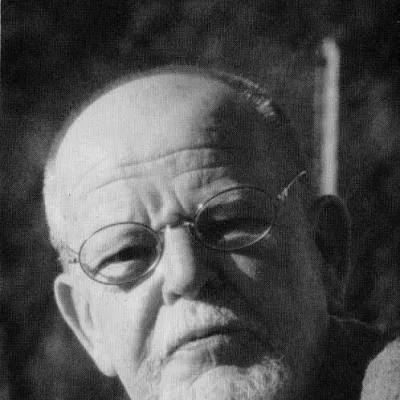
Claude Ballif
Human Design Chart
Biography
His music is known as a combination of tonality (in the sense of Bartók, for instance) and serialism - a system that he named "metatonality."
Claude Ballif was a committed pedagogue who taught composition and analysis at the Paris Conservatoire from 1971 to 1990, and then at the Sevran conservatory.
He died on 24 July 2004 in Poissons.
The Human Design of Claude Ballif: Manifesting Generator 1/3
Manifesting Generator 1/3 — Design at a Glance
Claude Ballif's design features a hybrid nature: the lightning-fast implementation power of a Manifestor paired with the constant energy source of a Generator. This configuration allowed him to skip steps and quickly draw results into his life. However, this speed carried risks. Often he acted too hastily, skipped necessary intermediate steps, and found himself forced to return later to fill gaps—a process that quickly led to frustration, addressing his central non-self theme. Additionally, his design tended to react simultaneously to numerous impulses and start multiple projects in parallel. Without inner consent, this complexity swiftly turned into exhaustion.
The mechanics of the manifesting generator require the strategy 'React instead of Initiate'. Claude Ballif had to wait for life to speak to him before acting. Only when his sacral center—his energy source—gave a clear 'yes' was the path open. Only then could he effectively use his speed without overburdening himself. With correct application of this strategy, potential frustration transformed into deep satisfaction. His work did not thrive through linear processing but in 'play mode'. Variety and parallel handling of different tasks were essential for him to maintain creative power and feel joy in the process.
Emotional Authority
Claude Ballif's design established a specific decision-making strategy: consciously sleeping on options. His inner authority resided in his defined Solar Plexus Center, meaning he was subject to constant emotional waves. This wave generated a permanent up-and-down of feelings; the world appeared colored by his current mood. In one moment something could totally excite him, in the next he saw the same thing completely negatively.
This mechanism required him to curb spontaneous reactions. His immediate feeling was merely a snapshot, an initial impression that had not yet aligned with his true truth. Quick decisions made directly from this emotional heat often risked negative consequences based on distorted perception.
The strategy involved taking time and allowing patience to prevail. Claude Ballif should hesitate, ask himself multiple times, and let important decisions mature. Only when the intense feelings subsided and he had gained emotional distance did clarity and calm set in. This process was essential for long-term realignments that significantly influenced his life path. By waiting for the intensity to subside, he reached a correct assessment beyond transient mood pressure.
The 1/3 Profile — Investigator / Martyr
Claude Ballif's design inclined him towards validating knowledge not just theoretically but through direct, often faulty interaction. As a 1/3 profile—Researcher and Experimenter—he oscillated between the urge for complete information before acting and the impulse to immediately try things out. This configuration defined his life work as a process of learning by trial and error.
Line 1 promoted strategic superficiality, enabling him to act in the here and now while peripherally noticing without getting lost in deep analysis. This served as a survival strategy and art form of perception. Simultaneously, Line 3 drove him towards authenticity through adaptability and acceptance of failure. Mistakes were not failures but an essential mechanism for knowledge acquisition.
His judgments emerged only after combining theoretical examination with practical validation. When he deemed something good, he had thoroughly tested it both mentally and practically. These self-earned insights formed the core theme of his existence: connecting scientific curiosity with adventurous experimentation, akin to a scientist who is also an adventurer. His design demanded this double confirmation to develop true understanding.
Single Definition — Defined & Open Centers
Claude Ballifs design creates a fundamental tension between inner, steady power and situational adaptability. His defined Sacral, Throat, Solar Plexus, and Root Centers form a solid energetic foundation: vital endurance for responding to initiations, reliable communication skills, and the necessity of achieving emotional clarity by waiting out feeling dynamics. This structural life force from his Root Center propelled him forward while his strategy involved not taking the first step himself but rather waiting for appropriate requests to make energy available.
At the same time, his open G, Heart, Spleen, Head, and Ajna Centers reflected their environment. Without a fixed identity or willpower, he tended to feel lost in false environments or give promises he couldn’t keep—a typical pattern of open centers. The open G Center made him vulnerable to “borrowed” identities, while the open Heart Center protected him from the pressure to prove his worth through competition. Instead, he relied on being externally initiated into the right direction. Open Spleen, Head, and Ajna Centers meant that intuition, inspiration, and mental concepts did not serve as his own authorities but rather were mirrors of external influences; spontaneous decisions or clinging to confusing thoughts would have distanced him from his true energy source.
The challenge lay in not wasting the power of his defined centers by adapting to false environments. By trusting his emotional authority and waiting for initiations, Claude Ballif could avoid falling into conditioning patterns of open centers such as identity search or being overwhelmed by mental questions. His design demanded patience: first wait out the emotional wave, then act, always ensuring he was in the right place to receive and effectively communicate the correct energy.
Channels for powerful action, intimacy and emotional waves.
Claude Ballifs Design is characterized by a strong urge to merge, which was driven by an emotional wave. The Channel of Union 59-6 connected his Sacral Center with the Solar Plexus and created powerful quantum energy called Intimacy. This configuration required patience: Only through waiting for the wave cycle could he gain clarity about relationships and correctly channel his intensity instead of misinterpreting it as flirting.
In contrast, the Channel of Charisma 34-20 influenced his personality. This channel linked sacral energy with the Throat Center and represented manifesting power. Here, the urge to act had to yield to the sacral reaction to avoid chaotic outbursts. By correctly affirming himself in the moment, he could inspire others; ignoring this inner guidance risked being carried away by his own energy like a misfired rocket.
Additionally, the Channel of Emotion Release 39-55 shaped his emotional landscape. As an Exclusion Channel between Root and Solar Plexus, it described moodiness as a mutative force pulsing between joy and melancholy. This mechanism challenged him to be authentic with his moods rather than rationalizing them. His ability to provoke the minds of others depended heavily on whether he was in the right mood himself.
Individual Gates like 29 (Yes-Saying) and 54 (worldly success as a spiritual prerequisite) supported these dynamics. Gate 29 emphasized the necessity of correct consent for persistence, while Gate 54 showed that worldly achievements often served as a foundation for deeper insight. Overall, Claude Ballif lived in a tension between the need for emotional distance to gain clarity and the immediate, charismatic impact of his personality.
Individual Circuitry — Circuit Signature
Claude Ballif's design set a tendency towards emotional intensity and the urge for change. As a Simple Defined individual, he had a continuous energetic flow connecting his Throat, Sacral, Solar Plexus, and Root Centers. This connection created a seamless system from impulse to expression.
The Knowledge Circuit worked specifically through Channel 55-39 ("Release Emotions"). This connected his Solar Plexus Center with his Root Center. While the circuit is generally associated with mutation and creative insights, in Claude Ballif's case only this aspect was active: the ability to directly transform emotional waves into physical energy or stress, which shaped his identity and expression impulsively.
Parallel to this, the Archer Circuit operated through Channel 6-59 ("Coupling"). This connected his Sacral Center with his Solar Plexus Center. Here it was not about general care or preservation of the circuit's genetic legacy but specifically about the primal energy of coupling and sexual drive, fueled by his life force and colored by emotional waves.
The Integration complemented this picture through Channel 20-34 ("Charisma"). This connected his Throat Center with his Sacral Center. It allowed Claude Ballif to express power from reacting to life (Gate 34) directly in the present moment (Gate 20). This underscored his highest individuality and self-affirmation by intuitively translating correct behavior into the current moment.
Together, these three circuits painted a picture of a person whose identity was defined by emotional impulses, primal coupling energy, and charismatic expression in the now – all directly interwoven due to his simple definition.
Right Angle Cross of the Sleeping Phoenix 2
Claude Ballif's design carried the signature of the right cross of the sleeping phoenix 2. This configuration established a fundamental disposition of inner collection and waiting for the right moment. His energy was not designed to be constantly discharged outward or prematurely depleted. Instead, it manifested in stillness where the inherent potential quietly grew.
The Cross in Human Design represents the deeper essence of a person beyond external roles or expectations. It describes who one truly is at their core. For Claude Ballif, this meant a nature that fueled strength through restraint and patience. The energy of this specific cross demanded not actively seeking but being ready when the moment ripened. It was about trusting in one's inner rhythm without disturbing it through excessive action.
Claude Ballif lived this dynamic as someone whose true strength lay in the ability to pull back and collect. His design challenged him to preserve his own power rather than unnecessarily giving it away, allowing him to use his energy where it was truly needed. This stance protected him from exhaustion and enabled him to deploy his energy effectively without overburdening himself or fighting against his natural flow. It was a strategy of inner readiness, not constant doing. Through this collection, he could unfold his full potential without overwhelming himself or struggling against his natural current.
Saturn Return · Uranus Opposition · Chiron Return · 2nd Saturn Return — Life Cycles
Claude Ballif's design tended towards the conscious structuring of his internal rhythms; his life became a lesson in which these cycles were externally taught and validated. This attitude was reflected in 1971 when, at age 47, he taught composition and analysis at the Paris Conservatory. This period coincided with his Chiron Return phase. In Human Design, this cycle does not mark a process of wound healing but rather a bloom time of fulfillment. Provided one has lived according to their strategy and authority, the incarnation cross increasingly unfolds in everyday life; meaning and purpose become experiential. Ballif's work as a teacher was no coincidence but the concrete manifestation of this mechanical ripening: The internal order he had previously built now became the foundation for imparting knowledge to others. Through teaching at the conservatory, he validated his own structures through their transmission. The Chiron Return acts as a fulfillment cycle in which previous efforts are condensed into a coherent whole. Ballif did not use this phase to reflect on old injuries but rather actively demonstrated his life's purpose in public space. The combination of pedagogical role and this specific astrological-human-design mechanical window underscores how strongly his design was geared towards making internal processes visible and teachable through external form.
Manifesting Generator · Emotional Authority — Synthesis
Claude Ballif lived a creative path, deeply reactive to the world around him. The combination of manifesting generator strategy and emotional authority points to a personality that was full of energy and innovative spirit but always needed time to gain emotional clarity. This interplay manifested in the ability to quickly develop and implement ideas while simultaneously requiring a careful process of waiting and feeling to ensure inner correctness. The open definition of many centers indicates high sensitivity to external influences, leading him to constantly realign himself and adjust his direction based on circumstances.
A central paradox in Claude Ballif's design lies in the tension between the drive for rapid manifestation and the necessity of emotional maturation. He possessed the energy to set things in motion, yet to avoid frustration, it was crucial not to be carried away by impulses but instead pay attention to the yes signal from his sacral center. This interplay between action and waiting, between spontaneous creativity and emotional clarity, shaped his path and revealed a personality that was both dynamic and profound.
3 Defined Channels
Incarnation Cross - Right Angle Cross of the Sleeping Phoenix 2
Solar Return
The Solar Return shows the moment when the sun returns to its exact birth position - your personal solar year.
Life Cycles
Discover the life cycles with a detailed triple view (birth chart, cycle chart, composite).
Human Design Profile
- Strategy
- To respond - wait for something to respond to
- Authority
- Emotional Authority
- Profile
- 1/3 - Investigator / Martyr
- Definition
- Single Definition
- Incarnation Cross
- Right Angle Cross of the Sleeping Phoenix 2
- Date of Birth
- 22.05.1924 04:00
- Place of Birth
- Paris, France
Frequently Asked Questions
What was Claude Ballif's Human Design type?
Which Profile did Claude Ballif have in his Human Design?
What Authority guided Claude Ballif's decisions?
What incarnation cross did Claude Ballif have?
When was Claude Ballif born?
Discover your own Human Design
Are you also a Manifesting Generator? Find out in a personal reading how to unfold your multi-talents and direct your energy wisely.
More Personalities
Back to overviewAaliyah

Aldair

Alexia

Alizée

Angèle

Angeli
