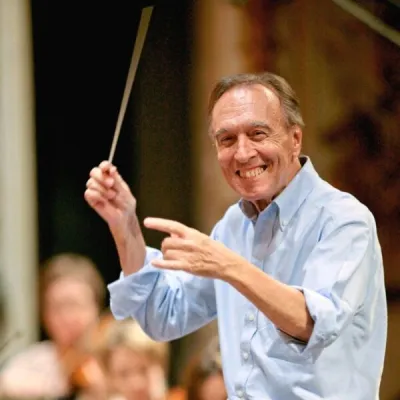
Photo: Wikimedia Commons
Claudio Abbado
Human Design Chart
Biography
The son of a violinist and a pianist, he was raised under Nazi occupation of his country. He decided to conduct when he was eight. Dark, aristocratic, handsome, he had two marriages; two kids with the first.
He was named as successor to von Karajan of the Berlin Philharmonic in October 1988. He continued to direct the state opera in Vienna where he lived with Russian violinist Viktoria Mullova, 29. On 17 October 1991 he stepped down as musical director due to health reasons, agreeing to one more opera, "The Marriage of Figaro," in the 1993-94 season.
A prominent supporter of the Italian Communist Party, his projects are nonetheless supported by plutocratic industrialists who are fans. Dedicated to modernism, he also has notched up major successes in Rossini, Verdi and Bizet. Italian to the roots, he is Viennese by training, temperament and musical training.
Claudio Abbado as a Generator 1/3 in Human Design
Generator 1/3 — Design at a Glance
Claudio Abbados Human Design shows a tendency towards high endurance and a fundamental energetic foundation. As a Generator, he had a lot of sacral power that was not released through self-initiation but rather by reacting to life impulses. His energy worked similarly to that of a workhorse: extremely strong and durable as long as it was available for a task that intrinsically interested him.
The central mechanism of his character consisted in responding instead of initiating. Satisfaction arose only when his actions resulted from an inner confirmation – that feeling of „Yes! Let's get started!“ coming from the gut. If he ignored this principle or tried to work against the will of his design, it led sooner or later to frustration and energy depletion. Especially dangerous for him was being prevented from working on his heart project when he still wanted to continue full of power; such suppression quickly resulted in burnout.
Conversely, no one could stop him if he used his energy in harmony with this pattern. The most successful strategy for Claudio Abbado was to wait for signals from life and then respond through action. Living by this principle rewarded him with a feeling of deep fulfillment. Deviations from it, especially constant initiative without inner resonance, resulted in persistent dissatisfaction. His strength therefore did not lie in driving forward but in powerfully responding to what was offered.
Emotional Authority
Claudio Abbado showed decision-making that required time and emotional distance; spontaneous reactions were unreliable for him. His design carried Emotional Authority anchored in the defined Emotional Center. This meant that his inner truth did not lie in the first reaction, but only revealed itself after an emotional wave had subsided.
His feelings underwent a permanent up and down. In one moment he could be enthusiastic about something, in the next view it negatively. However, this mood coloring was just a snapshot, no final truth. Quick decisions based on such fluctuation risked misjudgments.
The mechanics of his authority required patience. He had to take time for decisions to mature – often through multiple „sleeping over“. Only when intense feelings subsided and emotional distance was gained did clarity set in. This process of calmness was essential for long-term direction setting. Claudio Abbado learned to let himself be delayed and to ask questions repeatedly until the emotional wave had ebbed away. Only then could he use his deep, comprehensive insight free from the distortion of current mood levels.
The 1/3 Profile — Investigator / Martyr
Claudio Abbados showed as someone whose judgments were based on a double check: theoretical depth and practical experience. His design tended towards making trustworthy statements only after something was both intellectually and empirically tested in heart and guts. This attitude resulted from his Profile 1/3, the Researcher-Experimentor.
The mechanics described a learning process through mistakes. Line 1 required pause, concentration, and careful consideration of consequences before action. There was pressure to commit and provide energy for the concentration process. Early action without this stillness often led to time loss. At the same time, Line 3 pushed experiments, detailed work, and rejection of shortcuts. Here trial and error were central; experiences at the end of the road were necessary to gain real understanding.
A typical pattern with Claudio Abbado was potential fear of implementation. The energy of Line 1 could dominate and create a feeling of not knowing enough yet. This conflicted with the urge of Line 3 to simply try things out. His path lay in overcoming this inner resistance through practical action. Only self-earned insights counted for him. If Claudio Abbado valued something as good, he had thoroughly penetrated it – both mentally and practically.
Triple Split Definition — Defined & Open Centers
Claudio Abbado revealed himself as someone with a continuous, self-sustaining energy architecture. His design was fully defined – all centers except the Head were active. This shaped an autonomous presence in thinking (Ajna), communication (Throat), identity (G Center), willpower (Heart), vitality (Sacral), emotions (Solar Plexus), intuition (Spleen) and stress management (Root). He was a closed system that generated his own field without being dependent on external inspiration.
This configuration meant a constant, trustworthy function in every life area. His mental work, his expression, and his emotional depth came from internal sources. However, the open Head Center led to situational mental pressure. Here lay the vulnerability of being distracted by doubts or questions from others instead of trusting the clear inner authority of defined centers. While the defined areas offered stability, the open Head Center could create confusion when he tried to find answers in the mental space rather than his internal structure.
The mechanics of this design suggested that his strength lay in structuring and expressing complex connections from a firm inner core. He did not rely on external confirmation to know who he was or where he was going. Instead, he used the energy of his defined centers to point out a clear direction and interact with others while considering mental pressure as a transient phenomenon that should not dictate his decisions.
Channels for intimacy, logic, pioneering spirit and community.
Claudio Abbado showed himself to be someone whose behavior was marked by a drive towards merging and intimacy but who always had to wait for the emotional wave. Parallel to this, there was a permanent internal process of logically ordering details and an insatiable impulse to correct patterns and perfect them, which often appeared as criticism or dissatisfaction. This constellation formed the stable foundation of his personality.
The Channel of Union 59-6 connected sexuality with the emotional wave of pleasure and pain. This created a powerful, sacral energy called intimacy. His emotional wave determined the timing of every release of intimate feelings; waiting for these cycles allowed him to perceive whether something had developed between him and others. Without this patience, his intensity could be misunderstood.
At the same time, his mind permanently organized details in its own mental system through the Channel of Acceptance 17-62. Logic influenced here thought processes: He visualized patterns and translated them into words to give meaning. Everything he could not logically integrate into his worldview remained incomprehensible. This led to a pressure to communicate opinions in detail as soon as invited.
Another key aspect was the perfectionist urge of the Channel of Judgment 58-18 to correct any pattern. Gate 58 drove the need for 'better and more', while Gate 18 assessed what was out of balance. If this criticism appeared uninvited, it acted as an endless stream of data on errors; when invited, however, it offered valuable solutions.
Additionally, the Channel of Initiation 51-25 shaped a natural competitiveness. It connected ego with Higher Self and encouraged him to cross creative boundaries if he correctly entered situations. The Channel of Community 37-40 further promoted the ability to build bridges for individuals to occupy an honorable place in a group based on mutual support rather than hierarchy.
Individual Gates like Gate 52 (Concentration and Silence) or Gate 30 (Recognizing Feelings and Destiny) supported this structure through inner reflection and accepting limitations as a learning process.
Collective Circuitry — Circuit Signature
Claudio Abbado's design laid a tendency towards internal strength and strategic distance. As someone with Triple Definition, his energetic foundation consisted of three separate, parallel operating power fields that did not flow directly into each other. The Centering Circuit connected Identity and Heart Centers in him. This created a fortified individuality and strong convictions, but the lack of direct connection to Throat often made this inner security hard to express verbally.
The Understanding Circuit worked as two independent segments: Ajna with Throat Center enabled rational, future-oriented communication, while Spleen and Root Centers linked instinctive safety with stress reactions. Both groups remained separate from each other. The Ego Circuit connected Heart and Solar Plexus Centers. This promoted cooperation and resource management in social environments but required regular rest pauses due to the lack of a Sacral connection for regeneration. Finally, the Archer Circuit connected Sacral and Solar Plexus Centers. This configuration emphasized instinctive care and protection of genetics and family survival driven by a primal life force. Together, these four circuits colored his entire chart: intense inner identity, clear rational planning, social support with need for recovery, and deeply rooted caring instincts formed a complex but clearly defined energetic profile.
Right Angle Cross of Service 2
Claudio Abbado's Human Design configuration established a fundamental orientation towards serving others. His existential drive did not stem from superficial politeness but from the deep motivation to find meaning through supporting and advancing others. This setup characterized his approach as someone who wanted to positively influence the world by putting himself in the background, giving space to others.
The right service cross 2 describes exactly this dynamic: It's about an authentic dedication where the well-being of the community or fellow humans is at the center. Claudio Abbado showed himself as a person whose actions were guided by this inner compass. He did not seek personal fame for its own sake but found his confirmation in how his efforts benefited others. This energy prompted him to take responsibility and create structures that enabled the growth of others. His design challenged him not to keep his gifts solely for himself, but to use them as a tool for the greater good. As a result, his life was marked by continuous support and care. Claudio Abbado lived this orientation consistently, ensuring that his influence always served a larger whole. His presence worked stabilizing and promoting because he understood that true strength lies in strengthening others.
Saturn Return · Uranus Opposition · Chiron Return · 2nd Saturn Return — Life Cycles
Claudio Abbado's life followed a clear rhythm of astrological cycles marking crucial turning points in his career. His first Saturn return at the age of 30 condensed years of groundwork: In 1963, he won the first prize at the Dimitri Mitropoulos International Music Competition. This cycle established his professional viability and recognition on an international level.
With the Uranus opposition around the mid-40s, a phase of expansion and public acclaim began. This was evident in 1973 when he received the Mozart Medal – a moment where his influence became visible beyond mere technical mastery.
The Chiron return, a fulfillment cycle between ages 49 to 51, brought the bloom of his incarnation purpose. Here, the meaning of one's design unfolds increasingly in life. In 1984, Claudio Abbado received the Grand Cross of Merit of the Italian Republic, underscoring this phase of full realization and recognition.
The second Saturn return around age 58 brought a severe test. This cycle often demands deep reorientation or dealing with limits. In 1991, due to health reasons, Claudio Abbado stepped down from his position as music director. This crisis marked the end of an era and forced him to confront his own mortality before new paths could be sought. Each of these cycles shaped his career through specific challenges and recognitions.
Generator · Emotional Authority — Synthesis
Claudio Abbado was a Generator whose life was characterized by the profound ability to react to impulses and release energy through action (Sacral Center). However, this sacral response was always filtered through an emotional wave (Emotional Authority), requiring careful consideration and waiting for emotional clarity. His profile as Researcher/Experimentor (1/3) reinforced this process, driving him to gather experiences and gain insights through trial and error – a constant search for the right timing and environment for his energy. The definition of Heart and G Centers points to a strong will and clear identity that helped him find his path in the world and inspire others.
A central paradox lay in the combination of this inner clarity with the need for external stimulation. While he possessed a defined mental center, allowing him to develop concepts (Ajna), he was simultaneously open to influences from outside through undefined centers, making him a mirror for the emotions of others. This led to a tension between the necessity to rely on his internal authority and the desire to connect with the world and influence it – a dynamic interplay that shaped his life and work.
5 Defined Channels
Incarnation Cross - Right Angle Cross of Service 2
Solar Return
The Solar Return shows the moment when the sun returns to its exact birth position - your personal solar year.
Life Cycles
Discover the life cycles with a detailed triple view (birth chart, cycle chart, composite).
Human Design Profile
- Type
- Generator
- Strategy
- To respond - wait for something to respond to
- Authority
- Emotional Authority
- Profile
- 1/3 - Investigator / Martyr
- Definition
- Triple Split
- Incarnation Cross
- Right Angle Cross of Service 2
- Date of Birth
- 26.06.1933 02:00
- Place of Birth
- Milan, Italy
Frequently Asked Questions
What was Claudio Abbado's Human Design type?
What Profile did Claudio Abbado have in Human Design?
Which Authority guided Claudio Abbado?
What incarnation cross did Claudio Abbado have?
When was Claudio Abbado born?
Discover your own Human Design
Are you also a Generator? Find out in a personal reading how to use your sacral energy correctly and discover deep satisfaction.
More Personalities
Back to overviewAaliyah

Alexia

Alizée

Angèle

Anne-Marie

Arcángel