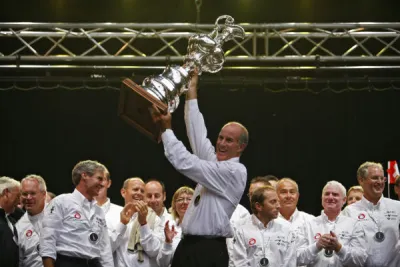
Ed Baird
Human Design Chart
Biography
Growing up in Florida, Baird raced in the Optimist class at junior level, before moving onto other dinghies. He won the World Laser Championships in 1980 and the World J/24 Championships in 1983.
While best known as a champion match racer and fleet racing helmsman, Baird has also coached world and Olympic champions such as Anna Tunnicliffe, Sally Barkow and Kevin Mahaney. He was a premier instructor for North-U’s Tactical and speed clinics in the 90’s, has written an instructional book (Laser Racing) and over a hundred tactical how-to articles. Baird has worked with ESPN, Outdoor Life Network, Versus and Television New Zealand as an expert commentator for shows about sailboat racing.
Human Design Analysis: Ed Baird as Generator 2/4
Generator 2/4 — Design at a Glance
Ed Baird's design indicates a tendency towards high endurance and productive power. As a Generator, he had plenty of sacral energy that made him extremely strong, similar to a workhorse – provided this energy was used for appropriate tasks. His central life strategy involved not initiating things himself but responding to signals from his environment. Only when life gave an impulse and his inner self responded with a clear "yes" could he act effectively.
This mechanism was crucial for his well-being. When Ed Baird acted in accordance with this response, it led to deep satisfaction and a sense of fulfillment. Deviations from this pattern, however, brought problems: initiating things out of his own will or suppressing the urge to continue working on his heart project when he still had plenty of power resulted in frustration and energy loss. Even working on things without inner desire led to burnout for him since he was wasting his valuable resource. His success depended on waiting until life spoke to him, then responding with full force.
Sacral Authority
Ed Baird's design inclines towards direct, physical decision-making. Instead of conducting complex cognitive analyses, he responded to external stimuli with immediate internal signals. This mechanism is determined by his Sacral Authority, which functions as an inner instance of the Generator. For this, an open Emotional Center is a prerequisite, simplifying the process since strategy and authority are identical: wait and react.
Decision-making for Ed Baird took the form of a "gut feeling" or surge of energy. He learned to pay attention to specific bodily sounds like grunts, hums, or an affirming "mm-hm." These signals marked the moment when his sacral motor kicked in. When this resonance occurred, he felt vital and alive. Then, he had seemingly inexhaustible energy at his disposal with which he could accomplish his work with great enthusiasm. His design foresaw that he would go through life with joy and satisfaction, fully immersed in his activities without needing a rigid sense of purpose.
Central to Ed's approach was the distinction between true resonance and false starts. The necessity of pausing – waiting for the impulse – formed the prerequisite for this vital energy. Only by this waiting could he ensure that his reaction was authentic. His design allowed him to fully immerse himself in what truly motivated him, thereby finding natural satisfaction in his alignment.
The 2/4 Profile — Hermit / Opportunist
Ed Baird's design was characterized by a constant oscillation between the need for withdrawal and the desire for community. This tension between Line 2 (Natural Talent) and Line 4 (Networker) significantly shaped his approach to life. Line 2 imparted a selective stance, where he often offered his contribution as an example role model, but risked crisis if this service was not recognized. Simultaneously, Line 4, also known as the "Burnout" line, strongly pulled him into his network. Here, he sought opportunities and influence, which for projectors carried the risk of emotional burnout from overstimulation.
For Ed Baird, it was crucial to create a safe environment where he could clearly communicate when he wanted company and when he needed solitude. During his alone time, he reflected on the insights gathered in his network. Only when his need for peace was satisfied did he actively return to spend time with his favorite people. This conscious management of phases was essential for his health, as it allowed him to evaluate the knowledge from his network during periods of isolation and develop clear ideas without falling into burnout or isolation.
Split Definition — Defined & Open Centers
Ed Baird's Human Design defines a tendency towards reliable, identity-driven communication, driven by generative life energy and constant inner pressure. His defined centers – Throat, G Center, Sacral, Spleen, and Root – form the mechanical basis: He has a fixed identity and direction (G), the ability to transform through interaction (Throat) as well as a constant energy reserve waiting for reactions (Sacral). Intuitive moment-to-moment decisions (Spleen) and a persistent stress pressure to move forward (Root) round out this stable foundation.
At the same time, Ed Baird is situationally and environmentally influenced by his open centers: Head, Ajna, Heart, and Solar Plexus. Without his own mental inspiration or constant concepts, he tends to get caught up in others' doubts or seek answers that do not come from him (open Head and Ajna Centers). Since the Heart Center is open, he lacks a persistent will; he tends towards conditioning, proving his worth through promises despite this energy not being anchored within him. His open Solar Plexus reflects environmental moods rather than having its own emotional waves, making him vulnerable to emotional absorption.
The synthesis of defined Sacral energy as a reactive motor and fixed G identity alongside openness in the Heart (no ego will) and Solar Plexus (emotional reflection) shapes his essence. He does not act out of caprice or emotional impulsivity but reacts to life with clear direction and intuitive certainty, while perceiving mental and emotional influences from the environment as information without personalizing them.
Channels for change, reflection, care and life purpose.
Ed Baird's design sets a fundamental attitude that oscillates between pulsating change and stubborn defense of his own integrity. The Mutation Channel 60-3 connects the Root Center to the Sacral Center through the Gate of Limitation (60) and the Gate of Order (3). This connection generates a powerful but melancholic energy, bringing evolutionary change yet requiring patience as it works in unpredictable pulses. Ed Baird had to learn not to fight this inner moodiness but to trust the process until new mutations showed themselves naturally.
Parallel to this, the Lost Son Channel 13-33 promotes deep reflection ability. Through the Gate of Listeners (13), Ed Baird gathers information and secrets while the Gate of Retreat (33) allows withdrawal to process these experiences. This creates a treasure trove of life wisdom that requires time before it can be shared. The challenge lies in timing: not revealing too early but also not isolating so much that insights are lost.
In interpersonal interactions, the Preservation Channel 27-50 acts as a stabilizing force. It connects the Sacral Center to the Spleen Center through the Gate of Care (27) and the Gate of Values (50). This gave Ed Baird an aura that inspired trust and made him a natural protector of tribal values. His energy served to nourish others and maintain structures, provided he acted according to his own reactions and did not take on too much responsibility.
Simultaneously, the Life Struggle Channel 38-28 drives Ed Baird towards stubborn individualization. Through the Gate of Fighter (38) and the Gate of Player (28), he seeks meaning in life's struggles. This energy forces him to defend his integrity against external pressure and only engage in conflicts that have deep personal value. The synthesis of these mechanisms shows someone who patiently endures change, gains wisdom through withdrawal, strengthens community through care, and always stubbornly follows their own path.
Individual Circuitry — Circuit Signature
Ed Baird's design sets a tendency towards individual transformation paired with the drive to instinctively preserve family structures. His chart displays separate energetic poles: on one side, the pulsating power of personal identity and innovation; on the other, cyclical reflection on emotional pasts as well as timeless protective instincts.
The Knowledge Circuit connects his Sacral, Root, and Spleen Centers. This creates an acoustically-pulsing energy: Mutations (Channel 3-60) drive deviations from the known while Life Struggle (Channel 28-38) carries this change into the world. It's about expressing a unique identity through new knowledge and creative impulses.
Parallel to this, the Purpose Circuit connects his Throat and Identity Centers. Here visual, cyclical processing of emotions takes center stage. The Lost Son Channel (33-13) promotes reflecting on past experiences to understand their meaning and share these insights with the collective – a process of emotional learning from the past.
The third pole is formed by the Protector Circuit connecting his Sacral and Spleen Centers. Through the Preservation Channel (27-50), an ancient, probing energy of familial protection shows itself. It's not about abstract logic but instinct-driven nourishment, care, and preservation of genetics and family.
These three circuits create a tension between the acoustic expression of new identity (Knowledge), visual processing of emotional patterns (Purpose), and silent, probing care (Protector). None of these energies flow directly into each other; they exist as parallel, independent forces in Ed Baird's design.
Right Angle Cross of Contagion 2
Ed Baird's design predisposed him to act as a sensitive resonant body for his social environment. He was someone who intuitively absorbed moods and information from his surroundings and furthered or transformed this energy. This dynamic stemmed from the right infection cross 2, a configuration that makes people channels of collective energies.
The mechanics of this design do not describe individual isolation but rather a deep connection through exchange. Ed Baird was designed to dynamically adapt in groups and unconsciously absorb the atmosphere around him before giving it back out. This created a natural flow of communication and strengthened the social fabric around him. He functioned less as an isolated observer but as an active participant in the process of social learning and emotional transmission.
This energy shaped his interactions through high adaptability. By collecting information from his environment, he could transform it into new forms or pass it on to others. It was a life task of exchange: capturing ideas and moods that did not stay with him but flowed through him. His design thus fostered an environment where information remained alive and gained significance through contact with other people.
Saturn Return · Uranus Opposition · Chiron Return · 2nd Saturn Return — Life Cycles
Ed Baird overcame his first major test and solidified his identity through a clear, measurable success. In 1983, at the age of 25, he won the world championships in the J/24 class. This victory marks the concrete proof of overcoming the first Saturn return. During this cycle, years of groundwork often condense into a sustainable result that establishes one's position in life. For Ed Baird, this moment showed that not only had he survived the demands of his early adulthood but also mastered them through exceptional performance. The win was no coincidence but the visible outcome of a phase where structure and competence solidified. It was a milestone proving his ability to process pressure and derive strength from it. This success served as a foundation for further development, giving him the necessary security to fill his role with more authority. The mechanics of the first Saturn return often require such confirmation to align inner identity with external reality. Ed Baird fulfilled this requirement through athletic excellence, which shaped his fundamental approach as someone who directly tackles challenges and resolves them through discipline and skill.
Generator · Sacral Authority — Synthesis
Ed Baird's design reveals a central thread of dynamic exchange between internal energy and external reaction. As a Generator with sacral authority, he is destined to react to life – a process reinforced by the connection of Sacral, Root, and Spleen centers. This combination creates a strong ability for endurance and action as long as there is an authentic inner drive. The channels 27-50 and 38-28 further emphasize this aspect by stressing the need to conserve energy and face challenges in order to fully realize one's potential. The profile of natural talent/networker points towards an interaction between the desire for alone time for reflection and a longing for connection with others – a rhythm that nourishes sacral reaction and prepares energy for new ventures.
A central paradox in Ed Baird's design lies in the tension between his defined G-Center identity and open centers for mental awareness and emotions. While the G-Center provides clear direction, he is also receptive to other people's energies and must learn not to internalize them. This openness can indeed lead to wisdom and deep understanding but also carries the risk of getting lost in conditioning or making decisions based on others' emotions. The ability to balance this inner conflict – between knowing one's path and accepting life's fluid nature – seems key to fulfilling his potential.
4 Defined Channels
Incarnation Cross - Right Angle Cross of Contagion 2
Solar Return
The Solar Return shows the moment when the sun returns to its exact birth position - your personal solar year.
Life Cycles
Discover the life cycles with a detailed triple view (birth chart, cycle chart, composite).
Human Design Profile
- Type
- Generator
- Strategy
- To respond - wait for something to respond to
- Authority
- Sacral Authority
- Profile
- 2/4 - Hermit / Opportunist
- Definition
- Split Definition
- Incarnation Cross
- Right Angle Cross of Contagion 2
- Date of Birth
- 17.05.1958 07:36
- Place of Birth
- St.Petersburg, FL, United States
Frequently Asked Questions
What is Ed Baird's Human Design type?
What Profile does Ed Baird have in Human Design?
Which Authority guides Ed Baird?
Which incarnation cross is active for Ed Baird?
When was Ed Baird born?
Discover your own Human Design
Are you also a Generator? Find out in a personal reading how to use your sacral energy correctly and discover deep satisfaction.
More Personalities
Back to overviewAaliyah

Aldair

Alexia

Angèle

Anne-Marie

Arcángel