
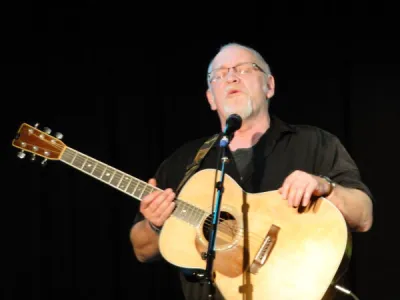
Eric Bogle
Human Design Chart
Biography
Eric Bogle — Manifesting Generator with Profile 2/4
Manifesting Generator 2/4 — Design at a Glance
Eric Bogle exhibited a hybrid nature combining the speed of a Manifestor and the energy of a Generator. His design indicated a tendency to skip steps and start multiple projects simultaneously. This configuration described him as someone who could quickly pull things into his life by utilizing connections between Motor Center and Throat Center.
As a Manifesting Generator, he possessed constant sacral energy, similar to pure Generators. However, unlike them, he had the ability to shorten processes. Yet this speed carried risks: sometimes he was too quick and skipped important steps, leading him to backtrack and fill in gaps later. Additionally, he tended to do multiple things at once because he responded to many impulses.
Frustration arose when strategy or authority were not respected. The correct approach for him was to react to life rather than initiate it. Only when his sacral center gave a clear "Yes!" did he begin to act. Regular checks of inner approval were essential to enter the productive Play mode. In this state, Eric Bogle derived deep satisfaction from his work and benefited from variety instead of focusing on just one thing.
Sacral Authority
Eric Bogle demonstrated decision-making rooted deeply in his physical reaction to external stimuli. His design suggested that he did not act through analytical thinking but rather waited for an internal, sacral response. This authority, specific to the Generator type, manifested as a direct gut feeling – often audible as grunting or humming – or as a palpable surge of energy. When an external impulse triggered this resonance, it led to a state of vital energy and great enthusiasm, enabling him to fulfill tasks with joy and without compulsive purposefulness.
This process was supported by an active Spleen Center function. This connection gave Eric Bogle the ability for quick, instinctive reactions. He had immediate access to his physical perception, making his decisions not only emotionally grounded but also spontaneous and reliable. The combination of the sacral response to stimuli and spleen-supported speed created a system in which he could intuitively move through life, guided by a deep sense of well-being and a natural source of enthusiasm that showed itself as soon as he aligned with his inner engine.
The 2/4 Profile — Hermit / Opportunist
Eric Bogle exhibited a fundamental disposition that oscillated between the deep need for withdrawal and the desire to connect with close confidants. His design suggested that he sought clarity in solitude to process knowledge from his social network. This tension is characteristic of Profile 2/4, which combines a natural talent with networking aspects. Line 2 brings a natural talent often left unrecognised until reinforced by success; it attracts attention but can also set unrealistic expectations for personal achievement. Simultaneously, Line 4 acts as a wallflower using humility to protect perceived inadequacies, creating a sense of being an outsider.
For Eric Bogle, it was essential to create a safe environment where he could communicate clearly: when he needed company and when he required solitude. During his "me-time," he immersed himself in internal processes, created peace, and gained clarity. Once this need was satisfied, he returned from his cave to spend time with his favourite people. This rhythm allowed him to reflect on the knowledge of his network during solitary moments, evaluate it, and develop brilliant ideas. The determination for success from Line 2 met the protective humility of Line 4, creating a complex yet powerful dynamic.
Single Definition — Defined & Open Centers
Eric Bogle revealed himself through a foundation of reliable inner identity and vital energy that carried his communication and intuition. His defined G Center gave him a stable sense of direction and self-love, independent of external validation. This internal security flowed into his defined Throat Center, allowing him to speak from his personal truth – clearly, consistently, without the need to define himself through others.
His defined Sacral Center served as the motor, a source of immense power that only responded to correct reactions. This meant that Eric Bogle did not waste energy on initiatives but rather by patiently waiting for life to ask him questions. His spontaneous intuition came from his defined Spleen Center, a body consciousness that acted in the present moment and allowed him to make trustworthy judgments without having to rationalize them.
This stable inner core contrasted sharply with his open centers. His open Head and Ajna Centers made him vulnerable to mental pressure and the absorption of foreign concepts; he tended to get entangled in questions that were not his own or feel uncertain when clear answers weren’t available. The open Heart Center led to a tendency to want to prove his worth through promises, although he lacked the constant willpower for it. Additionally, his open Solar Plexus absorbed emotional waves from the environment, causing him to experience other people’s moods as his own instability. Finally, he took in external stress and adrenaline through his open Root Center, a pressure not self-generated but coming from outside, often ending in cycles of avoidant flight or overactivity.
Channels for intuitive power, leadership and authentic presence.
Eric Bogle showed a fundamental stance that combined logical leadership with deep inner integrity. His design suggested that he gained influence not through authority but through trust and invitation. The Channel of the Alpha Animal 7-31 defined this ability for collective leadership: He could understand patterns and recognize trends to show others the way without taking it away from them. Success depended on being invited by a majority in a context he had chosen – a role “behind the throne” based on tested knowledge.
This leadership quality rested on a basis of authentic behavior. The Channel of Exploration 34-10 connected his Sacral Center with the G Center and promoted self-love as well as holding onto personal convictions. Eric Bogle was designed to accept and honor himself, enabling him to act independently of external expectations. Complementing this was the Channel of Perfect Form 57-10, which linked intuitive insight from the Spleen Center with this self-behavior. This created a spontaneous, appropriate reaction to the environment free of unfounded future fears, perfecting his survival in the here and now through intuitive clarity.
Supporting this structure was the Personality Channel of Power 34-57. This channel connected the defensive intuition of the Spleen with the generative power of the Sacral Center. It served as an inner watchdog that warned him of dangers and helped navigate life safely through selective attention. This defensive intelligence secured his individuality and vitality, so he only reacted when it was necessary for his well-being. Together, these channels formed a system where authentic, intuitive survival behavior created a foundation for trustworthy collective influence. Eric Bogle thus acted as someone who guided others through his own centeredness and logical foresight, always assuming he had been invited to do so.
Individual Circuitry — Circuit Signature
Eric Bogle revealed himself as someone whose design combined deep inner centering with clear rational structure. His simple definition created a coherent energetic flow through the Identity, Throat, Sacral, and Spleen Centers. The Centering Circuit connected his Identity directly with the Sacral Center (Channel 10-34). This promoted a solid self-worth and strong individual convictions that often remained hard to verbalize within this circuit due to its lack of direct connection to the Throat Center. Parallel to this, the Understanding Circuit worked through the Channel between Throat and Identity Centers (Channel 31-7). Here, he was driven by an “emotionless ratio” to structure and share logical insights for the future – free from emotional coloring. Thus, a tension field emerged between inner individual certainty and the rational desire for external communication. Integration completed this picture: Through Channels between Identity/Spleen (Channel 10-57) as well as Sacral/Spleen (Channel 34-57), he drew strength from reacting to life to make it effective in the present moment. This mechanism underscores his highest individuality: He did not act based on external validation but led intuitive security and logical planning into a coherent whole that secured his survival and manifested his unique perspective.
Right Angle Cross of the Vessel of Love 3
Eric Bogles Design revealed a tendency towards deep, often painful devotion. His inner world was marked by a paradox: to experience true connection, his ego had to fully step back. This aligned with the mechanics of the "Right Cross of the Love Vessel 3". Here, love does not function as an ownership claim or self-affirmation but rather as an empty vessel. This vessel can only be filled with what it is meant to carry – namely another person – once it has been emptied of all egoistic contents.
This configuration described an existential dynamic of sacrifice. Eric Bogle approached life in a way that saw the loss of self not as defeat, but as a necessary act of transformation. The willingness to empty oneself created the space for a higher connection or for another being. It was not passive submission, but rather an active, though internal task: pushing aside the ego so something greater could manifest.
This mechanism required unconditional devotion, often linked with pain, as it dissolved the protection of personal ego. For Eric Bogle, this meant that true closeness could only be achieved through this radical openness and letting go of control. Love thus became a process of constant realignment towards self-forgetfulness to preserve the integrity of the connection.
Saturn Return · Uranus Opposition · Chiron Return · 2nd Saturn Return — Life Cycles
Eric Bogles Human Design profile is marked by two clear, cyclical turning points that structure his life phases. The first significant period began with the Saturn Return around age 25. This cycle often calls for a fundamental realignment and taking responsibility for one's path. Eric Bogle responded concretely: In 1969, at the age of 25, he emigrated to Australia. This decision marked not only a geographical change but also the practical implementation of his maturation phase, where the foundations of adult life solidify and a new base is created.
The second crucial phase came with the Uranus Opposition around age 40. This cycle often brings unexpected changes, liberation from old structures, or public recognition for lived principles. For Eric Bogle, this was evident in 1984 when he received the United Nations Peace Medal at the age of 40. This award underscores the dynamics of this cycle: it was not a mere coincidence but the result of long-term development that now culminated in official confirmation. Both events—the emigration and the honor—illustrate how astrological cycles can shape concrete life decisions and outcomes by marking moments of consolidation and breakthrough.
Manifesting Generator · Sacral Authority — Synthesis
A central thread in this design is the dynamic balance between inner reaction and outer expression. The combination of sacral authority, the Manifesting Generator type, and defined centers for identity and love points to a person whose energy is deeply rooted in the present moment (Sacral), but also possesses a strong drive towards self-actualization and expressing their truth (G Center, Throat). The recurring emphasis on reaction rather than initiation, coupled with the ability to act quickly, shapes a personality that acts most effectively when responding to external impulses while considering its inner guidance.
The central paradox lies in the tension between the need for solitude for reflection (Line 2 in Profile) and the desire for community and connection (Line 4). This duality is amplified by the open, receptive centers, which allow for a constant intake of information from the environment. While this openness enables a deep understanding of others, it also carries the risk of losing oneself in the emotions and stress of others, requiring an ongoing process of centering and setting boundaries.
4 Defined Channels
Incarnation Cross - Right Angle Cross of the Vessel of Love 3
Solar Return
The Solar Return shows the moment when the sun returns to its exact birth position - your personal solar year.
Life Cycles
Discover the life cycles with a detailed triple view (birth chart, cycle chart, composite).
Human Design Profile
- Strategy
- To respond - wait for something to respond to
- Authority
- Sacral Authority
- Profile
- 2/4 - Hermit / Opportunist
- Definition
- Single Definition
- Incarnation Cross
- Right Angle Cross of the Vessel of Love 3
- Date of Birth
- 23.09.1944 03:55
- Place of Birth
- Peebles, United Kingdom
Frequently Asked Questions
What is Eric Bogle's Human Design type?
What Profile does Eric Bogle have?
What authority does Eric Bogle have?
What incarnation cross does Eric Bogle have?
When was Eric Bogle born?
Discover your own Human Design
Are you also a Manifesting Generator? Find out in a personal reading how to unfold your multi-talents and direct your energy wisely.
More Personalities
Back to overviewAaliyah

Aldair

Alexia

Alizée

Angèle

Angeli
