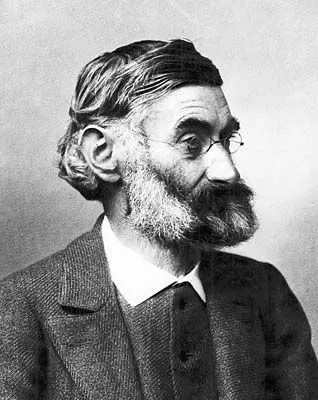
Ernst Abbe
Human Design Chart
Biography
He took over the Zeiss company in 1889 after the death of Carl Zeiss. Abbé died on 14 January 1905.
Ernst Abbe as a Generator 2/4 in Human Design
Generator 2/4 — Design at a Glance
Ernst Abbe's design shows a tendency towards great endurance if he pursues tasks with inner consent. As a Generator, he has plenty of sacral energy that makes him strong and durable like a workhorse – provided this power is used for things that truly matter to him. His path to deep satisfaction does not lie in constant initiative but rather in reacting to impulses from the environment. The strategy involves waiting for signals and then actively responding when his sacral center gives a clear 'yes'. If he ignores these gut feelings or forces himself to work without inner joy, Ernst Abbe risks burnout and persistent frustration. Similarly problematic is when external circumstances prevent him from continuing with his heart project despite having the energy available. The materialization of his goals works differently than for other types: it relies on reacting from the gut rather than pushing everything forward by himself. If he lives according to this principle, nothing can stop him and he experiences a profound sense of fulfillment. However, if he acts against his design, such as through excessive initiative, this inevitably leads to a lack of energy and feelings of frustration. His strength lies in the enduring implementation of what he is passionate about from within.
Emotional Authority
Ernst Abbe's decision-making strategy is based on the rhythm of emotional waves; immediate reactions prove deceptive. True clarity emerges only after emotions subside through temporal distancing, such as by sleeping on an issue overnight. This is not merely a preference but a mechanical necessity of his design.
His inner authority lies in his defined Solar Plexus Center. In Human Design mechanics, every defined Emotional Center carries this authority regardless of other configurations in the chart. Ernst Abbe was subject to constant emotional waves with continuous ups and downs of feelings. The world appeared colored by his current mood: totally enthusiastic at one moment, then completely negative about the same situation shortly after.
This feeling in the moment is merely a snapshot, an initial impression that does not yet represent his truth. Quick, spontaneous decisions based on such emotions often have negative consequences. The more time Ernst Abbe took to let a decision mature, the deeper and broader he could see. This required patience and conscious hesitation. He should take his time and ask himself multiple times. Over time, intense feelings subsided, emotional distance gained significance, clarity and calmness set in. Only then had he gone through the process. This mechanism particularly shaped long-term decisions with significant influence on his life course.
The 2/4 Profile — Hermit / Opportunist
Ernst Abbe's design inclines towards a constant alternation between deep withdrawal and the need for close social exchange. This Profile 2/4, known as 'Natural Talent', creates an internal tension: On one hand, Line 2 pushes him toward solitude and security; on the other, Line 4 draws him into his familiar network. For Ernst Abbe, it was crucial to communicate clear boundaries – when he sought company and when he wanted to be undisturbed.
During his alone time, he immersed himself in internal processes to find peace and clarity. This phase of isolation served not for escape but condensation. Only after the need for withdrawal was satisfied did he return from 'his cave' to his favorite people. This rhythm allowed him to reflect on and evaluate the knowledge of his network in silence.
Line 2 brings caution and a conservative nature that protects his security, while also projecting expectations and contradictions. In contrast, Line 4 emphasizes persistence and the ability to trigger unexpected events. Through this combination, Ernst Abbe could use the collective wisdom of his environment to develop brilliant ideas in solitude. The balance between protecting the inner self (Line 2) and utilizing the network (Line 4) shaped his work approach: withdrawal for reflection, then exchange for verification. Without this clear separation, the synthesis of personal knowledge and collective intelligence would not have been possible. His design required this dynamic pendulum movement to gain both depth and breadth in his understanding.
Single Definition — Defined & Open Centers
Ernst Abbe's design showed a tendency towards immense inner substance and constant vitality. Five of his six energy centers were defined: Heart, Sacral, Solar Plexus, Spleen, and Root. This closed chain created a foundation of deep intuition and endurance. The defined Heart Center gave him the strength for self-determination and the need to control his life and resources himself. He tended to take promises seriously and clearly express his own worth, which strengthened his self-esteem as long as he only committed to what he could hold.
The defined Sacral Center functioned as a constant motor. However, its energy was available only through reaction to external questions, not by initiation. A positive response activated his full power; a negative one protected him from exhaustion. Parallel to this, the defined Solar Plexus Center served as an emotional authority. Ernst Abbe needed time to wait out the emotional wave before making decisions. Immediate action in emotional highs or lows led to chaos; patient waiting revealed the truth of the situation.
The defined Spleen Center steered his instinctive survival consciousness in the present moment, while the defined Root Center provided the necessary pressure to advance materially and cope with stress. Together, these centers formed a high inner coherence.
At the same time, four open centers shaped his vulnerability to external influences: Head, Ajna, G, and Throat were open. The open Head and Ajna Centers made him susceptible to mental inspirations or confusion from the environment. He tended to question whether he knew the right answer instead of trusting his inner authority. The open G Center meant that he did not have a fixed identity but crystallized it through relationships and places. False environments generated feelings of lostness in him; correct places allowed him to flourish. The open Throat required him to wait for invitations to speak rather than initiating communication to avoid unnecessary stress. This configuration demanded from him to channel his strong inner energy through appropriate reactions and patience while observing mental and identity-related reflections of the environment without accepting them as his own truth.
Channels for instinctive engagement, care and communal struggle.
Ernst Abbe's design showed a tendency towards instinctive capitalism combined with the ability to defend values and structure communities. This mechanism drove the identification of market gaps, selling solutions, and establishing stable structures through willpower and emotional integrity.
Channel of Devotion 44-26 connected the Spleen Center with the Heart Center. Gate 44 (Awareness) provided instinctive intelligence while Gate 26 (Egoist) contributed ego strength. This allowed him to selectively and convincingly use historical memory to sell something that represented an improvement to a target group. As a direct connection between Heart and Spleen, this channel formed the main health network; it was instinctively watchful of threats or need for improvement for the tribe. Ernst Abbe used his willpower to offer exactly what the tribe needed, often before the tribe knew it themselves.
Channel of Preservation 27-50 connected Sacral Center with Spleen Center through Gate 27 (Care) and Gate 50 (Values). This enhanced the quality of all tribal activities through selfless interest in others and traditional values for maintaining order. The sacral energy reacted spontaneously to survival instincts to care for what was created. Ernst Abbe automatically drew trust; people looked to him for support. He defended basic values and laws that regulated communal relationships, taking responsibility for those who could not provide for themselves, thereby ensuring the tribe's continuity.
Channel of Life Struggle 38-28 connected Root Center with Spleen Center through Gate 38 (Fighter) and Gate 28 (Player). This served the struggle to find meaning in life. Gate 28 recognized which fight was appropriate, while Gate 38 provided pressure for maintaining individual integrity against external forces. Ernst Abbe showed stubborn determination to go his own way and find significance in struggles. This drove forward individuation and mutated the status quo through adrenalinated energy.
Channel of Recognition 30-41 connected Root Center with Solar Plexus Center through Gate 41 (Limitation) and Gate 30 (Recognition of Feelings). The pressure from the root energized a phantasmagoric vision of countless scenarios. Emotions heated the drive to seek an intense need for new experience. Ernst Abbe's restlessness was balanced by patience; he enjoyed dreams without succumbing to the pressure of expectations, making his experiences more fulfilling.
Channel of Community 37-40 connected Solar Plexus Center with Heart Center through Gate 37 (Friendship) and Gate 40 (Aloneness). This secured tribal business through emotional clarity and willpower. Ernst Abbe waited for the right invitation to become part of an organization. He built bridges for individuals to live in a community where everyone had an honorable place. A good deal was carefully considered and formulated over time so that it would be beneficial for both sides.
Tribal Circuitry — Circuit Signature
Ernst Abbe's design combined innovative identity with emotional reflection and tribe-oriented cooperation. His Knowledge Circuit, activated through the Life Struggle Channel (Spleen-Root), promoted the expression form of a unique individuality strengthened by mutations and creative impulses. This worked in conjunction with the Meaning Finding Circuit, which processed past experiences wave-like through the Recognition Channel (Solar Plexus-Root) to gain collectively learnable insights.
Furthermore, Ego and Archer Circuits shaped his dynamics. The Ego Circuit connected Heart, Spleen, and Solar Plexus through Channels Devotion (26-44) and Community (37-40). This supported cooperative resource creation in the collective via mutual support and communication but required quiet pauses for regeneration. Parallel to this, the Archer Circuit secured survival through instinctive care and preservation of family over the Preservation Channel (Sacral-Spleen).
As a person with Simple Definition, these centers – Heart, Spleen, Sacral, Root, and Solar Plexus – formed an integrated energetic unit. Ernst Abbe thus expressed himself as someone who conveyed new knowledge through emotional waves, sought meaning in the past, created resources for his tribe while instinctively protecting the continuity of his genetic line. This mechanism shaped his ability to initiate transformation and learn collectively.
Right Angle Cross of the Unexpected 4
Ernst Abbe's Human Design included the configuration of the right cross of the Unexpected 4. Since the specific mechanical details of this structure are not defined in the available data, no clear behavior or character trait can be derived from it. This configuration remains neutral within the analysis and lacks a definitive expression. There were no particular emphases or derived patterns that emerged from this element. The mechanics did not act as a determining factor for his actions or decisions due to the lack of descriptive characteristics. Thus, this cross neither contributed to a specific life task nor noticeably shaped his daily routine. It existed merely as a structural component of his design without revealing concrete tendencies, challenges, or strengths. The absence of defined properties means that this aspect did not shape his personality. Ernst Abbe lived and acted independently of the potential implications of this undefined element. There were no events attributable to an activation or effect of the right cross of the Unexpected 4. The analysis remains deliberately open here as there are no facts allowing for interpretation. This underscores that not all parts of a design need to be active to influence someone's life. Ernst Abbe's path was determined by other clearly defined aspects of his Human Design, while this cross remained in the background.
Saturn Return · Uranus Opposition · Chiron Return · 2nd Saturn Return — Life Cycles
Ernst Abbe's design was characterized by a clear tendency towards structural anchoring, visible across several maturation phases. In 1869, at age 29, he developed the Abbe condenser. This marked his first Saturn Return: a life stage where inner discipline and long-term planning often lead to concrete, sustainable results. The technical innovation here was an expression of this condensed preparatory work.
Ten years later in 1878, he created homogeneous immersion systems. At age 38, Ernst Abbe experienced the Uranus Opposition. This cycle frequently demands a realignment or breaking with established patterns for newer, innovative solutions. His work on the immersion systems demonstrated this dynamic adaptability and willingness to further develop existing structures.
A turning point occurred in 1889 when he founded the Carl Zeiss Foundation. At age 49, Ernst Abbe experienced his Chiron Return. In Human Design mechanics, this is not a healing process in a medical sense but rather a phase of fulfillment and bloom: one's life purpose unfolds increasingly outwardly. The foundation was the institutional manifestation of this goal – not as repair but as completion of his intention.
The final establishment of the foundation statutes in 1896, at age 56, fell during his second Saturn Return. This cycle often cements what has been achieved through clear rules and responsibility. Publishing for the staff underscored the intent to permanently anchor the structures previously created. Ernst Abbe's path thus showed an arc from individual technical achievement to sustainable institutional security.
Generator · Emotional Authority — Synthesis
Ernst Abbe was a Generator who, through the interplay of sacral energy (Design) and emotional authority, possessed a profound ability to react and act sustainably. His design required him to respond to external impulses rather than initiate – a principle that manifested in his work when he developed innovative solutions from existing conditions. The cyclical nature of his emotional wave demanded patience and waiting for clarity before making decisions. This tendency towards reflection was reinforced by Line 2 of his Profile, which drove him into phases of isolation to gather insights that he then shared with his network (Line 4). The connection between Root Center and Sacral Center points to a deep drive to create and maintain something enduring – a lifelong pursuit.
A central tension in Ernst Abbe's design lay between the need for community and solitude (Profile 2/4) as well as the ability to react versus an internal emotional process. He was both geared towards responding to external demands while also needing time to process his emotions and make clear decisions. This duality manifested in his engagement with the collective (Ego Circuit), while he simultaneously valued independent thinking and action – a combination that enabled him to develop innovative solutions as well as create sustainable structures, as evidenced by the foundation's establishment.
5 Defined Channels
Incarnation Cross - Right Angle Cross of the Unexpected 4
Solar Return
The Solar Return shows the moment when the sun returns to its exact birth position - your personal solar year.
Life Cycles
Discover the life cycles with a detailed triple view (birth chart, cycle chart, composite).
Human Design Profile
- Type
- Generator
- Strategy
- To respond - wait for something to respond to
- Authority
- Emotional Authority
- Profile
- 2/4 - Hermit / Opportunist
- Definition
- Single Definition
- Incarnation Cross
- Right Angle Cross of the Unexpected 4
- Date of Birth
- 23.01.1840 21:30
- Place of Birth
- Eisenach/Thür., Germany
Frequently Asked Questions
What was Ernst Abbe's Human Design type?
What Profile did Ernst Abbe have in Human Design?
Which Authority guided Ernst Abbe?
What incarnation cross did Ernst Abbe have?
When was Ernst Abbe born?
Discover your own Human Design
Are you also a Generator? Find out in a personal reading how to use your sacral energy correctly and discover deep satisfaction.
More Personalities
Back to overviewAaliyah

Alexia

Angèle

Anne-Marie

Arcángel

Arno