
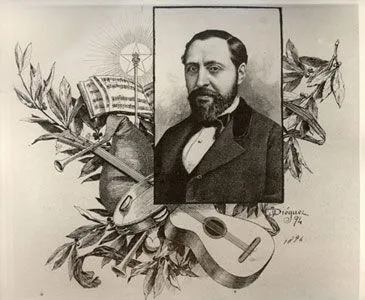
Francisco Asenjo Barbieri
Human Design Chart
Biography
In addition to his compositions, Barbieri was also an accomplished musician. He was the founder of La España Musical (a society for the promotion of Spanish operetta) and the Society for Orchestral Music.
He died 19 February 1894.
Francisco Asenjo Barbieri — Projector with Profile 3/5
Projector 3/5 — Design at a Glance
Francisco Asenjo Barbieri was characterized by a focusing aura that immediately revealed systemic weaknesses. His design worked like a bright flashlight, illuminating areas where others were still in the dark. He could instantly recognize where errors lay or processes failed within a system.
However, this immediate perception required a specific strategy. Directly addressing deficits would have provoked resistance, akin to shining bright light directly into someone's face. Instead, Francisco Asenjo Barbieri was most effective through his own harmonious glow. By embodying functioning patterns himself, he attracted others who then actively sought out his insights. His central life task was to wait for an honest and respectful invitation before taking on a leadership role.
Furthermore, due to his undefined Sacral Center, Francisco Asenjo Barbieri did not have a constant source of intrinsic life energy. His energy flow followed wave-like patterns: phases of high productivity and rapid work alternated with necessary rest periods. These recovery times were essential for preventing burnout. Societal expectations of constant availability often stood in opposition to this biological rhythm.
If he lived by the strategy of patience and waiting for an invitation, his path was rewarded with success. Ignoring this mechanism and trying to impose leadership against others' will or without sufficient rest led sooner or later to his non-self theme: deep bitterness. His design thus demanded a balance between clear systemic insight and the discipline to carefully preserve one's own energy.
Self-Projected Authority
Francisco Asenjo Barbieris design placed authority in the self, a configuration that only appears with Projectors and comes with pronounced openness as well as the risk of being distracted by external motoric energies. His inner truth lay in his identity; decisions did not arise from logical deliberation but through spontaneous expression of his essence. Francisco Asenjo Barbieri showed himself to be someone who had to distinguish between self and mind. When he engaged in self-talk or discussed with others upon invitation, it was important to listen to oneself: what came out spontaneously without thought represented his authentic uniqueness. Alternatively, he oriented himself by a physical feeling that drew him geographically or thematically away from something. By following this inner direction faithfully, he could become a guide for others and unleash his specific success potential. The central challenge lay in not sinking into openness and constantly chasing after energy but using one's identity as a compass. This mechanism emphasized the necessity of listening to oneself to appear authentic rather than being distracted by external influences.
The 3/5 Profile — Martyr / Heretic
Francisco Asenjo Barbieri was someone who gained knowledge not from theoretical distance, but through intense personal experimentation. His design indicated a tendency to remain initially skeptical and experience everything firsthand before accepting it. This attitude stemmed from his Line 3 of the Experimenter. It demanded withdrawal and adaptation to learn from one's own mistakes and setbacks. It was a process of responsible retreat necessary for developing practical insights.
Only after this phase of reflection did he step into the role of Helper. His Line 5, the Hero Line, propelled him to present self-acquired knowledge to others. This was particularly effective with strangers or in crisis situations. Often, he confessed his earlier mistakes and lack of knowledge at that time. This openness served as justification for his current competence and created a charismatic aura. Others were drawn to this wealth of life experience because they wanted to learn from his practical solutions.
The dynamic between necessary withdrawal for adaptation and later public presentation shaped his essence. He learned through failure, then emerged as a hero. This path was fraught with the risk of public setbacks, yet it was precisely this authenticity that made his message accessible and trustworthy.
Single Definition — Defined & Open Centers
Francisco Asenjo Barbier's design was characterized by a clear, stable core: his defined G Center gave him a reliable sense of self and inner direction. He knew who he was and where he stood, which allowed him to love others without being dependent on them. This firm identity flowed into his also defined Throat Center, serving as a steady pivot point for communication. His voice wasn't the product of fleeting moods or mental confusion but sprang directly from this deep self-assurance. Thus, he spoke and acted with an uncommon clarity and honesty, since his manifestation always came from this central "I."
This stable core sharply contrasted with his seven open centers: Head, Ajna, Heart, Sacral, Solar Plexus, Spleen, and Root were undefined. Francisco Asenjo Barbier was thus a mirror for his environment. His open Head and open Ajna Center absorbed inspirations and concepts; he tended to question whether certain thoughts were truly relevant or merely mental distractions. Without a stable mental system, he could take in others' ideas and reflect on them without identifying them as his own truth.
His open Heart Center meant that willpower and the need to prove himself did not come from within him. He tended to feel the pressure of the environment to achieve more or perform better to appear valuable, even though this was not part of his design. Similarly, his open Solar Plexus absorbed others' emotions; he could swing between happiness and sadness without these feelings being his own. His open Sacral Center lacked a constant energy flow; he took on the vitality of his environment, leading to phases of high activity followed by exhaustion since he wasn't designed to continuously generate generative energy.
The open Spleen and Root Centers made him vulnerable to fears and stress from the environment. He tended to feel uncertain or act spontaneously to escape this fear, though spontaneous decisions often did not serve his long-term interests. The pressure of his open Root Center drove him to complete tasks that actually belonged to others, which could lead to cycles of tension and burnout. Francisco Asenjo Barbier's challenge was to not misinterpret situational influences as his own reality but to use his defined G identity and Throat as the only fixed point in a constantly shifting inner field.
Channels for reflection, memory and inner retreat.
Francisco Asenjo Barbieri revealed himself as a guardian of stories and collective memory, whose expression only came after intense inner processing. This stance resulted from the Lost Son Channel 13-33, which connected the G Center with the Throat Center. Through Gate 13, the Listener's Gate, he gathered information and secrets, stored memories, and actively listened to his surroundings. This input flowed into Gate 33, the Withdrawn Gate, where he withdrew to reflect on the collected experiences. He patiently waited for hidden truths beneath the surface to reveal themselves before communicating them. This cyclical process of maturation allowed him to bring continuity and stability to the transmission of knowledge, as he only spoke once lessons from his experiences were fully understood.
Additionally, other energies influenced him. Gate 19 brought a connection to resources, territory, spirituality, and the need for a safe environment for relationships. Gate 24 promoted mental mutations and the search for inner peace through renewal. Gate 44 contributed watchfulness and transformation through interaction without conditions. In the personality area, Gate 12 influenced restraint and the impact of emotional mood on communication, while Gate 15 emphasized collective behavior and adaptation to natural rhythms. Gate 23 allowed him to recognize difference and bring individual mutations into the world through explanation. On a design level, Gate 2 stood for receptivity as a foundation for new directions, Gate 35 promoted change through interaction and experience, and Gate 16 supported experimenting to improve something new. Gate 56 encouraged translating mental processes into figurative stories, while Gate 25 embodied a spiritual stance of innocence and centeredness. This constellation shaped Francisco Asenjo Barbieri as someone who deeply listened, patiently processed, and ultimately spoke with wisdom.
Collective Circuitry — Circuit Signature
Francisco Asenjo Barbieris design sets a tendency to emotionally process past experiences and grasp the meaning within them. His energy follows a wave-like rhythm with clear beginnings, middles, and ends rather than linear logic. This is evident in the connection between his Throat Center and Identity Center through Channel "The Lost Son." This configuration links the ability to sense internal emotional wave movements directly with external expression.
Francisco Asenjo Barbieri reflected on events from the past to gain insights. These felt truths were not primarily intended for himself but should be shared with the collective to enable communal learning. In contrast to cool reason, here emotional depth was at the forefront; the illogical and inexplicable became visible through expression. Since his design is simply defined, these connected centers form a coherent flow. Energy flows from Identity through the Throat outward, which inclines Francisco Asenjo Barbieri to formulate his personal meaning-making processes and emotional cycles as contributions for others. This marks him as someone who learns from the past to share these lessons with others through his expression.
Right Angle Cross of the Four Ways 2
Francisco Asenjo Barbieri exhibited a fundamental disposition characterized by strategic orientation and the ability to find the right path through complex situations. His design featured the imprint of the right cross of the four paths 2, a configuration that did not seek immediate, impulsive solutions but recognized the value of patient navigation.
This structure described an inner capability to navigate opaque labyrinths without losing sight of the bigger picture. It was an energy that accepted complex entanglements not as obstacles but as necessary parts of the path. Francisco Asenjo Barbieris approach involved exploring the way step by step while always keeping the strategic overall direction in mind.
The mechanics of this cross promoted a stance of wise adaptability. Instead of fighting against resistance or getting lost in details, Francisco Asenjo Barbieri focused on what was essential: progress within given circumstances. This gave him a certain calmness towards the unpredictable, as he understood that the right path often only becomes visible through movement. His strength thus lay not in avoiding complexity but in the art of traversing it while maintaining his own course.
Projector · Self-Projected Authority — Synthesis
Francisco Asenjo Barbieri lived a life marked by a profound ability to recognize patterns and uncover their hidden meanings (Gate 13/33). This inclination towards identifying flaws in systems, combined with a G Center that dictates strong identity and direction, points to someone who not only perceived discrepancies in his environment but also possessed an inner compass to guide alternative paths. His profile as an Explorer/Hero (3/5) reinforces this impression – he gathered experiences through personal experimentation and shared knowledge with others, often marked by mistakes and their overcoming. The openness of his centers allowed for deep resonance with the energies of others, yet required constant mindfulness to avoid conditioning or being overwhelmed by external influences.
A central paradox in Francisco Asenjo Barbieris design lies in the tension between his ability for deep analysis and his need for authenticity. As a Projector whose authority is based on self-conversations and inner listening, he was geared towards recognizing truth – yet his open throat and undefined solar plexus center made him susceptible to the emotions and opinions of others. This likely led to constant weighing between personal judgment and external influences in search of the right form of expression to effectively convey insights without losing his own integrity.
1 Defined Channel
Incarnation Cross - Right Angle Cross of the Four Ways 2
Solar Return
The Solar Return shows the moment when the sun returns to its exact birth position - your personal solar year.
Life Cycles
Discover the life cycles with a detailed triple view (birth chart, cycle chart, composite).
Human Design Profile
- Type
- Projector
- Strategy
- Wait for the respectful invitation
- Authority
- Self-Projected Authority
- Profile
- 3/5 - Martyr / Heretic
- Definition
- Single Definition
- Incarnation Cross
- Right Angle Cross of the Four Ways 2
- Date of Birth
- 03.08.1823 12:00
- Place of Birth
- Madrid, Spain
Frequently Asked Questions
Which Human Design Type Was Francisco Asenjo Barbieri?
Which profile did Francisco Asenjo Barbieri have?
What authority did Francisco Asenjo Barbieri possess?
Which incarnation cross did Francisco Asenjo Barbieri have?
When was Francisco Asenjo Barbieri born?
Discover your own Human Design
Are you also a Projector? Find out in a personal reading how to unfold your leadership qualities and recognize the right invitations.
More Personalities
Back to overviewSissy Spacek

Aaliyah

Alain-Fournier

Alexia

Alizée

Anémone
