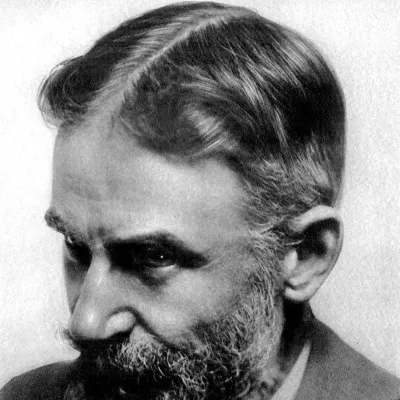
George Bernard Shaw
Human Design Chart
Biography
Shaw received a formal education until the age of 14 when he went to work as a clerk. He and his mother moved to London in 1876 and he began writing a series of five novels, 1879-1883, of which only two were published. He was known for being an advocate of socialist views, joining the Fabian Society in 1884, lecturing widely and becoming a leader. He was a music and drama critic for three publications, 1888-1898 and during this period began his writing for the theatre. Shaw gained reputation for his numerous plays, but also wrote volumes of critical and political essays, an autobiography in 1949 and volumes of letters.
Shaw, a redhead and a vegetarian, married Charlotte Payne-Townsend in 1898.
He died on 2 November 1950, Ayot St. Lawrence, England.
What does Manifesting Generator 2/4 mean for George Bernard Shaw?
Manifesting Generator 2/4 — Design at a Glance
George Bernard Shaw revealed himself as a Hybrid being that combined the lightning-fast action capability of a Manifestor with the constant energy source of a Generator. His design inclined him to quickly draw things into his life and skip steps in the process. However, this speed was a double-edged sword: often acting too hastily led to having to backtrack on missed stages, which caused frustration as it went against his natural drive for immediate effectiveness.
Moreover, Shaw tended to pursue multiple projects simultaneously rather than focusing on one thing at a time. This multi-tasking tendency stemmed from reacting to many different impulses. Without internal confirmation, this creative enthusiasm quickly turned into dissatisfaction. The key to his satisfaction did not lie in linear task completion but in what is called the "Play Mode". Here, variety and constant re-evaluation of his own consent were crucial.
As a Manifesting Generator, Shaw possessed a defined sacral power. This required the strategy of responding rather than initiating. He had to react to life impulses and only act when his inner authority gave its approval. Only through this continuous validation – even during already started projects – could he channel his immense energy without falling into frustration. His effectiveness thus did not arise from mere haste but from playful yet authoritative use of his hybrid nature.
Emotional Authority
George Bernard Shaw exhibited an internal decision-making structure that required time and distance. His design featured emotional authority in the defined Solar Plexus Center. This configuration was subject to a constant wave cycle of feelings: moods swung between enthusiasm and rejection, with each current feeling merely a snapshot, not the deeper truth. Spontaneous reactions to these transient emotional states were often misleading and could lead to misjudgments.
The mechanics of his design demanded delay. George Bernard Shaw had to let decisions rest in order to neutralize the influence of passing mood swings. Through conscious waiting—often over several nights—the initial emotional waves subsided. Only during this phase of calmness and distance did true clarity emerge. This process filtered out mood-driven distortions and allowed for clearer recognition of long-term consequences. Patience was not an optional feature but a central strategy to ensure correct orientation. Emotional authority took precedence over other defined centers; their signals should not be overridden by logical reasoning or external pressure until the natural cycle of rise and fall had run its course. Only in this way could George Bernard Shaw distinguish his deeper truth from fleeting impulses.
The 2/4 Profile — Hermit / Opportunist
George Bernard Shaw lived in a constant tension between the urge to withdraw and the desire for connection. His design as Profile 2/4 required clear communication of his needs: He needed phases of solitude to gain inner clarity, as well as times of community with familiar people. During this "Me-Time," he distilled impulses from his social network and developed brilliant ideas from them.
This dynamic was shaped by his Leadership energy in Gate 31. This position gave him a natural authority that was only stable when lived democratically and developmentally oriented. Acting without regard for the collective risked being perceived as arrogant or losing credibility. Thus, his leadership competence matured through balancing individual strength with collective responsibility.
This was complemented by the Line Resonance in Gate 27, which gave him transpersonal care and generosity. Shaw shared nobly but had to learn to curate his network carefully. Random giving would have exhausted him; instead, it was about supporting those who deserved it. His social environment thus served as a resonance space whose inputs he reflected upon during solitude and transformed into valuable insights. This cyclical movement between isolation and interaction shaped his way of processing and sharing knowledge.
Split Definition — Defined & Open Centers
George Bernard Shaw's design inclined towards a consistent expression and inner orientation. His defined throat acted as a reliable pivot point for communication, translating messages from other centers into clear language. This happened not through mental planning but as a direct transmutation of energy into action.
His primary decision-making mechanism came from his defined sacral center. As the guardian of an enormous power source, he generated daily vital energy that felt like a constant hum. His strategy was to wait for life and then react rather than initiate anything. Only a confirming response from the gut unlocked full sacral power; any mental initiative without this affirmation led to resistance and exhaustion.
Parallel to this, his defined solar plexus shaped his emotional authority. He was designed to wait out the ups and downs of the emotional wave before acting. Truth revealed itself over time for him, not in impulsive moments. This patience protected him from chaotic decisions at the peaks or troughs of his mood waves.
His defined G Center gave him a firm self-identity and sense of personal direction. He knew who he was and where he was going without having to direct others. The defined spleen supported this through spontaneous intuition in the moment, while the defined root center provided the specific pressure needed for material survival and advancement.
In contrast, head, ajna, and heart centers were open. This freed him from constant mental focus or the need to prove willpower. Instead of getting stuck in endless questions or seeking inspiration, he could embrace new ideas without needing to identify them as his own truth. The open heart liberated him from the pressure to make promises or prove his worth through competition. He tended to perceive others' ego vibrations rather than getting caught up in cycles of self-doubt and overcompensation.
Channels for intuitive form, emotional depth, care and growth.
George Bernard Shaw's design inclined towards intuitive self-perfection, serving as a model for the collective. Channel of Perfect Form 57-10 connected spleen and G Center: He acted spontaneously based on inner insight (Gate 57) and secured his survival through authentic behavior (Gate 10). This individual integrity was not egoism but a projection of dignity that inspired others.
His articulation followed the emotional wave. Channel of Openness 22-12 connected solar plexus and throat: He spoke only when motivated effectively (Gate 12) if his mood matched (Gate 22). Impulsive speaking led to misunderstandings; patiently waiting for the right emotional tide allowed him to deeply move others through voice and word, initiating change.
This transmission was based on completed cycles. Channel of Maturation 42-53 connected root and sacral center: He went through experiences until their end (Gate 53), then reflected upon them (Gate 42) to gain wisdom. Only this way could he avoid frustration and translate his lessons as useful information for others, rather than getting stuck in recurring patterns.
The foundation was clan-oriented preservation. Channel of Preservation 27-50 connected sacral center and spleen: He provided and protected (Gate 27) based on traditional values and laws (Gate 50). His care was selfless but required clear boundaries; he only responded to genuine requests to avoid exhausting his own energy.
These mechanisms served the dominant personality sun in Gate 31. This gate represented the transmission of leadership and identity to the collective. George Bernard Shaw's intuitive form-giving, emotional articulation, cyclical maturation, and clan-oriented care were not isolated traits but tools to direct and pass on collective forces. His uniqueness drew attention not through intent but as a natural consequence of how he structured his energy in service to the community.
Individual Circuitry — Circuit Signature
George Bernard Shaw's design showed a tendency towards emotional openness and conscious preservation of personal intuition. This configuration arose from four parallel, non-directly connected energetic focal points due to his split definition.
In the Knowledge Circuit, he linked throat and solar plexus centers via Channel of Openness. This shaped an expression based on emotional waves: He did not just communicate dry facts but let his feelings and moods resonate directly in his words.
The Meaning-Finding Circuit connected his sacral with root center through Channel of Maturation. Here, a cyclical energy allowed him to reflect upon past experiences and share derived emotional insights with others to learn collectively from history.
Parallel to this, the Protector Circuit linked sacral and spleen centers via Channel of Preservation. This mirrored an ancient impulse: instinctive protection and preservation of his own genetics and family through care and sustenance.
Finally, the Integration Circuit connected identity with spleen center via Channel of Perfect Form. This supported him in drawing strength from reacting to life and making this effective through intuitive knowledge as well as appropriate behavior here and now. These four areas existed as separate forces alongside each other without forming a single continuous flow.
Right Angle Cross of the Unexpected 2
George Bernard Shaw's Human Design profile featured the configuration known as 'The Right Cross of the Unexpected 2'. This structure established a foundational stance that responded to spontaneous, unforeseen turns in life rather than adhering to a rigid long-term plan. For him, the unexpected was not an obstacle but the actual driver of his development.
In Human Design mechanics, this cross describes a specific energy distribution that requires flexibility and adaptability. Individuals with this configuration often exhibit a natural inclination towards situations that change rapidly or have uncertain outcomes. They learn best through direct experience in the present moment rather than theoretical preparation for a fixed goal.
This orientation shaped George Bernard Shaw's life path as an ongoing process of new beginnings. He was less someone who followed a predetermined course and more one who found his direction through encounters with surprising events. The mechanics of this design support trust in instinct when external circumstances suddenly change, not through aimless wandering but through strategic openness to opportunities that only become apparent in the moment. This ability to use the unforeseen as a resource was a central component of his energetic signature and significantly influenced how he dealt with challenges and opportunities.
Saturn Return · Uranus Opposition · Chiron Return · 2nd Saturn Return — Life Cycles
George Bernard Shaw's design indicated a tendency towards structural anchoring followed by systemic expansion. In 1884, at age 28, he joined the Fabian Society, marking his first Saturn Return, a cycle where years of groundwork often condenses into a solid result and long-term commitments are entered into. His life mission was revealed here in seeking hidden truths while having the need to convey insights so that others would actually absorb them.
Ten years later, in 1895 at age 39, he became a theater critic for Saturday Review. This coincided with his Uranus Opposition, a phase often bringing deep upheavals and the necessity of breaking free from old structures. For his design, this meant transitioning to a role where he could uncover hidden connections and pass them on to others. Both turning points underscore his fundamental approach: seeking what lies beneath the surface and conveying these insights into new contexts. His career development thus followed rhythmic impulses in his chart, from stabilization through Saturn to expansive realignment via Uranus.
Manifesting Generator · Emotional Authority — Synthesis
George Bernard Shaw lived a life marked by deep internal tension between the urge for rapid implementation and the need for mature deliberation. As an Manifesting Generator, he had the ability to initiate things quickly (through the connection of sacral energy with the Throat Center), yet his emotional authority required time to let decisions ripen and fully grasp their consequences. This dynamic was reflected in a constant interplay between impulsive actions and withdrawal for clarity – a pattern amplified by his profile as a natural talent and networker, nurturing both a desire for solitude and community.
A central paradox lay in how he connected his inner world with the outer one. The defined communication and manifestation area enabled him to transform and express messages, yet the channel of the Completed Form (57/10) pointed towards self-orientation that placed personal behavior at the forefront – a process guided by intuitive insight and appreciation for being oneself. Career turning points coinciding with Saturn Return and Uranus Opposition underscore this interaction between inner development and outer expression.
4 Defined Channels
Incarnation Cross - Right Angle Cross of the Unexpected 2
Solar Return
The Solar Return shows the moment when the sun returns to its exact birth position - your personal solar year.
Life Cycles
Discover the life cycles with a detailed triple view (birth chart, cycle chart, composite).
Human Design Profile
- Strategy
- To respond - wait for something to respond to
- Authority
- Emotional Authority
- Profile
- 2/4 - Hermit / Opportunist
- Definition
- Split Definition
- Incarnation Cross
- Right Angle Cross of the Unexpected 2
- Date of Birth
- 26.07.1856 00:55
- Place of Birth
- Dublin, IRE
Frequently Asked Questions
What was George Bernard Shaw's Human Design type?
What Profile did George Bernard Shaw have in his Human Design?
Which Authority determined George Bernard Shaw's decisions?
What incarnation cross was assigned to George Bernard Shaw?
When was George Bernard Shaw born?
Discover your own Human Design
Are you also a Manifesting Generator? Find out in a personal reading how to unfold your multi-talents and direct your energy wisely.
More Personalities
Back to overviewAldair

Alizée

Angeli

Arletty

Artus

Balthus