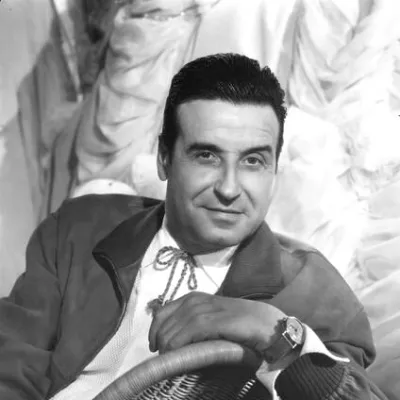
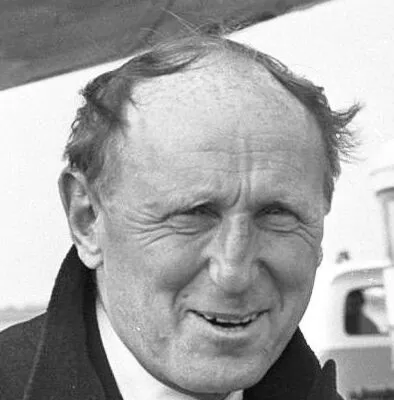
Photo: Wikimedia Commons
Georges Lautner
Human Design Chart
Biography
He died on 22 November 2013.
Human Design Analysis: Georges Lautner as Projector 3/5
Projector 3/5 — Design at a Glance
Georges Lautner's design pointed towards a tendency for focused perception. As a projector, he did not have a constant, intrinsic energy source, but rather phases of high activity that had to be balanced with necessary rest periods. His undefined Sacral Center meant that he had to protect himself from exhaustion by not constantly providing work performance.
His aura acted like a bright flashlight that directly pointed out weaknesses in systems or relationships of others. Georges Lautner immediately saw what was wrong. However, immediately addressing these errors would have provoked resistance, as it would have felt like a bright light in the face. The more effective strategy was to attract others through his own harmonious behavior, so that people would come to him for advice on their own.
Therefore, it was crucial for Georges Lautner to wait for a respectful and honest invitation before bringing in his leadership or advice. This strategy of invitation rather than imposition allowed him to effectively use his specific gift – finding solutions for other people's problems – without overloading himself or provoking conflicts. If he lived according to this design, he was rewarded with success; ignoring this dynamic sooner or later led to bitterness. His influence therefore did not lie in constant presence, but in the quality of his targeted, invited interventions.
Emotional Authority
Georges Lautner's design pointed towards emotional depth and fluctuation. He showed himself as someone whose inner truth did not lie in the first reaction, but only became visible after the waves had subsided. His inner authority was the emotional one, carried by his defined Solar Plexus Center. This meant that he was under the influence of a permanent emotional wave that colored his perception of the world through the current mood. What appeared as exciting in one moment could be negative in the next. His immediate feeling was merely a snapshot, not yet the final clarity. Quick, spontaneous decisions made in this emotional heat often risked negative consequences, as they were based on fleeting impulses.
The mechanics of his authority required patience and time. He had to let decisions mature, sleep on them multiple times to gain emotional distance. Only when the intense feelings subsided did true calm and clarity set in. This process was especially crucial for long-term, life-defining decisions. Emotional authority always took precedence over other defined centers in his chart. Georges Lautner lived in a rhythm of up and down, which forced him to take his time and ask himself multiple times before acting. Only through this hesitation and waiting could he recognize the deeper truth of his situation, beyond the often misleading first emotional impression.
The 3/5 Profile — Martyr / Heretic
Georges Lautner showed himself as someone who gained his knowledge not from books, but through his own, often painful experimentation. His design as a 3/5 profile marked him as an experimenter and later as a hero who presented these practical experiences to others. Line 3 drove him to initially test everything himself, as he did not accept anything at face value. This learning process through trial and error was individual and required discipline and material ambition, as described by the energy of Gate 41. He had to fail to learn, and this adaptability formed the basis of his competence.
At the same time, he carried the burden of Line 5, the Hero Line. This was about the life struggle and the question of whether the effort was worth it. Lautner used his self-acquired knowledge to solve other people's problems, which made him attractive to his environment. This role of the rescuer flattered him, but became painful when his experiments failed in public. The dynamics of Gate 28 also showed an intuitive ability to resolve alliances and join stronger groups when trust was abused or conflicts provoked. So he moved between private learning through mistakes and public presentation as a competent advisor who drew from his own experience to lead or save others.
Single Definition — Defined & Open Centers
Georges Lautner's Human Design profile indicated a tendency towards emotional depth and patient decision-making. His defined Solar Plexus Center acted as an inner authority, recognizing truth not in the immediate moment but after experiencing an emotional wave. This configuration shaped him as someone who cultivated patience to gain clarity rather than acting impulsively. Simultaneously, his defined Root Center propelled him with a persistent, adrenaline-driven pressure that fostered existential security and emotional intelligence. This combination of emotional reflection and inner drive created a dynamic tension between the need for calm and the impulse to move.
In contrast, his design revealed several areas of openness. His open Head Center made him susceptible to mental pressure and the temptation to engage with questions that were not his own. Often, he sought inspiration to resolve inner confusion rather than trusting the natural flow of his thoughts. Similarly, his open Ajna Center led him to adopt concepts and opinions without identifying them as his own truth, occasionally leading to uncertainty about his own thinking as he mirrored foreign intellectual currents.
His open G Center meant he did not have a fixed identity or direction but discovered these through interaction with his environment and other people. He relied on others to initiate him to find the right place and the right love. Additionally, his open Heart, Sacral, and Spleen Centers revealed a vulnerability to conditioning in the areas of willpower, vital energy, and health. He tended to prove himself or cling to unhealthy environments to generate a sense of security or worth, which distracted him from his true nature. The wisdom of his design lay in using these open areas as mirrors and instead relying on his emotional authority and inner drive.
Channels for restless drive energy and emotional intuition.
Georges Lautner's Human Design profile indicated a tendency towards intense emotional restlessness, driven by a deep desire for new experiences. This trait resulted from Channel 41-30, which connected Root Drive with Solar Plexus Emotions. Gate 41 initiated the physiological urge to develop, while Gate 30 heated up the feelings, creating a strong desire to leap from unfamiliarity into experience. This configuration demanded patience to follow the emotional wave before making decisions.
Additionally, other energies were at play: Gate 31 brought the ability to transmit power and lead, while Gate 28 emphasized decision-making in the here and now and taking risks according to type strategy. Gate 27 added a genetic role of care, enriching activities through warmth and self-preservation. In his design, Gate 60 showed acceptance of limitations for transcendence, and Gate 22 highlighted openness to social mutation through calm listening. Gate 54 connected worldly success with spiritual insight, supported by partnerships. Gate 39 provided adrenaline through provocation and analysis to trigger mutations. Gate 36 allowed the release of emotional energy through crises as a cyclical movement. This combination shaped a person who navigated between a desire for experience and the need for emotional clarity, with care and leadership influencing his interactions with others.
Collective Circuitry — Circuit Signature
Georges Lautner's Human Design profile indicated a tendency towards processing past events emotionally. He was someone who did not just logically evaluate experiences but lived them through wave-like feeling cycles. This configuration shaped his way of experiencing the world: less through cool reason looking into the future, but through reflecting on the past.
This trait resulted from the Meaning Circuit. In Georges Lautner, this circuit was active through the Recognizing Channel, which connected the Solar Plexus Center with the Root Center. The Solar Plexus Center steered emotional waves – each cycle had a beginning, a middle, and an end, often accompanied by descending feeling phases. The Root Center provided immediate, instinctive energy. Since both centers were directly connected, this emotional intensity flowed seamlessly into physical reaction.
The purpose of this connection was to collect the felt insights and emotions generated in the Solar Plexus to share with the collective. It was about learning together from the past. Georges Lautner used this energy to interpret and explain visual and emotional patterns from history. As he had a Simple Definition, these connected centers formed a coherent, continuous energetic flow, unfragmented by separate groups. His experience was thus a continuous unit from the emotional wave to the immediate root energy.
Right Angle Cross of the Unexpected 4
Georges Lautner's design carried the signature of the right cross of the Unexpected. This indicated a specific configuration characterized by a strong, often surprising aura. People with this structure often acted like magnets for new influences and unexpected turns. They were predisposed to attract the unforeseen and integrate it into their life path.
This configuration signaled a high sensitivity to the new and foreign. Georges Lautner was seen as someone who, through his presence, often acted as a catalyst for changes. Others were drawn to his way without knowing exactly why. It was not about deliberate manipulation but a natural radiation that drew attention.
The right cross of the Unexpected combined various energetic centers into a whole that promoted openness to the unexpected. Georges Lautner lived in a constant readiness to embrace whatever came his way. This attitude enabled him to thrive in dynamic environments where routine was absent. He was a bringer of the new, who through his existence often set impulses that moved others. His magnetism lay in the ability to break through the familiar and make space for the unexpected. This shaped his interactions and his place in the world significantly.
Saturn Return · Uranus Opposition · Chiron Return · 2nd Saturn Return — Life Cycles
Georges Lautner's life followed a clear rhythm of maturation and structural consolidation. His design showed a tendency for his identity and life structure to condense through recurring, cyclical tests. First, the first Saturn Return occurred. This cycle marked the transition from youth to adult responsibility, where earlier attempts coalesced into a solid foundation.
Then, the Uranus Opposition took effect. It often brought sudden changes or a drive for freedom, which put the previously established structures to the test and required adjustments.
Around the age of 49 to 51, the Chiron Return occurred. This was not a process of wound healing in the traditional sense but a fulfillment cycle. Here it was shown that his own incarnation cross increasingly unfolded in life. If Georges Lautner had lived according to his strategy and authority, the meaning and purpose of his design became experiential and bloomed in this phase.
Finally, the second Saturn Return occurred. This cycle crowned the preceding phases. It stood for the final confirmation of the worked-out life structure and the integration of all previous experiences into a stable, mature form. Thus, Georges Lautner's design was marked by these four major astrological milestones, which showed a clear line from foundation through testing to fulfillment and confirmation.
Projector · Emotional Authority — Synthesis
Georges Lautner was a Projector, who through his defined Emotional Center and the Channel of Recognition (Gate 41/30) developed a deep understanding of the dynamics of other people. He lived life as an experimenter and hero (Profile 3/5), always in search of new experiences to expand his knowledge and make it accessible to others. This combination led to a pronounced ability to recognize hidden patterns and potentials, yet always with the necessity to wait for the emotional wave to arrive at a clear truth.
A central paradox in his design lay in the tension between the need to explore the unexpected (right cross) and the emotional depth that required a maturing perspective. He was destined to shed light on the dark and expose errors, yet the way he did this was crucial. The projection of his energy could be perceived as enlightening as well as disturbing, which constantly challenged him to find timing and expression that took into account both his perceptual abilities and the emotional landscape of others.
1 Defined Channel
Incarnation Cross - Right Angle Cross of the Unexpected 4
Solar Return
The Solar Return shows the moment when the sun returns to its exact birth position - your personal solar year.
Life Cycles
Discover the life cycles with a detailed triple view (birth chart, cycle chart, composite).
Human Design Profile
- Type
- Projector
- Strategy
- Wait for the respectful invitation
- Authority
- Emotional Authority
- Profile
- 3/5 - Martyr / Heretic
- Definition
- Single Definition
- Incarnation Cross
- Right Angle Cross of the Unexpected 4
- Date of Birth
- 24.01.1926 23:00
- Place of Birth
- Nice, France
Frequently Asked Questions
What was Georges Lautner's Human Design type?
What profile did Georges Lautner have?
What authority did Georges Lautner have?
What incarnation cross did Georges Lautner have?
When was Georges Lautner born?
Discover your own Human Design
Are you also a Projector? Find out in a personal reading how to unfold your leadership qualities and recognize the right invitations.
More Personalities
Back to overviewSissy Spacek
Alain-Fournier
Anémone

Ann-Margret
Bourvil
Christian-Jaque