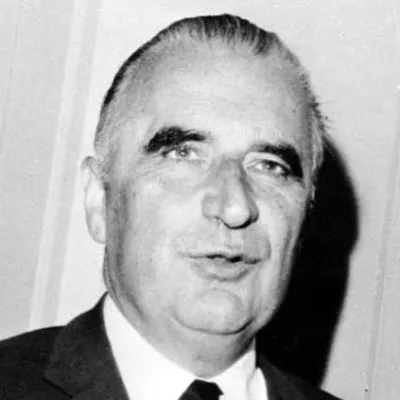
Georges Pompidou
Human Design Chart
Biography
From 1969-1974, he served as the 19th President of France, and 2nd President of the Fifth French Republic, during which time he ended France's opposition of Britain's entry into the common market.
Pompidou died suddenly from Waldenström's macroglobulinemia at 9 p.m. on 2 April 1974, Paris, France. His wife Claude died 3 July 2007 in Paris, age 94.
Georges Pompidou as a Generator 3/5 in Human Design
Generator 3/5 — Design at a Glance
Georges Pompidou possessed enormous endurance and was known as a powerful 'workhorse' whose energy required specific conditions to be effective. His Generator design dictated that this power would not be unleashed through spontaneous initiative but rather in response to external impulses. The central mechanics of his Sacral Center demanded waiting for an internal signal - a clear 'yes' from the gut - before acting.
This system harbored two significant risks: If Georges Pompidou engaged in activities that did not provide him with inner pleasure, he wasted his resources and was prone to exhaustion. Conversely, blocking his work on projects that ignited burning enthusiasm led to frustration and energy loss. He was only successful when he responded to life signals and synchronized his actions with this internal green light.
Living in harmony with this reactive strategy instead of initiating action rewarded him with a profound sense of fulfillment and unparalleled resilience. Deviating from it by trying to force things or initiate without inner confirmation led to persistent frustration and a noticeable deficit of life energy. His strength lay not in pushing forward but in the powerful response to what life presented.
Sacral Authority
Georges Pompidou made decisions based on an immediate physical resonance rather than intellectual analysis. His design established Sacral Authority, marking him as a Generator. This inner instance acted like a 'gut feeling': In response to external stimuli, his body responded with clear signals - a surge of energy or vitality upon agreement, emptiness and fatigue upon disagreement. With the Emotions Center open, this authority could operate freely without being distorted by emotional turbulence.
Pompidou also had an activated Spleen Center, which served as a supportive instance. This endowed his Sacral reaction with speed and instinctive spontaneity. He could quickly engage with situations guided by deep physical perception that provided reliable orientation. Rather than pondering for long, he reacted directly to what energized or repelled him. This mechanism allowed him to tackle tasks with great enthusiasm and inexhaustible energy as long as they received his inner approval. His life force flowed naturally when he responded rather than initiated, enabling him to immerse himself fully in his activities without compulsive purposefulness.
The 3/5 Profile — Martyr / Heretic
Georges Pompidou acquired knowledge not from books but through personal experimentation and failure. His design inclined him towards skepticism toward established truths and a tendency to test everything personally. This attitude stemmed from Line 3 of the Experimenter, which defined responsibility through trial and error. Pompidou was willing to sacrifice himself to this mutative process to gather practical experience.
He then utilized these accumulated insights in the role of Line 5, the Hero or Saviour. Here it was about solving others' problems with self-acquired knowledge. His appeal to others rested on presenting a rich trove of life experience. The mechanics of his Profile 3/5 described a cycle: private experimentation followed by public action as an authority.
Crucial in this role was the dependence on public perception. Success in this heroic role flattered him, but public failure in demonstrable experiments was acutely painful. Line 5 also demanded objectivity and impartiality, especially in crisis management. Pompidou had to learn to act with influence without being swayed by emotions. This distance was crucial for his success on the material plane. His path involved translating the subjective experiences of Line 3 into the objective application of Line 5 to be perceived as a cool storyteller and problem solver.
Single Definition — Defined & Open Centers
Georges Pompidou's design laid a tendency towards vital, reactive power, steered by instinctive intelligence and persistent progress pressure. His defined Sacral Center generated an enormous daily energy source that manifested as constant humming or restlessness. This vital force required reaction rather than initiation: Only responding to questions with an inner yes or no answer ensured his energy was available without being overloaded by mental decisions. This protected him from frustration and exhaustion, as his Sacral Motor only worked sustainably when correctly addressed.
Parallel to this, his defined Spleen Center served as authority for momentary well-being and protection. It provided spontaneous, intuitive judgments in the here and now, helping him stay healthy and protect himself from danger. This bodily intelligence required trust in the first alarm without rational justification. This was complemented by his defined Root Center, which delivered a firm pressure towards material forward movement. This stress served as motivation for survival and correction, anchored in the joy of existence.
In contrast, his open centers reflected the environment without their own constancy. His open Head and Ajna Centers absorbed mental inspiration and concepts but tended to identify with doubts or others' ideas rather than seeing them as transient information. The open G Center lacked a fixed identity, adapting to directions and places in the environment; Pompidou tended to search for his lost direction instead of waiting for initiation by others. His open Heart Center lacked consistent willpower, making him vulnerable to proving his worth through promises or competition – a trap often ending in self-doubt. Finally, his open Solar Plexus absorbed the emotions of the environment without recognizing them as its own, leaving him emotionally vulnerable and personalizing foreign moods.
Channels & Gates
Georges Pompidou showed himself as someone breaking evolutionary change driven by pulsating, adrenalized energy. His design laid a tendency to force innovations often accompanied by melancholy and mechanical mood swings. This dynamics stemmed from the Channel of Mutation 60-3, connecting the Root Center with the Sacral Center. Gate 60, the Gate of Limitation, required acceptance of boundaries while Gate 3, the Gate of Order, tried to structure new possibilities out of the confusion of a fresh start. This combination generated an unpredictable frequency: A strong pulse of creativity alternated with phases of inner tension and stillness. Pompidou had to learn patience in waiting for the right moment for innovation rather than filling the melancholic gaps between pulses with rational argumentation.
Parallel to this, the Channel of Life Struggle 38-28 shaped his attitude. This channel connected the Root Center with the Spleen Center and drove him towards seeking individual integrity. Gate 38, the Gate of the Fighter, exerted pressure to resist external forces that diverted him from his true nature. Gate 28, the Gate of the Player, helped him recognize which struggles had value and were worth fighting for. This configuration generated a stubborn determination to challenge the status quo with individual values. The internal pressure to express this change was enormous; if not channeled, it led to frustration. Pompidou's design thus connected the mutative power of renewal with the fighter's will towards individuation, making him a driving yet unpredictable presence always waiting for the next impulse or engaging in a meaningful struggle.
Circuit Signature
Georges Pompidou's design laid a tendency towards pulsating, acoustic creativity closely linked to the search for individual identity. The Knowledge Circuit connected his Sacral, Root, and Spleen Centers directly. This created a common flow of mutation (Channel 3-60) – the ability to break free from old patterns – and life struggle (Channel 28-38), mobilizing energy to bring change into the world. This configuration promoted the expression of unique identity through innovative impulses.
Parallel to this, the Meaning Circuit also included his Sacral and Root Centers but as a separate segment of the first circuit since no direct connection existed between all three centers. Here dominated Channel 42-53 (Maturation), allowing cyclical, visual processing of past experiences. This energy served to reflect emotions and insights from the past for collective learning.
The tension between these two circuits shaped Georges Pompidou's energetic profile: On one hand, the driving force towards transformation and innovation through the Knowledge Circuit; on the other, the deep emotional reflection of the past through the Meaning Circuit. Both systems shared the Sacral and Root Centers but expressed differently – once as pulsing renewal, once as wave-like processing of experience. This duality created a dynamic interaction between individual development and integration of historical experiences.
Right Angle Cross of Tension 2
Georges Pompidou was characterized by an archetypal dynamic that served as a structuring background factor in his Human Design. His chart contained the representation of the 'Right Cross of Tension 2'. This configuration did not mark his essence superficially but rather as a deeply rooted pattern influencing his inner alignment and reactions to external circumstances. The Right Cross of Tension 2 symbolizes a specific energetic quality often associated with an internal sense of being torn or the need for balance between opposing poles. It acts as a background factor permeating the entire design, thus functioning as a constant element in Georges Pompidou's life. This tension provided a foundation upon which other aspects of his design built and interacted. While it was not always consciously felt, it remained present like an undercurrent shaping the landscape. For Georges Pompidou, this meant that his decisions and behavior were influenced by this underlying tension, even if he may not have been explicitly aware of it. The mechanics of this cross promoted a stance seeking both stability and change, leading to a complex, multi-layered personality. It was an integral part of his energetic signature and contributed to how he perceived and fulfilled his role in the world.
Saturn Return · Uranus Opposition · Chiron Return · 2nd Saturn Return — Life Cycles
Georges Pompidou's design inclined towards structured power expression, which came into full effect during later life phases. This manifested through two crucial astrological turning points: the Chiron Return and the second Saturn Return. The Chiron Return marks a fulfillment cycle where one's incarnation cross unfolds and purpose becomes experiential – provided that the individual has lived according to their strategy and authority. It is not about healing old wounds but rather a bloom period of life task realization. In 1962, at age 51, Georges Pompidou became Prime Minister of France. This event correlated with his Chiron Return, signaling the increasing manifestation of his inner purpose on the highest political level.
The second Saturn Return brings structure, responsibility, and often consolidation of acquired position. It stands for maturity and establishment of lasting achievements. In 1969, at age 58, Pompidou became the second President of the Fifth Republic. This rise to France's highest office coincided with his second Saturn Return, underscoring the mechanics of this cycle: years of groundwork condensed into a robust result of power and structure. Both cycles shaped Georges Pompidou's path not as random career peaks but as an expression of deep Human Design mechanisms. His design fostered development where personal maturity was directly linked to political ascent. The correlation between these astrological phases and his offices highlighted how his inner blueprint manifested outwardly – through clear structuring and the fulfillment of a specific life task in the political sphere.
Generator · Sacral Authority — Synthesis
Georges Pompidou primarily lived through his sacral energy (Sacral Center, Generator Type), driving him to sustained activity and a deep need for expression. This power was, however, inseparable from an inner melancholy (Channel 3-60 of the Knowledge Circuit), pointing towards constant confrontation with limitations and rebirth. His profile as an experimenter/hero and savior (Profile 3/5) amplified this drive to gather knowledge through personal experimentation and make it usable for others – a process always marked by pulsating, transformative energy. The repeated career events at key moments of his cycles (Chiron Return in 1962, Saturn Return in 1969) showed that he found his life task through the expression of this dynamic.
Pompidou operated within a central paradox: He was a Generator with inexhaustible energy but always coupled with an internal tension and awareness of impermanence. The sacral authority urged him to listen to his inner voice, while the channel of mutation continually pushed him into new, uncertain directions. This field of tension between established power and evolutionary change shaped his path as he carried responsibility for current events while constantly seeking new possibilities.
3 Defined Channels
Incarnation Cross - Right Angle Cross of Tension 2
Solar Return
The Solar Return shows the moment when the sun returns to its exact birth position - your personal solar year.
Life Cycles
Discover the life cycles with a detailed triple view (birth chart, cycle chart, composite).
Human Design Profile
- Type
- Generator
- Strategy
- To respond - wait for something to respond to
- Authority
- Sacral Authority
- Profile
- 3/5 - Martyr / Heretic
- Definition
- Single Definition
- Incarnation Cross
- Right Angle Cross of Tension 2
- Date of Birth
- 05.07.1911 07:30
- Place of Birth
- Montboudif, France
Frequently Asked Questions
What was Georges Pompidou's Human Design type?
What profile did Georges Pompidou have?
Which authority guided Georges Pompidou?
What incarnation cross did Georges Pompidou have?
When was Georges Pompidou born?
Discover your own Human Design
Are you also a Generator? Find out in a personal reading how to use your sacral energy correctly and discover deep satisfaction.
More Personalities
Back to overviewAaliyah

Alexia

Angèle

Anne-Marie

Arcángel

Arno