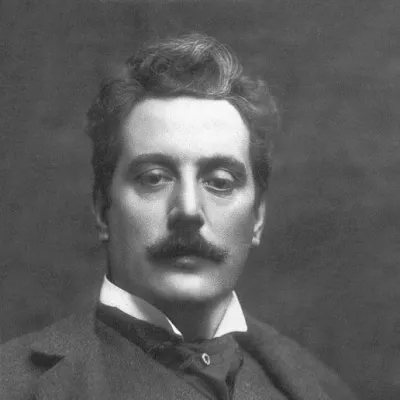
Photo: Wikimedia Commons
Giacomo Puccini
Human Design Chart
Biography
Puccini was not a child prodigy, but descended from a long line of musicians, conductors and composers. His father died when he was five, on 18 February 1864, and he became heir to the position of choir master and organist at a local church and professor of music at Collegio Ponziano. However, he fell under the spell of opera, and never pursued these positions. He showed musical talent early, and began playing the organ at age 14. Two years later, he was composing religious music and studying at a local conservatory in Milan, the latter made possible from a stipend of a wealthy great-uncle and a scholarship from Queen Margherita. He produced his first stage work, "La Villi," in 1883 which brought him attention among some of opera's more influential people. He became a major success after this. The opera "Manon Lescaut," which premiered in February 1893, marked the start of his mature style and helped establish him as artistic successor to Maestro Giuseppi Verdi. His next three works were his most famous: "La Boheme," 1896, "Tosca," 1900 and "Madame Butterfly," 1904.
He had an interesting personal style, being fond of hunting, mechanical devices of any kind, collector of cars and motor boats and acquiring houses.
His wife, the former Elvira Gemignani, was extremely jealous. She had been his mistress for 20 years while married to another man. He had a son by her in 1886. They married in 1904 after her husband's death but she was said to be a "pathologically invasive woman." In 1908, she accused a housemaid of being Puccini's lover, which eventually drove the woman to suicide. Elvira was jailed for five months and the couple separated, but later reconciled.
What does Manifestor 2/4 mean for Giacomo Puccini?
Manifestor 2/4 — Design at a Glance
Giacomo Puccini was a Manifestor. His design marked him as a pioneer and visionary with the task of guiding the world into a new direction. The structure of his chart compares this role to an emperor in ancient Rome: He had the vision of a great empire but did not lead wars or battles himself. Instead, he delegated tasks to others, much like an emperor sending soldiers to conquer lands for him.
This superior mindset and grand thinking often led Giacomo Puccini to be misunderstood. His visions polarized his surroundings. Some people loved him because of his dreams and followed him willingly. Others disliked or even hated him due to these vast perspectives. This pain point of misunderstanding was a central aspect of his experience.
To find the right followers, it was essential for Giacomo Puccini to inform others about his intentions and visions at the right time and precisely. This strategy of informing minimized conflicts and allowed suitable people to follow him. If he followed this strategy, his design rewarded him with a deep sense of inner peace. Living against his nature by not informing led to persistent, deep anger. The contrast between peace when following the design and anger when deviating was the clear emotional feedback from his system.
Emotional Authority
Giacomo Puccini showed himself as someone who did not follow the first impulse at crucial crossroads but consciously allowed time. His inner authority was emotional, carried by the defined Solar Plexus Center. In Human Design mechanics: If this center is colored, it always takes charge in decision-making, regardless of other defined areas in the design. This subjected him to a constant wave of ups and downs of his emotions. The world appeared filtered through the lens of his current mood; what was exciting at one moment could be negative the next.
Since this immediate emotional reaction was merely a snapshot and not necessarily his deeper truth, spontaneous judgments were risky. Puccini therefore needed patience to reach his true clarity. The process required consciously 'ripening' decisions, often accompanied by multiple nights of sleep. Only when the initial strong feelings subsided and an emotional distance set in did calmness arise. This temporal buffer served to avoid emotional deception. Only after this wave movement could he recognize if an option truly suited him. This mechanism significantly shaped his approach to long-term life decisions: He sought not quick solutions but waited for the moment when the storms within calmed, revealing the true direction.
The 2/4 Profile — Hermit / Opportunist
Giacomo Puccini showed himself as someone living in a constant interplay between deep withdrawal and the desire for social connection. His design bears Profile 2/4, which inherently carries tension between Line 2 – seclusion – and Line 4 – network. This configuration generated a cyclical pattern: Puccini regularly retreated into his 'cave' to gain inner clarity isolated from external influences and deepen mental processes. In this phase of independence, he processed the knowledge gathered in social contexts previously.
Line 2 demanded this isolation to avoid conditioning and maintain self-reliance; it served as a space for reflection and evaluation. Once this need for peace was fulfilled, Puccini re-emerged driven by Line 4's desire to spend time with his favorite people. This social side sought recognition and influence within its network.
For this dynamic, clear communication of availability was crucial: He had to make it clear when he sought company and when he wanted solitude. Only then could the knowledge of the network effectively condense into brilliant ideas during seclusion. The constant oscillation between these two poles shaped his way of interacting with his environment – a process requiring both the depth of inner reflection as well as the breadth of social interaction.
Single Definition — Defined & Open Centers
Giacomo Puccini revealed a design with four defined centers, indicating a consistent internal structure and reliable energy sources. His throat was defined, allowing him to communicate messages from his body clearly and authentically, independent of external influences. The defined G Center gave him a deep sense of self-love and clear inner direction; he knew who he was without having to prove it to others. His heart center stood for available willpower: He could make promises and keep them, strengthening his self-esteem as long as he only committed to what he could deliver. Additionally, he had a defined solar plexus as an emotional authority. This required patience; truth revealed itself to him only after the emotional wave had run its course. Impulsive decisions at the peaks or troughs of this wave led to chaos, while waiting for emotional clarity allowed deep insights.
In contrast, his head, ajna, and sacral centers were open. The open head center made him vulnerable to mental pressure and the temptation to seek answers to others' questions rather than trusting his inner authority. Similarly, the undefined ajna center meant a flexible mind that tended to interpret foreign opinions or concepts as its own truth if not mindful. Particularly significant was the open sacral center: It lacked constant life energy. Puccini was conditioned to absorb and amplify energy from the environment, which made him prone to overexertion and ignoring exhaustion signals. He had to learn that he was not designed for continuous work but rather needed to proceed in spurts and take adequate rest to maintain his vitality. This combination of stable inner identity and openness to external energies shaped his unique approach to the world.
Channels for presence, emotional change and community.
Giacomo Puccini revealed a fundamental presence based on self-love and trust. His design was marked by the Awakening Channel 10-20, connecting the G Center with the Throat Center. This channel expressed the essence 'I am': Survival and thriving depended on accepting oneself in every moment. Through this radiant clarity, he unconsciously inspired others to be themselves without actively leading them. His authenticity acted as a silent leadership force that minimized resistance.
Parallel to this, the Channel of Transience 35-36 drove his emotional search for new experiences. This channel connected the solar plexus center with the throat center and resisted logical caution. Driven by the Gate of Change (35) with its stance 'I was already there', he constantly sought novelty to escape from emotional stagnation. The Gate of Crisis (36) often perceived inexperience as inadequacy, leading him to create crises or adventures just to set things in motion. This restless longing served the purpose of gaining wisdom through experience. With increasing maturity, he learned to accept his emotional waves and derive advice for others from them. His heroic stories and feeling of a fully lived life inspired people to join him in his endeavors. The combination of calm self-confirmation through awakening and restless drive for experience defined his unique expression: He lived his design simply by being and simultaneously through the active creation of emotional depth.
Individual Circuitry — Circuit Signature
Giacomo Puccini's design inclined towards emotional reflection, paired with a need for social resources and individual power in the present moment. As a Simple Defined, he had a continuous energetic flow through G-, Throat-, Solar Plexus- and Heart Centers. The Meaning-Making Circuit connected his throat center with his solar plexus center (Channel 35-36). This generated a wave-like emotional movement aimed at giving meaning to the past and sharing this experience visually or emotionally with others. Parallel, the Ego Circuit worked through Channel 40-37 between heart and solar plexus centers. Here it was about community and the give-and-take principle. Since there was no connection to the sacral center, rest pauses were essential to regenerate social resources before cooperation resumed. Finally, the Integration Circuit connected his throat with his identity center (Channel 20-10). This allowed him to draw strength from reactions to life through proper behavior and intuition and make this individual power effective in the present moment. The combination of these circuits shaped a dynamic interplay between processing past emotions, building communal support, and exercising highest individuality here and now.
Right Angle Cross of the Vessel of Love 4
Giacomo Puccini's design indicated a tendency towards a deep, archetypal structuring characterized by the right cross of the Love Vessel. This configuration described not a fleeting emotional fluctuation but a fundamental pattern in how inner values and connections were integrated into his life. The right cross functioned as an organizing principle that brought experience and feeling into coherent form. It was a dynamic seeking stability through devotion, where love was understood not merely as emotion but as a supporting structure. Thus, Puccini appeared as someone whose inner world was shaped by this specific archetypal force, which placed actions and perceptions in a larger context. The emphasis lay on the durability and depth of these bonds that profoundly shaped his experience. Without inventing external events, it remains clear that this cross was a central part of his energetic map, significantly influencing how he existed and acted. It conveyed an attitude of rooting in emotional truths that were natural and constitutive for him.
Saturn Return · Uranus Opposition · Chiron Return · 2nd Saturn Return — Life Cycles
Giacomo Puccini's design indicated a tendency towards cyclical turning points where external circumstances tested his inner alignment. In 1886, at the age of 28, he asked his publisher for an extension to his stipend and support for his family. This marked the first Saturn return, a phase often bringing material responsibility and the necessity of securing livelihood to the forefront.
A sudden change occurred in 1897 when Puccini met the singer Enrico Caruso for the first time. This Uranus opposition signaled a fateful break with the known and opened new paths through significant encounters that shaped his further journey.
In 1907, during his Chiron return, Puccini gave a performance in New York and recorded tracks primarily from *Butterfly*. This cycle represents the bloom of one's purpose; here, his artistic identity became increasingly manifest and experiential in public space if he followed his strategy.
The last great test came with the second Saturn return in 1915: Puccini was attacked by French newspapers for not joining Hall Caine’s protest against the shelling of Reims. This crisis of recognition and moral positioning demanded a deep reorientation of his stance towards public expectations.
Manifestor · Emotional Authority — Synthesis
He was a Manifestor navigating life, always driven by an inner vision (Gate 10) and the urge to express it. However, this ability for initiation and expression of principles was marked by profound emotional sensitivity – a wave of feelings (emotional authority), which allowed decisions to mature and experienced the world in constant change. The profile as a natural talent and networker points towards a rhythm between the need for inner reflection and the desire for connection, enabling him to gain clarity from isolation and then share it with others.
A central paradox lay in the tension between his manifesting impulse toward direct action and the necessity of emotional clarification. He acted as a pioneer (Manifestor), yet decisions did not mature instantly but required the cycle of feeling. This led to an inner dynamic where the need for immediate implementation met the cyclical nature of his emotional wave – an interplay between 'I want' (Heart Center) and 'I feel'. Confirmed by events encompassing both professional advancement and crises, in which expressing one's position (Cross of Love Vessel) was crucial.
3 Defined Channels
Incarnation Cross - Right Angle Cross of the Vessel of Love 4
Solar Return
The Solar Return shows the moment when the sun returns to its exact birth position - your personal solar year.
Life Cycles
Discover the life cycles with a detailed triple view (birth chart, cycle chart, composite).
Human Design Profile
- Type
- Manifestor
- Strategy
- To inform others before acting
- Authority
- Emotional Authority
- Profile
- 2/4 - Hermit / Opportunist
- Definition
- Single Definition
- Incarnation Cross
- Right Angle Cross of the Vessel of Love 4
- Date of Birth
- 22.12.1858 02:00
- Place of Birth
- Lucca, Italy
Frequently Asked Questions
What was Giacomo Puccini's Human Design type?
What profile did Giacomo Puccini have?
What authority did Giacomo Puccini have?
What incarnation cross did Giacomo Puccini have?
When was Giacomo Puccini born?
Discover your own Human Design
Are you also a Manifestor? Find out in a personal reading how to use your initiation power peacefully and dissolve resistance.
More Personalities
Back to overviewAaliyah

Alexia

Alizée

Angèle

Anne-Marie

Arcángel