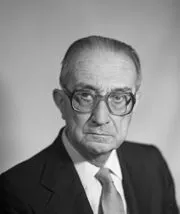
Giulio Carlo Argan
Human Design Chart
Biography
Giulio Carlo Argan died on 12 November 1992, aged 83, in Rome.
Giulio Carlo Argan as a Reflector 2/5 in Human Design
Reflector 2/5 — Design at a Glance
Giulio Carlo Argan's design did not establish a constant, inherent energy base. As a Reflector, he had undefined centers, making him a sensitive mirror of his environment. He perceived the energies of other people as well as natural rhythms such as seasons or astronomical constellations intensely and reflected them. This structure shaped his stance as a neutral observer who gained clarity through non-attachment rather than exhausting himself by identifying with his surroundings.
The mechanics of this type require waiting for a complete lunar cycle before making important decisions. This month is used to fully integrate and understand the changing influences from nature and environment. Giulio Carlo Argan followed this strategy of waiting. By not prematurely committing or getting entangled in identification, he created space for authentic answers to his situation.
Following this natural rhythm led him to find environments and people that suited him well. The reward for this patience was a joyful surprise about the course of events. Had he negotiated against his design and acted without waiting for the cycle, the result would have been deep, lasting disappointment – both in relation to himself as well as the state of the world. His path was thus characterized by the ability to respect the wisdom of time and the moon to remain in harmony with his own nature.
No Inner Authority
Giulio Carlo Argan's design tended not to create decisions from individual intuition or willpower, but through external resonance and the necessary time for evaluation. He did not have inner physical authority – a rare state that occurs among mental projectors (approximately 1.7% of humanity) when no centers below the Throat Center are defined. For him, decision-making ability primarily arose in exchange with others. Through energetic interactions in his open centers, dormant potentials were activated, allowing him to view and express issues from many perspectives. This high resonance capability helped him find the right environment and suitable conversation partners for this dialogue.
However, clarifying this complex information flow required withdrawal and time. Giulio Carlo Argan had to withdraw alone to recognize the red thread, filter out what was essential from a mass of data and structure it meaningfully. This process of information filtering was his capital success: developing specific intelligence that creates order. Additionally, it was crucial for him to stay in an environment where he felt comfortable and could exchange trustingly. Over time, this deepened his sense of what truly belonged to him and the significance of his insights.
The 2/5 Profile — Hermit / Heretic
Giulio Carlo Argan's design established a fundamental tension: between the deep inner need for withdrawal for self-exploration and the external expectation to function as spontaneous solutions or heroes. As someone with the profile 2/5, the natural talent and savior, he showed himself in a dynamic balance between hermit and hero roles. The line 2 demanded strategic alone time to gain clarity about his unique contribution – a process of self-preservation and integrity maintenance. Without this phase of withdrawal, there was the risk of wearing himself out through unreflective helpfulness.
At the same time, line 5 projected a signal for the environment: others sought solutions from him and saw him as an example or savior in crisis situations. This expectation conflicted with his need for isolation. Argan had to learn to be selective – carefully weighing where he invested his energy and set boundaries. His contribution was often unusual, marked by the natural talent of line 2, but not always recognized as a service to the collective. This could lead to frustration, especially when the transience of goals was ignored. The mechanics described here a dilemma: how does one remain authentic and intact while the environment continuously calls for the 'savior'? Argan's path lay in accepting this irony of expectations – that his value often only emerges through withdrawal but is effective only in public. He did not use solitude as an escape, but as a tool to sharpen his unique perspective before sharing it with others.
No Definition — Defined & Open Centers
Giulio Carlo Argan's design featured a completely open profile: All nine centers were undefined. This did not create an internal, constant energy source for identity, willpower, or emotional stability but shaped him into a pure resonance instrument of his environment. He absorbed inspiration (Head Center), concepts (Ajna), communication (Throat), identity and direction (G Center), ego and willpower (Heart Center), vital energy (Sacral), emotions (Solar Plexus), intuition and fear (Spleen) as well as stress pressure (Root).
Without defined centers, he lacked a firm, unchanging personality or a steady inner compass. Instead, he reflected situationally the entire spectrum of human experience. His challenge was to distinguish between this absorbed 'not-self' conditioning and his own truth. He tended to identify with foreign stress, ego, or emotions, which could lead to exhaustion if he tried to exert control over energies that were not his.
The open G Center meant that his identity and life direction were not internally prescribed but arose through initiation by others and the right place. He adapted to the energetic influences of his environment; at the wrong place or with the wrong people, he felt lost while flourishing at the correct location and amplifying the energy of others. The open Heart Center freed him from the need to prove willpower or keep promises to demonstrate value. Instead, he learned not to have to prove his worth.
The open Sacral and Solar Plexus Centers made him vulnerable to over-identification with foreign vitality and emotional waves. Health arose through letting go of these identifications and waiting for correct initiation rather than actively seeking answers or confirmation. His design allowed him to act as a mirror: open to new insights from all directions without connecting to them, and capable of exploring the mysteries of life by absorbing and transforming mental pressure from others instead of experiencing it as his own confusion.
Channels & Gates
Giulio Carlo Argan's design inclined towards individual promotion within collective structures. He was someone who drew attention through the expression form of his uniqueness and used this focus to make a concrete contribution for group goals. This attitude stemmed from Gate 8 of the Cross, the Gate of Contribution and Promotion. Here it was about individually stepping in and through empowerment causing a mutation that made him appear as a creative role model. The activation of this individuality was central to his identity.
This dynamic orientation was complemented by the skilled handling of power and direction as described by Gate 14. As one of the three gates of the individual process, this energy had a pulsating nature. It propelled the Sphinx Cross forward and ensured clear orientation. The mutation through Gate 14 initiated a navigation that required the influence of Gate 2. This was about accumulating and preserving power and wealth, always connected with grace and self-control. Giulio Carlo Argan had to learn to handle this force without misusing or succumbing to it.
Internally, recognizing feelings played an important role. Gate 30 linked to controlling the inner fire and the concept of the fate goddess initiating learning processes. The desire for positive emotions propelled his experiences forward while he simultaneously saw through illusions of great expectations. Freedom was recognized as a deception; instead, he accepted limitations as part of his destiny. Parallel to this, Gate 29 of the Sacral Center, the Gate of Saying Yes, worked. It emphasized the importance of persistence and life-affirming attitudes towards challenges. The reward for correct action came inevitably provided that he only said yes when it was true. False saying yes would have caused personal difficulties. This configuration shaped his way of dealing with inner impulses and external demands.
Circuit Signature
Giulio Carlo Argan's design exhibited a specific neutrality regarding structural connection patterns. There was no defined circuit activation, meaning there were no predefined energetic pathways that automatically connected certain centers. The absence of concrete circuits or streams indicated that his integration of energy flows was not determined by rigid mechanical rules. Instead, this level of his design remained open and flexible.
Without set channel or center activations in this area, Giulio Carlo Argan appeared as someone whose energetic landscape was neutral regarding these aspects. This created a space particularly receptive to external influences and individual experiences. The mechanics describe this not as a deficit but as freedom from preordained patterns. Where others had to experience certain themes or challenges through defined circuits, Giulio Carlo Argan remained unbound in this aspect. He could take on and process energies and impulses without a specific internal flow necessarily directing these processes. This openness allowed for adaptability that was not dependent on internal, fixed connection structures. His design offered no automated compass but an empty space filled by life itself. The lack of definition in the circuits underscored a fundamental impartiality towards specific energetic themes often prestructured through such connections. Giulio Carlo Argan lived this neutrality as potential for individual, non-mechanically prescribed development.
Right Angle Cross of Contagion 2
Giulio Carlo Argan's design revealed a profound, often unconscious ability to absorb the energy and mood of his surroundings. He was someone who intuitively put himself in other people's shoes, even identifying with their fate or emotions. This tendency towards emotional contagion was not mere coincidence but an expression of the right infection cross (Cross 514).
This configuration describes a high level of empathy and the inclination to internalize the essence of others. For Giulio Carlo Argan, this meant a constant danger: he could easily be infected by the feelings of his environment. The challenge was to maintain personal boundaries so as not to lose himself in the emotional world of others. Without this conscious separation, exhaustion and loss of identity were imminent.
The mechanics of this cross are a force of intuitive connection and empathy. It allowed Giulio Carlo Argan to sense connections that eluded others. Yet it required discipline. Only through the conscious direction of this energy could he manage the burden of constantly absorbing other states. His design marked him as a sensitive observer, whose strength lay in connection but also his weakness in the risk of over-identification with others. It was a dynamic that created deep understanding while demanding the preservation of self as a central life task.
Saturn Return · Uranus Opposition · Chiron Return · 2nd Saturn Return — Life Cycles
The provided data contains exclusively astrological transits and no Human Design mechanics such as Gates, Channels or Centers. Therefore, a character analysis based on the Human Design system is not possible. The raw content lists only standard events like the first Saturn return, Uranus opposition, Chiron return, and second Saturn return. Without specific HD configurations, no personalized characterization or mechanistic classification can be made. The requested structure, which demands a description derived from the chart, cannot be fulfilled due to missing necessary facts. Any assumption about Giulio Carlo Argan's design would be pure invention and violate strict analytical rules. Thus, the text remains devoid of substantive content regarding Human Design. No biographical details or external knowledge are added. The absence of HD data makes an output in the required format impossible without violating instructions for exclusive use of provided facts. Therefore, no further elaboration is given here.
Reflector · No Inner Authority — Synthesis
Giulio Carlo Argan lived a life marked by profound openness and resonance with his environment. As a Reflector, he perceived the energies of others and nature exceptionally intensely, without possessing an enduring internal energy source. This ability to reflect the world as a mirror required living in harmony with cycles—a waiting and observing to make authentic decisions. The combination of Profile Natural Talent/Hero (2/5) and undefined central centers like Head, Ajna, and G suggests he constantly moved between the need for withdrawal and the expectation to offer solutions. His strength lay in absorbing energies and reflecting them without being consumed by them—a role that enabled him to recognize patterns and open new perspectives.
Central to Argan was the tension field between his ability for deep resonance and the lack of an inner, defined authority. He perceived the world intensely, yet decisions had to be reflected over a longer period to avoid being overwhelmed by external influences. The activation of specific Gates in the infection cross (8, 14, 29, 30) points to dynamics where he could both contribute and find power and direction, always with an awareness of the cyclical nature of challenges and rewards. This interplay between openness and the quest for inner clarity shaped his life and work.
Incarnation Cross - Right Angle Cross of Contagion 2
Solar Return
The Solar Return shows the moment when the sun returns to its exact birth position - your personal solar year.
Life Cycles
Discover the life cycles with a detailed triple view (birth chart, cycle chart, composite).
Human Design Profile
- Type
- Reflector
- Strategy
- Wait a lunar cycle (approx. 28 days)
- Authority
- No inner authority - learn more
- Profile
- 2/5 - Hermit / Heretic
- Definition
- No Definition
- Incarnation Cross
- Right Angle Cross of Contagion 2
- Date of Birth
- 17.05.1909 22:22
- Place of Birth
- Torino, Italy
Frequently Asked Questions
What was Giulio Carlo Argan's Human Design type?
What Profile did Giulio Carlo Argan have?
Which Authority guided Giulio Carlo Argan?
What incarnation cross did Giulio Carlo Argan have?
When was Giulio Carlo Argan born?
Discover your own Human Design
Are you also a Reflector? Find out in a personal reading how to find the right environment and understand your unique mirror effect.
More Personalities
Back to overviewBaekhyun

Jihyo

Laurent-Eynac
Starhawk
Jan Simon van der Aa
Rune Aanderaa