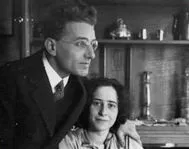
Günther Anders
Human Design Chart
Biography
From 1929 to 1937 he was married to Hannah Arendt. He died in Vienna on 17 December 1992 at age 90.
Günther Anders as a Generator 5/1 in Human Design
Generator 5/1 — Design at a Glance
Günther Anders had enormous and enduring sacral energy, making him seem like a strong workhorse. His design indicated that his strength was not in initiating actions but rather in responding to external impulses. The central strategy for him was “React instead of Initiate.” Satisfaction and deep fulfillment came only when he listened to inner signals - that feeling as if the sacral center is calling out: “Yes! Let’s get started!” - followed by action.
Two main pitfalls marked his energetic profile. First, wasting energy on tasks without internal desire, which for Generators can lead to burnout despite high potential. Second, holding back from heart projects even when full power was available. If Günther Anders lived against this design and constantly tried to initiate, he encountered persistent frustration and energy deficiency. In harmony with his nature, however, through reactive action from the gut, no one could stop him. His energy served to materialize things in life, but this process worked effectively only as a response to life signals, not as an independent drive.
Sacral Authority
Günther Anders' decision-making was characterized by direct physical resonance. As a Generator, he possessed sacral authority, meaning his inner voice resided not in the head but in the gut. This configuration allowed him to react immediately to external stimuli - often with grunts, hums, or a palpable surge of energy. His design indicated that he felt vital and energized as soon as his sacral motor kicked in. In these moments, he acted with great enthusiasm and immersed himself fully in his tasks, driven by joy and satisfaction rather than external purpose.
This mechanism fundamentally differed from intellectual planning. The energy arose only through the correct reaction to the stimulus, not through prior contemplation. With his open Emotional Center, he could clearly perceive these physical signals as the sole legitimate source for action impulses. His strategy was to wait until this inner “Yes” or “No” impulse came. This simplified his process significantly, as he wasn't torn between conflicting internal voices. Instead, he followed the direct instruction of his body, enabling him to navigate life efficiently and satisfyingly without overburdening himself or taking wrong paths.
The 5/1 Profile — Heretic / Investigator
Günther Anders was someone who combined an inner drive for research with the public role of a problem solver. His design created tension between private knowledge gathering and public expectations. As a 5/1 profile, he had almost magnetic qualities that made others want to use his knowledge trove to solve their own problems. This attraction could quickly lead to overload if clear boundaries were not set.
Line 1 in the profile represented the process of learning and storing experiences. Günther Anders lived the urge to take on new projects and master challenges to build up knowledge. Simultaneously, Line 5 acted as a Hero aspect: others sought answers from him, much like an expert at a conference. Without protective mechanisms, he risked being drained by unbridled demand.
The key was learning to say “No”. Only then could he maintain the balance between private accumulation and public availability. The symbol of Earth for grounding showed that new beginnings had to be pragmatic to avoid failures. By setting boundaries, he preserved his strength rather than losing it through constant availability. This allowed him to optimally use his gifts without sacrificing himself.
Single Definition — Defined & Open Centers
Günther Anders's design showed a tendency towards constant, vital energy that was only usable through reaction rather than initiation. His defined Sacral Center generated a daily fixed supply of power which manifested as a real buzzing or restlessness. This energy was available exclusively for activities to which he responded with a clear 'yes'; any mental decision that suppressed this sacral response led to frustration and exhaustion. The strategy involved letting life come to him and then acting only when the Sacral Center answered.
This motor was supported by his defined Spleen Center, which stood for momentary intuition and health. It provided spontaneous judgments in the present that could not be rationalized but had to be trusted to gain well-being. Additionally, his defined Root Pressure ensured he maintained the life impulse and dealt with stress in the material world.
In contrast, Head, Ajna, Throat, G Center, Heart, and Solar Plexus were open. These centers did not have their own constant identity or willpower but reflected the environment. Günther Anders tended to question whether he was inspiring enough or who would love him - thought patterns of non-self in the open centers. He had no consistent sense of direction (open G) or willpower (open Heart), instead absorbing these traits from others. Emotions in his open Solar Plexus were often not his own, but amplified foreign moods that he perceived as a barometer. Through trust in his sacral and spleen authority, he could use this reflection without losing himself or trying to gain control over the unpredictable through initiation.
Channels for change, care, ambition and maturation.
Günther Anders exhibited a dynamic tension between the urge for evolutionary change and the necessity of fully ripening experiences. His design was marked by two format channels setting a pulsating frequency for cyclical patterns. The Channel of Mutation 60-3 connected the Root Center with the Sacral Center through the Gate of Limitation (60) and the Gate of Order (3). This generated potential for evolutionary change dependent on accepting limitation and moving beyond the confusion of a new beginning. This energy was unpredictable, melancholic, and adrenalized; it permeated his way of living out his design and deeply conditioned all those around him.
Parallel to this, the Channel of Ripening 53-42 also between Root and Sacral, connecting the Gate of Beginnings (53) with the Gate of Growth (42). This channel demanded a full cycle of new experiences followed by reflection to gain wisdom. Günther Anders had to bring experiences to satisfying conclusions before starting anew; otherwise, he fell into repetitive patterns. These abstract experiential processes created a collective history from which humanity learned.
The social dimension of his design was determined by the Channel of Transformation 54-32 connecting the Root Center with the Spleen Center. Through the Gate of Ambition (54) and the Gate of Continuity (32), there arose a drive to rise through constant effort and improve one's position in life. This ambition was driven by fear of failure and the desire for recognition from the tribe.
Simultaneously, the Channel of Preservation 27-50 provided balance. It connected the Sacral Center with the Spleen Center through the Gate of Care (27) and the Gate of Values (50). This gave him the ability to preserve tribal values and take responsibility for others. His aura automatically attracted trust, yet he had to learn to offer support only when it aligned with his sacral response. This combination of mutative pulse, ambitious transformation, and nurturing preservation shaped his unique mechanical expression form.
Tribal Circuitry — Circuit Signature
Günther Anders's design linked life force with survival instinct and emotional memory. The Knowledge Circuit activated the Channel of Mutation (3-60), directly connecting Sacral and Root Centers. This promoted the urge to transform new knowledge and initiate change. Parallel, the Meaning Circuit worked through the Ripening Channel (42-53) also between Sacral and Root Centers. It directed energy towards reflecting on the past and finding meaning in past experiences. Both circuits created a tension: innovations from the field of knowledge had to ripen through an emotional cycle of meaning-finding before stabilizing.
Additionally, two more circuits shaped his inner self. The Ego Circuit utilized the Transformation Channel (32-54), connecting Spleen and Root Centers. This involved intuitive perception of what was relevant for survival or community, as well as resource exchange. The Archer Circuit activated the Preservation Channel (27-50) between Sacral and Spleen Centers. Here it was about instinctive protection, care, and preserving essentials - energies securing continuity.
Since all these centers lay in a single group, energy flowed continuously between life force (Sacral), pressure/survival (Root), and intuition/memory (Spleen). Günther Anders showed himself as someone who not only generated new impulses but filtered them through emotional ripening and instinctive scrutiny. The connection of mutation and preservation created a process where innovation was always linked with questions about meaning and protection.
Left Angle Cross of Cycles 1
Günther Anders' design carried the structure of the Left Cross of Cycles 1. This configuration formed an architectural framework within his Human Design chart, but it did not define any specific content or character tendency. Since no descriptive mechanics were provided for this particular cross constellation in the raw data, its concrete impact on his experience remains undefined. The left cross of cycles 1 primarily served as a structural background. It offered a geometric foundation without deriving behavioral patterns, emotional states, or strategic imperatives from it. Anders was not marked by this specific configuration; it was part of his energetic architecture but remained neutral and unspecific in its effect. Without further mechanical assignment, this element could not formulate a clear life task or challenge. It stood as pure scaffolding that framed other defined parts of his design without playing an active role in the sense of a comprehensible human experience. The absence of description here does not mean emptiness but rather the impossibility of deriving a valid characterization from this isolated structure. Günther Anders lived with this undefined framework, which did not impose specific demands on his actions or being.
Saturn Return · Uranus Opposition · Chiron Return · 2nd Saturn Return — Life Cycles
Günther Anders' design structured his life through clear phase endings marked by Saturn returns. The first return around the 27th year often condensed years of preparatory work into tangible results. This was evident in 1929: Günther Stern married Hannah Arendt. This partnership was a central milestone that solidified his personal development during this phase and created a new life foundation.
The Chiron return around the 48th to 50th year of life served as an achievement cycle, in which one's incarnation task unfolds increasingly and becomes experientially meaningful – provided strategy and authority are observed. For Günther Anders, this turning point occurred in 1950 with his permanent return to Europe, particularly Vienna. This step marked not only a geographical change but the anchoring in a new life phase where his personal purpose became clearer and guiding.
The second Saturn return around the 45th to 46th year further deepened this structuring by reviewing existing structures and often leading to a reorientation. For Günther Anders, this was evident in 1958 when he visited Hiroshima and Nagasaki on the anniversary of the atomic bomb drops. This visit underscored the intensity of his engagement with the consequences of technological developments and solidified his intellectual position during this period. The Saturn cycles thus not only marked temporal segments but gave his life a recognizable, densifying form.
Generator · Sacral Authority — Synthesis
Günther Anders' design reveals a deep, fundamental orientation towards reaction and cyclic experience. As a Generator with sacral authority, he was destined to react to impulses from life and release energy through action – a process strengthened by the connection of his defined Sacral, Root, and Spleen centers. This configuration points to someone capable of approaching themes with great endurance as long as they are carried by inner resonance. His profile as Hero/Researcher (5/1) underscores this inclination: he was destined to accumulate deep knowledge and make it available to others, focusing on the processes of learning and problem-solving. The connection between sacral energy and investigative curiosity suggests that his work was not only intellectually motivated but also arose from a deep need to engage with pressing questions of his time and find answers beyond mere thinking.
Central to Anders' design is an apparent paradox: his ability to gain profound insights and recognize complex connections (fostered by open centers) stood in tension with the necessity to react to external impulses and not get lost in initiatives. The open centers pointed to a high sensitivity towards the environment and others' needs, while the defined Sacral center urged him to selectively invest energy and focus on tasks that truly resonate. This field of tension between openness and focus shaped his path by forcing him constantly to consult his inner authority and adapt to life's changing demands – a process likely both inspiring and challenging.
4 Defined Channels
Incarnation Cross - Left Angle Cross of Cycles 1
Solar Return
The Solar Return shows the moment when the sun returns to its exact birth position - your personal solar year.
Life Cycles
Discover the life cycles with a detailed triple view (birth chart, cycle chart, composite).
Human Design Profile
- Type
- Generator
- Strategy
- To respond - wait for something to respond to
- Authority
- Sacral Authority
- Profile
- 5/1 - Heretic / Investigator
- Definition
- Single Definition
- Incarnation Cross
- Left Angle Cross of Cycles 1
- Date of Birth
- 12.07.1902 10:15
- Place of Birth
- Breslau, Germany
Frequently Asked Questions
What was Günther Anders' Human Design type?
Which Profile did Günther Anders have?
Which Authority guided Günther Anders?
What incarnation cross did Günther Anders have?
When was Günther Anders born?
Discover your own Human Design
Are you also a Generator? Find out in a personal reading how to use your sacral energy correctly and discover deep satisfaction.
More Personalities
Back to overviewAaliyah

Alexia

Angèle

Anne-Marie

Arcángel

Arno