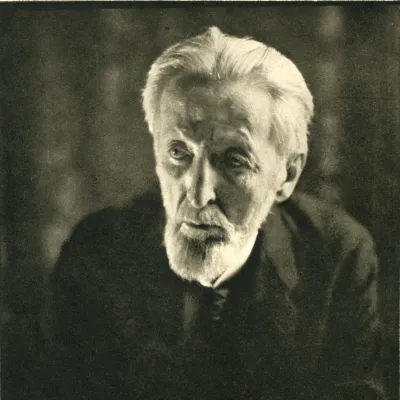
Hans Horst Meyer
Human Design Chart
Biography
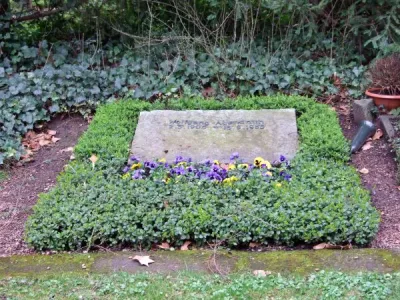
He died on 6 October 1939, aged 86, in Vienna, Austria.
Human Design Analysis: Hans Horst Meyer as Reflector 5/1
Reflector 5/1 — Design at a Glance
Hans Horst Meyer revealed himself as someone whose inner experience was strongly influenced by his interaction with the environment. His Human Design chart showed no defined centers, meaning he did not have constant, personal energy sources. Instead, Hans Horst Meyer acted as a mirror of humanity: He perceived the energy of his surroundings and the rhythms of nature – such as seasons or planetary constellations – particularly intensely and reflected them.
This configuration required a specific lifestyle to align with his design. It was important for him not to make crucial decisions impulsively but to wait at least one month, thus completing a lunar cycle. This strategy allowed him to automatically find people and environments that suited him well. When Hans Horst Meyer followed this approach and let himself be guided by his inner authority, he could observe freely without attachment. As a reward for doing so, he experienced a feeling of joyful surprise.
If he lived against this design, however, deep, lasting disappointment would arise – both regarding himself and the state of the world. His essence thus did not lie in a fixed, unchanging structure but in his ability to reflect various energies of his time and environment appropriately.
No Inner Authority
Hans Horst Meyer had no inner authority – a rare configuration that marked him either as a mental projector or reflector. This structure meant he could not rely on a fixed internal compass but gained orientation through external interactions. As a projector, energetic exchange processes with other people activated latent potentials in his open centers. This dialogue allowed him to view issues from multiple perspectives and filter information. However, evaluating this complex data required time and withdrawal into solitude to distinguish the essential from the non-essential and develop his specific intelligence. As a reflector, his decision-making was closely tied to the lunar cycle. He needed about 28 days for the moon to traverse his complete body graph and reveal reliable conditioning patterns. This rhythm gave him orientation over his essence and adapted to environments. In both cases, it was crucial that he remained in an environment that brought him well-being. There he met suitable people for trustworthy exchanges. Over time, this process deepened his sense of what was right for him and belonged to him. He learned not to be forced into decisions under pressure but to independently recognize the thread in a mass of information and structure it meaningfully.
The 5/1 Profile — Heretic / Investigator
Hans Horst Meyer's design inclined him towards acting as a hero who used profound knowledge to offer practical solutions during crises. As a 5/1 (Researcher), he possessed the magnetic quality that made people seek his insights. However, this often worked to his own disadvantage when clear boundaries were not set; similar to a scientist finding their mailbox full of inquiries at the end of a draining day.
His line 5 through Gate 36 conveyed the ability to provide life-saving practical answers during crises. This line stood for perfected survival through experience but could also lead to nervousness and self-destructive behavior if he convinced himself of things that were not true. On the other hand, his line 1 at Gate 10 showed humility and adaptability. Here it was important to accept one's place in a hierarchy. Attempts from outside to change his behavior triggered over-sensitive reactions.
The challenge for Hans Horst Meyer lay in learning to say 'no'. Only then could he maintain the balance between researching for himself (line 1) and problem-solving for others (line 5). Without this boundary, he risked being exhausted by constant demands from his environment rather than using his gifts optimally and sustainably. His path involved protecting the depth of his knowledge instead of distributing it uncontrollably.
No Definition — Defined & Open Centers
Hans Horst Meyer appeared as a person without fixed energetic or mental constants, since his design did not include any defined centers. This complete openness shaped an extreme sensitivity to the environment. His open Head Center and Ajna Center lacked consistent inspiration; he tended to engage with foreign questions and sought answers that were not his own, often leading to mental confusion. The open G Center meant a lack of stable identity; he adapted to others and searched for love and direction through external initiations rather than inner certainty. His open Heart Center drove him to prove his worth through promises, which ended in cycles of self-doubt when these could not be kept. The open Sacral Center allowed him to absorb and amplify foreign energy; he tended towards overexertion as he lacked natural limits for his vitality. His open Solar Plexus absorbed the emotions of others, leading to emotional instability if he interpreted them as his own. The open Spleen Center generated deep survival anxiety; he sought safety in others and avoided spontaneous decisions out of fear of making false steps. Finally, his open Root Center took on environmental stress, resulting in a feeling of uncontrollable pressure from which he often tried to escape through hectic activity rather than finding calm.
Channels & Gates
Hans Horst Meyer appeared as someone who did not see crises merely as an end but as necessary ground for new experiences. His design showed a tendency to experience emotional darkening to gain developmental potential from it. This happened via Gate 36, which symbolizes the darkening of light and releases strong emotional energy. The decline here was synonymous with crisis – an impersonal, cyclical process with beginning, middle, and end that paved the way for new things.
This inner dynamic met the basic friction of Gate 6, the engine for further development. Without this emotional impulse, no growth was possible. Hans Horst Meyer regulated his openness or closure through the biological BH value of this gate, which controls six different emotional waves in the context of fertility.
Parallel to this, Gate 10 functioned as a complex element in the G Center. It fed into the integration process and supported it based on personal convictions. As the dominant profile gate, it shaped his life through genetically predetermined behaviors that ensured survival – right behavior at the right time.
Another aspect was Gate 15, which represented collective behavior and established logical structures in societies. Here modesty showed through adaptation to natural rhythms. This gate contributed to the Magnetic Monopoly and could be found in all forms of life.
Together these gates formed a pattern: Hans Horst Meyer navigated between personal crisis (Gate 36) and emotional friction (Gate 6), while orienting himself through integrative convictions (Gate 10) and collective logic (Gate 15). His path was characterized by the ability to draw new experiences from dark phases and embed them in social structures.
Circuit Signature
Hans Horst Meyer appeared as someone who managed without a fixed inner structure. His design was completely undefined – no centers were connected through channels, there were no groups or circuits. This did not mean he was empty or passive; rather, his system was open to all possible energies. He functioned as a mirror of his environment: What met him, he took in, reflected it and let it pass on again. Since there were no fixed connections between his centers, he could take on any role that life demanded of him. He had no predefined topics or unchanging character traits guiding his actions. Instead, he responded flexibly to the context at hand. This total openness allowed him to immerse himself in various situations and experience their energies without prejudice. Hans Horst Meyer was a recipient of the world around him, free from inner constraints or fixed patterns. His experience of life was characterized by this constant adaptability and the ability to embrace the here and now without being limited by past imprints or fixed identities. He lived as an open system that could take in the full breadth of human experiences.
Left Angle Cross of the Plane 1
Hans Horst Meyer lived with an inner discipline aimed at making the unconscious conscious. His design was marked by the left cross of Level 1, a configuration that brings deep psychological patterns to light. This structure fostered a strong desire for self-reflection and the analysis of one's emotional triggers. Hans Horst Meyer emerged as someone who not only acted but questioned his motivations to appear authentic.
The mechanics of this cross require becoming aware of unconscious drivers. Those entering this level must learn to distinguish between conditioned reactions and true will. For Hans Horst Meyer, this meant a constant process of inner clarification. He sought the hidden reasons for his actions to free himself from old patterns. This work required patience and honesty with oneself.
His path involved integrating the shadows of his personality rather than denying them. Through continuous self-observation, he gained internal stability and clarity. Hans Horst Meyer used his insights to shape his interactions with the world more consciously. He understood that true freedom arises only through knowledge of one's own limits. His life approach was characterized by a striving for psychological integrity and the ability to be transparent about himself.
Saturn Return · Uranus Opposition · Chiron Return · 2nd Saturn Return — Life Cycles
Hans Horst Meyer's design indicated a tendency towards structural anchoring, evident in clear career steps. In 1881, at age 28, he received his habilitation and appointment to a chair in Dorpat. This marked his first Saturn return, a cycle that condenses years of groundwork into solid results and strengthens professional foundations.
The mechanics of his design also promoted adaptability to new environments. In 1895, at age 42, he established new labs in Marburg. This step fell on the Uranus opposition, often favoring structural renewal and transitioning to modern working conditions.
Around the Chiron return around age 50 is a fulfillment cycle where one's inner purpose increasingly unfolds. Hans Horst Meyer experienced this in 1904 with his appointment to the chair in Vienna at age 51. Here, the bloom of his work was evident as his life mission became fully tangible in a professional context.
Finally, further Saturn returns shaped his later career through additional responsibility. In 1913, at age 60, he took over the presidency of the German Society for Natural Scientists and Physicians. This second Saturn return confirmed previously established structures and gave his position final recognition within his professional community.
Reflector · No Inner Authority — Synthesis
Hans Horst Meyer was a Reflector whose life was marked by a special openness to the energies of his environment. Without defined centers, he perceived the world as a mirror, reacting to natural cycles and the energy of other people. This ability to reflect the surroundings combined with the Profile of Hero/Researcher (5/1), creating an ongoing quest for knowledge – not to hoard it but to offer solutions and make them accessible to others. The repeated professional successes tied to specific cycles (habilitation, new labs, appointment) pointed to a deep resonance with temporal currents he as a Reflector particularly strongly perceived and utilized in his work.
A central paradox lay in the lack of inner authority alongside an extensive knowledge base. As a Reflector, Meyer relied on external impulses for decision-making, yet his profile indicated a profound internal source of information and problem-solving skills. This combination likely led to a constant tension between the need for external validation and the ability to think and act independently – a dance between adapting to the environment and the drive to share knowledge.
Incarnation Cross - Left Angle Cross of the Plane 1
Solar Return
The Solar Return shows the moment when the sun returns to its exact birth position - your personal solar year.
Life Cycles
Discover the life cycles with a detailed triple view (birth chart, cycle chart, composite).
Human Design Profile
- Type
- Reflector
- Strategy
- Wait a lunar cycle (approx. 28 days)
- Authority
- No inner authority - learn more
- Profile
- 5/1 - Heretic / Investigator
- Definition
- No Definition
- Incarnation Cross
- Left Angle Cross of the Plane 1
- Date of Birth
- 17.03.1853 18:00
- Place of Birth
- Chernyakhovsk, Russia
Frequently Asked Questions
What was Hans Horst Meyer's Human Design type?
What profile did Hans Horst Meyer have in Human Design?
What authority did Hans Horst Meyer have?
What incarnation cross did Hans Horst Meyer have?
When was Hans Horst Meyer born?
Discover your own Human Design
Are you also a Reflector? Find out in a personal reading how to find the right environment and understand your unique mirror effect.
More Personalities
Back to overviewBaekhyun

Jihyo

Nadar
Rune Aanderaa

George Abell

Wolfgang Abendroth