
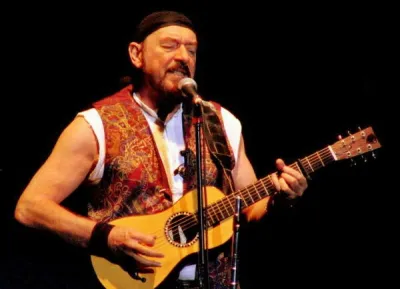
Photo: Wikimedia Commons
Ian Scott Anderson
Human Design Chart
Biography
Ian Scott Anderson as a Manifesting Generator 4/6 in Human Design
Manifesting Generator 4/6 — Design at a Glance
Ian Scott Anderson's design presents a hybrid nature: the connection of constant sacral energy with the ability for quick, step-skipping action. As an Manifestor Generator, he possessed the stamina of a Generator but could also swiftly draw things into his life by skipping steps. This speed carries risks: often, important steps were skipped too quickly, necessitating backtracking and catch-up work—a potential source of frustration for this type's non-self theme. Additionally, the design tended to pursue multiple things at once, driven by many different impulses.
The strategy was not to initiate but to react to life. Only when his sacral center responded with a clear "yes" and his inner authority agreed should he proceed. Regularly checking on started projects ensured they continued to resonate. When this process was followed, Ian Scott Anderson drew deep satisfaction from his work. Working simultaneously on different projects then became no hindrance but rather beneficial. The advice to finish one thing before starting the next did not fit his mechanics. Instead, his true creative power emerged in "play mode," characterized by variety and fun. Balancing high speed with waiting for inner impulses was crucial to avoid frustration from rushed or inauthentic action.
Sacral Authority
Ian Scott Anderson's design inclined him towards immediate, physical decision-making. Instead of intellectually analyzing situations, he responded to external stimuli through direct physical signals such as a grunt, an "mmh," or a palpable surge of energy. This mechanism is specific to Sacral Authority, which only occurs in the Generator type and whose strategy of responsiveness aligns with inner authority. This significantly simplified his decision-making process, provided that his emotional center remained open.
When Ian Scott Anderson's sacral motor engaged with something, he felt vital and alive. He seemed to have inexhaustible energy and tackled tasks with great enthusiasm, completely free from obsessive purposefulness. His design saw him born to go through life joyfully and immerse himself in his activities.
Additionally, the Spleen Center acted as a supportive instance for Sacral Authority. This gave him the ability to react particularly quickly and spontaneously. He had direct access to his physical well-being and instinctive perception, which he could reliably follow. The distinction between this genuine energy response and intellectual compulsion was central: Only the resonating response led to the desired vitality.
The 4/6 Profile — Opportunist / Role Model
Ian Scott Anderson's design sets a tendency towards an internal tension: between the deep emotional need for belonging and the detached desire for overview. In his first thirty years, before Saturn returned, Line 6 of his Profile (4/6) still acted like Line 3; he enjoyed experimenting in relationships and friendships frequently. Once Line 6 became active, a contradiction often appeared: the wish to belong to a community (Line 4) stood against the desire to be high on a mountain contemplating the meaning of life (Line 6). His life revolved around this conflict between Heart and Head.
In later years, it was expected that he would meet the demands of a wise role model and stand out through cooperation. His authority was always dependent on external recognition: influence existed only as long as the community accepted him; upon rejection, he had to step back. The great heart of Line 4 cautiously opened up to avoid injuries. Line 6 brought with it the need for security and rationalization while trying to maintain an overview of the entire picture – a task that was often difficult. Mutation was either accepted or rejected, which represented a crucial decision.
Single Definition — Defined & Open Centers
Ian Scott Anderson's Human Design indicates a tendency towards stable identity and constant mental structure, supported by reliable communication channels. His energy source was reactive: He had to wait to respond powerfully rather than taking initiative. These defined centers created a consistent internal architecture – clear self-perception (G Center), steady thinking (Ajna) and dependable expression (Throat). At the same time, the open nature of other centers required protection from external conditioning through emotions, stress or will pressure.
The defined G Center gave him a firm sense of self-identity and a feeling of lovability without dependency on others. His defined Ajna allowed for steady, specific thinking that was not easily influenced by outside forces. The connection to the Throat enabled him to clearly express his thoughts. The defined Sacral Center generated constant vital energy, but it could only be used correctly through reactive waiting; any initiative led to frustration and exhaustion.
In contrast, his Head Center was open, making him vulnerable to mental pressure and confusion when trying to find answers to questions that were not his own. His open Heart Center lacked consistent willpower, leading him to want to prove his worth by making promises, often ending in self-doubt. The open Solar Plexus absorbed foreign emotions, potentially causing emotional instability if he did not recognize them as non-self. Additionally, his Spleen Center was open, bringing a basic survival fear and tendency towards conditioning by others, along with the Root Center, which amplified external stress. These opennesses required conscious distance from foreign energies to protect the internal stability of defined centers.
Channels for inspiring leadership, powerful execution and clear structure.
Ian Scott Anderson's Human Design indicates a tendency towards logical, collective leadership that relies less on autocracy than on representative influence. This attitude was primarily shaped by Channel of the Alpha 7-31: Gate 7 provided the strategic role and understanding of existing patterns, while Gate 31 supplied the voice of a leader who could guide the collective into the future. However, the success of this mechanism essentially depended on an invitation from a like-minded 'pack'; without this recognition, potential remained untapped.
This leadership structure was complemented by Channel of Inspiration 1-8, which radiated a transformative perspective through creative example. This wasn't about verbal persuasion but attracting attention through authentic living and inspiring others to unfold their uniqueness. Channel of the Beat 14-2 supported this with the ability to materialize innovative directions; Gate 14 ensured resource competence while Gate 2 channeled higher knowledge to advance changes in life's pulse.
Deeper reflective processes were served by Channel of the Lost Son 13-33. Gate 13 collected experiences and secrets that Gate 33 processed into retreat places before sharing as mature wisdom – a process requiring patience. Dynamics in expression came from Channel of Charisma 34-20, where sacral energy (Gate 34) was directly translated into immediate action (Gate 20), provided it resonated internally. Intellectual structuring occurred through Channel of Structuring 43-23: Gate 43 received spontaneous insights that Gate 23 assimilated and clearly articulated to enhance efficiency.
Individual Gates like Gate 56 (pictorial storytelling) or Gate 12 (emotional poetry) colored these processes abstractly and poetically, while Gate 42 in the design focused on closing processes to enable new commitments.
Individual Circuitry — Circuit Signature
Ian Scott Anderson's Human Design indicates a tendency towards pulsating, acoustic creativity driven by emotional waves. The Knowledge Circuit connected his Ajna, Throat, Identity and Sacral Centers directly. This allowed for the expression of unique identity: innovative flashes (Channel 20-57) and inspiration (Channel 1-8) flowed through the emotional wave of Solar Plexus into the Throat Center to initiate transformation. Structuring (Channel 43-23) gave this process form.
Alongside this creative dynamism, a focused visual logic emerged in the Understanding Circuit. Here Channel of 'Alpha' (31-7) directly connected Throat and Identity Centers. This energy aimed at rational future design free from Solar Plexus emotions to share logical insights strategically.
Parallel to this, the Meaning Finding Circuit worked cyclically and emotionally. Channel 'The Lost Son' (33-13) also directly linked Throat and Identity Centers. This energy reflected on past experiences to find their meaning and share these felt understandings with the collective – in contrast to the future-oriented rationality of the Understanding Circuit.
Integration ensured survival through charisma. The Channel of Charisma (20-34) connected Throat and Sacral Centers directly. This allowed drawing strength from reacting to life and making it acoustically effective in the present. As Ian Scott Anderson had a Simple Definition, all these centers formed an interconnected energetic flow without separate segments.
Right Angle Cross of the Sphinx 3
Ian Scott Anderson's design points towards a deep, often unconscious imprinting by maternal influence and early female role models. This configuration suggests that this imprinting is experienced more as an internal protective or defining force shaping self-image and emotional foundation.
The right cross of the Sphinx 3 describes exactly this dynamic: It concerns the investigation of the relationship with the mother or primary female figures in childhood. These early experiences significantly shape the current understanding of safety, care, and feminine energy. This is a kind of inner 'programming' that may unconsciously guide Ian Scott Anderson.
The challenge lies in decoding these early patterns. By understanding how these initial bonds shaped his perception of security, he can recognize where certain emotional reactions or safety needs originate from. It's less about conscious choice than a deeply rooted structure determining his experience of closeness and protection. Through this self-reflection, it becomes clear how much the early environment has marked his emotional landscape – not as a flaw but as a fundamental basis for his inner world.
Saturn Return · Uranus Opposition · Chiron Return · 2nd Saturn Return — Life Cycles
Ian Scott Anderson's design tends towards cyclical redefinition, with return phases expressing internal maturation. This pattern was evident in his career structure: In 1995 at age 48, he released his second solo work 'Divinities – Twelve Dances With God'. This marked the Chiron return, a fulfillment cycle where his incarnation cross unfolds increasingly. Living according to his strategy and authority here means experiencing purpose as tangible reality; it's not about healing old wounds but blooming into one’s life task. Anderson's publication served as evidence of how this energetic opening enabled artistic redefinition.
The structure repeated with reinforced consistency: In 2003 at age 56, his fourth solo album 'Rupi’s Dance' was released. This coincided with the second Saturn return, a phase where years of groundwork and structural decisions condense into sustainable results. While the Chiron period emphasized purpose, the Saturn time solidified the foundation of this new artistic identity. Both events underscore how Anderson's design favors rhythmic deepening over linear progress: first the unfolding of purpose, then anchoring the insights gained in a stable form.
Manifesting Generator · Sacral Authority — Synthesis
Ian Scott Anderson navigates life through a dynamic interplay between inner drive and need for external validation. His design as an Manifesting Generator paired with sacral authority points to someone whose energy arises from reaction – constantly responding to life rather than initiating it. This responsiveness is amplified by the definition in the G Center, suggesting a deep internal direction and identity that can only fully unfold when carried by sacral energy. The connection of creativity (Gate 1) and leadership (Gate 31), along with the ability for structuring (Channel 23-43), shows someone who potentially develops innovative ideas and communicates them effectively – provided he finds the right rhythm between inner drive and external resonance.
The central paradox in Ian Scott Anderson's chart lies in the tension between a desire for individuality (G Center) and openness to external influences (undefined centers). While the defined G Center provides clear direction, open centers make him receptive to others' energies. This constellation requires constant balancing between his inner compass and environmental demands, potentially leading to a search for authenticity within an ever-changing context. The ability to draw inner wisdom from this openness and use it constructively seems key to his well-being and fulfillment.
6 Defined Channels
Incarnation Cross - Right Angle Cross of the Sphinx 3
Solar Return
The Solar Return shows the moment when the sun returns to its exact birth position - your personal solar year.
Life Cycles
Discover the life cycles with a detailed triple view (birth chart, cycle chart, composite).
Human Design Profile
- Strategy
- To respond - wait for something to respond to
- Authority
- Sacral Authority
- Profile
- 4/6 - Opportunist / Role Model
- Definition
- Single Definition
- Incarnation Cross
- Right Angle Cross of the Sphinx 3
- Date of Birth
- 10.08.1947 07:30
- Place of Birth
- Dunfermline, United Kingdom
Frequently Asked Questions
What is Ian Scott Anderson's Human Design type?
What are Ian Scott Anderson's Profiles in Human Design?
What authority does Ian Scott Anderson have?
What incarnation cross does Ian Scott Anderson have?
When was Ian Scott Anderson born?
Discover your own Human Design
Are you also a Manifesting Generator? Find out in a personal reading how to unfold your multi-talents and direct your energy wisely.
More Personalities
Back to overviewAaliyah

Aldair

Alexia

Alizée

Angèle

Angeli
