
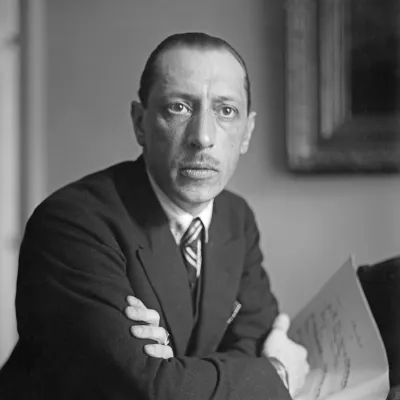
Igor Stravinsky
Human Design Chart
Biography
Stravinsky led a privileged childhood, spending much of his youth on the vast estates of his aristocratic relatives. His father was a Russian opera singer who raised his son to be educated for the law. Music was young Igor's avocation until he met Rimsy-Korsakov in 1902, and began to study music formally with him in 1907. One year later his first symphony was performed. His prodigious ability was brought to the attention of Russian impresario Sergei Diaghilev of the Ballet Russe, who commissioned the young composer to write ballet scores. Dropping his law books forever, Stravinsky became an overnight sensation when his famous ballet "Firebird," was performed in 1910. When the avant-garde ballet "The Rite of Spring," choreographed by Nijinsky, was first performed in Paris three years later, riotous protests broke out in what Stravinsky later called "the battle of May 29, 1913." The following year the work was performed by a symphony orchestra and was recognized as a landmark and masterpiece of modern music.
Only seven years prior he had decided on a career in music.
Igor Stravinsky as a Manifesting Generator 4/6 in Human Design
Manifesting Generator 4/6 — Design at a Glance
Igor Stravinsky revealed himself as a Hybrid being that combined the lightning-fast impact of a Manifestor with the constant energy source of a Generator. His design allowed him to skip steps and quickly bring results into life. However, this ability carries risks: Often he acted too quickly, neglected necessary intermediate steps, and later had to return to fill in gaps – a process that caused frustration. Additionally, he tended to pursue multiple projects simultaneously, which led to overload without inner alignment.
The solution lay in his strategy: He responded to impulses rather than initiating himself. Only when his Sacral Center gave a clear "yes" and his inner authority agreed did he invest his energy. Regular checks ensured that enthusiasm persisted. Under these conditions, Stravinsky found deep satisfaction in creation. The advice to finish things one at a time did not suit him; instead, he thrived in the "play mode". Variety and parallel handling of different tasks were not disturbances but rather the source of his creativity and joy of life. His speed became a service when it was directed through reaction rather than initiation.
Emotional Authority
Igor Stravinsky's design suggests a tendency to avoid making decisions based on the initial impulse and instead allows them to pass through the filter of time and shifting emotions. Spontaneous reactions were often unreliable for him; instead, he showed a need for detachment to gain clarity. This attitude stemmed from his emotional authority. The defined Emotional Center carried this inner guidance, meaning that his perception of the world was always marked by a constant wave of presence and absence. At one moment, he could show total enthusiasm, while in the next, he might negatively evaluate the same situation. His immediate feeling was just a snapshot, not necessarily the deeper truth. Quick decisions from this emotional state therefore risked negative consequences. Instead, his system required patience: He had to "sleep on" decisions to go through the process. Over time, intense feelings subsided, an emotional distance emerged, and calmness set in. Only then had he gone through the decision-making process and could take a clear, lasting direction. This was especially true for long-term choices that significantly influenced his life course. Emotional authority always took precedence over other defined centers; it determined the pace and quality of his inner consent, regardless of other energetic factors in his chart.
The 4/6 Profile — Opportunist / Role Model
Igor Stravinsky's design sets a life dynamics centered around the inner conflict between Heart (Line 4) and Head (Line 6). In his first half of life, before Saturn’s return, his energy was experimental and searching. During this phase he appeared like Line 3, trying out relationships and friendships and longing for belonging.
With the activation of Line 6, however, tension arose between the desire for community and the need for distance as well as meaning-making. This profile defined a development towards the role of wise role model in later years. For that, the "big heart" of Line 4 had to learn to be cautious so as not to open up to false people and avoid getting hurt. Line 6 brought freedom from expectations and justice; crises were seen as corrections from pure feelings, not as means to an end.
The fourth line carried the task of passing on mutations and removing blockages. As a prophet, Igor Stravinsky needed the right mood to convincingly spread his message and recognize the right moment. At the same time, Line 6 looked beyond mere meaning-making towards innocence. His life was marked by the necessity to reconcile these two poles – the emotional network and distant wisdom – in order to serve others through cooperation and role model function.
Single Definition — Defined & Open Centers
Igor Stravinsky was characterized by a fully defined energy system that provided him with a constant inner structure. His design was marked by permanent availability of sacral energy, emotional depth, and firm identity. The defined Sacral Center generated daily vital power, but this could only be accessed through appropriate reactions to external impulses; initiatives without invitations led to exhaustion. As an emotional authority, his Solar Plexus Center demanded patience: truths revealed themselves only at the end of the emotional wave, not in impulsive moments.
Mentally, Stravinsky was under constant pressure from defined Head and Ajna Centers to ask questions and develop concepts. Since these centers did not drive engines, he could not implement these inspirations directly; they served as impulses for others or required waiting for the right timing. His defined Throat Center allowed him to reliably express these thoughts and bring them into the world. The defined G Center gave him a clear, unchanging identity and direction, while the defined Root Center provided the necessary pressure for physical survival and progress.
In contrast, his open centers revealed areas of conditioning. His open Heart Center tended towards uncertainty about self-worth and the temptation to make promises to gain admiration – a trap he had to avoid by trusting in his authority. The open Spleen Center made him vulnerable to existential fears and the urge for spontaneous decisions to calm down; true intuition developed here only through long-term observation and deconditioning from external influences. Stravinsky's challenge lay in integrating mental pressure with sacral reaction, always guided by the emotional clarity of his authority.
Channels for powerful, logical and emotional self-expression.
Igor Stravinsky was characterized by a paradoxical basic attitude: the power of restraint. His design focused on pausing and emotional clarity, which acted as an inner 'stop' mechanism. This quality stood in tension with the pressing impulse of his surrounding channels, which sought mutation and expression. Only through this conscious pause did his mutative poetry become effective.
This field of tension drew from several mechanical streams. The Beat channel 14-2 connected the Sacral Center to the G Center. It offered resources for innovation and new directions by linking material focus with higher knowledge for living. Simultaneously, the Logic channel 63-4 between Head and Ajna Centers filtered patterns through healthy doubt to ensure only consistent structures were accepted – a process that excluded unfounded belief.
The organization of these insights occurred via the Accepting channel 17-62. It connected Ajna with Throat Center and translated visual opinions into detailed language, allowing precise mental structuring before communication. In contrast, the Charisma channel 34-20 from Sacral to Throat Center generated a strong urge for immediate manifestation through sacral reaction, often appearing restless and making it difficult to sit still.
Emotionally marked was Igor Stravinsky by the Transience channel 36-35. This connected Solar Plexus with Throat Center and sought new experiences, sometimes even creating crises to instigate movement. The underlying mood was determined by the Feelings channel 39-55. It linked Root with Solar Plexus Center and set the pulsating wave between joy and melancholy in motion, using provocation as a means to evoke the right spirit within oneself and others.
The Sun in Gate 12 functioned as a central regulator. As a Stop Codon, it demanded restraint in the face of temptations from other channels. It reminded that true creativity and emotional depth often matured only in silence before they could enter the world.
Individual Circuitry — Circuit Signature
Igor Stravinsky was marked by a tension between pulsating creativity and focused logic. His design connected all defined centers into one group, leading to an integrated yet complex energy flow. The Knowledge Circuit drove him to follow his unique path. Here two separate segments were at work: On one hand, the Beat channel linked Identity with Sacral Center, creating rhythmic acoustic expression. On the other hand, the Emotions Freezing channel connected Solar Plexus with Root Center, translating emotional waves directly into physical reaction. This promoted individual transformation and melancholy as a driving force.
Simultaneously, the Understanding Circuit dominated an emotionless rationality. The Logic channel linked Head-, Ajna- and Throat Centers while Accepting stabilized this structure. Here it was about strategic insight and vision for a better future, free from emotional coloring. This clear visual logic contrasted with the pulsating creativity of the Knowledge Circuit.
The Meaning Finding Circuit complemented this through cyclical reflection on the past. The Transience channel connected Throat- and Solar Plexus Centers. Igor Stravinsky emotionally and wave-like reflected past experiences to learn together with others from them. This emotional processing from the Solar Plexus worked abatingly and cyclically, in contrast to the future-oriented logic of understanding.
Finally, the Integration channel Charisma secured survival. It connected Throat- and Sacral Centers, making power effective through proper behavior and reaction to life in the present moment. This gave him high individuality and the ability to make his energy acoustically and present. The combination of rhythmic identity, clear logic, emotional past reflection, and charismatic presence shaped his specific energetic profile.
Right Angle Cross of Eden 2
Igor Stravinsky lived with the deep inner conviction that his own existence and work only made sense when it seamlessly integrated into a higher plan or collective vision. His design indicated that he did not act as an isolated individual but rather as an instrument for something greater. This attitude stemmed from the configuration of the right cross of Eden 2. This archetypal channel connected spiritual intuition with practical service to a higher order. It was not about passive submission, but active identification as part of a transcendent whole. Here, individual independence took a back seat to serving this vision. Stravinsky felt called upon by this mechanism to direct his talents and energies into the flow of a tradition or larger goal. His life was marked by the search for this seamless integration with the transpersonal. The energy of this cross demanded a dedication that dissolved personal egoism and instead placed the connection to the whole at the center. This created an existential foundation where actions were only felt as right when they served this higher structure. Thus, his path became a continuous process of integrating and participating in something far beyond his personal biography.
Saturn Return · Uranus Opposition · Chiron Return · 2nd Saturn Return — Life Cycles
Igor Stravinsky's design indicates a tendency to use existential cycles as catalysts for artistic maturation and biographical turning points. His path was marked by moments when planetary influences carried inner developments outward. In 1923, at the age of 41, his Uranus opposition became active. This cycle often marks a phase of sudden change and liberation from the past. For Stravinsky, this crystallized in the performance of "Les Noces," where his wife illustrated the text with watercolors. The event underscored the uranian dynamics: a creative breakthrough that emerged through new perspectives and unexpected connections.
Later, in 1939 at the age of 57, he experienced his second Saturn return. This cycle demands confrontation with structure, responsibility, and the limits of life. Stravinsky encountered this in the crisis of his first wife Jekaterina Nossenko's death. The Saturn influence manifested not merely as loss but as a profound upheaval of personal foundations. Both cycles – the expansive Uranus phase and the condensing Saturn period – shaped his biography decisively. They showed how his Human Design was geared towards translating external events into deep inner transformations, with each cycle requiring a specific quality of maturation.
Manifesting Generator · Emotional Authority — Synthesis
Igor Strawinsky lived a life marked by profound inner dynamics. His design as a Manifesting Generator (MG) with defined sacral energy and emotional authority points to someone who was driven to act – often quickly and unconventionally – but always required an internal maturation process to make decisions. This combination of rapid reaction and emotional processing created continuity in his work: constant experimentation with new forms and expressions (fuelled by the defined Head Center), followed by a phase of reflection and refinement before embarking on new paths again. The Profile as Networker/Role Model reinforced this trait, positioning him as an innovator and mediator between tradition and modernity.
Central to Strawinsky's life was a paradox between the desire for connection and the urge towards individuality. Line 4 in the profile indicates a longing to be part of a community and find value through relationships, while Line 6 felt called to stand out from the crowd and chart a unique path. This tension manifested in phases of intense collaboration (documented by an event in 1923) and simultaneous withdrawal for self-discovery. Emotional authority required time to process these inner conflicts, while sacral energy continually propelled him to explore new creative paths – a dance between heart and head that shaped his entire body of work.
6 Defined Channels
Incarnation Cross - Right Angle Cross of Eden 2
Solar Return
The Solar Return shows the moment when the sun returns to its exact birth position - your personal solar year.
Life Cycles
Discover the life cycles with a detailed triple view (birth chart, cycle chart, composite).
Human Design Profile
- Strategy
- To respond - wait for something to respond to
- Authority
- Emotional Authority
- Profile
- 4/6 - Opportunist / Role Model
- Definition
- Single Definition
- Incarnation Cross
- Right Angle Cross of Eden 2
- Date of Birth
- 17.06.1882 12:00
- Place of Birth
- Oranienbaum, Russia
Frequently Asked Questions
What was Igor Stravinsky's Human Design type?
What Profile did Igor Stravinsky have in Human Design?
Which Authority guided Igor Stravinsky?
What incarnation cross did Igor Stravinsky have?
When was Igor Stravinsky born?
Discover your own Human Design
Are you also a Manifesting Generator? Find out in a personal reading how to unfold your multi-talents and direct your energy wisely.
More Personalities
Back to overviewAaliyah

Aldair

Alexia

Alizée

Angèle

Angeli
