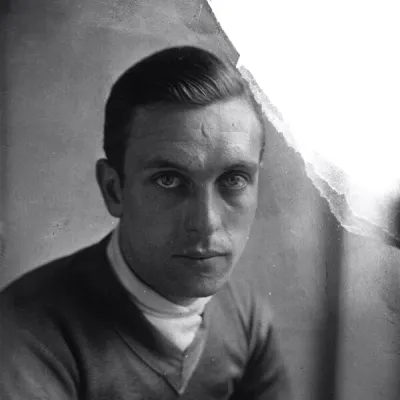
Jean Aerts
Human Design Chart
Biography
In 1927 professional and amateur riders rode concurrently at the Nürburgring in Germany and Aerts finished 5th, the highest ranked amateur. He also competed in three events at the 1928 Summer Olympics.
Although he lacked climbing ability for major tours, he used his sprinting ability to win 11 stages of the Tour de France, including six in 1933.
He died on 15 June 1992 in Bruges, Belgium, aged 84.
Human Design Analysis: Jean Aerts as Reflector 4/1
Reflector 4/1 — Design at a Glance
Jean Aerts revealed through his Human Design as someone without constant, inherent energies. His design did not have defined centers, which made him function like a mirror for humanity. He perceived the energy of his surroundings – from people and nature such as seasons or astronomical constellations – particularly intensely and reflected it.
This mechanism required a specific lifestyle: The strategy of the Reflector was to wait at least one moon cycle, about a month, before making important decisions. This served to live in harmony with natural cycles. If Jean Aerts followed this strategy and trusted his inner authority, he automatically found suitable environments and people. In this state, he lived free from attachment and identification, observed the world neutrally, and was rewarded with a feeling of joyful surprise.
If he lived against this design, it resulted in deep, lasting disappointment. This affected either his own self-image or the general condition of the world. His chart thus suggested that his satisfaction and clarity directly depended on whether he had the necessary patience to wait for the moon cycle to clearly reflect changing influences from his environment rather than getting entangled in them.
No Inner Authority
Jean Aerts did not have inner authority – a rare configuration that fundamentally shaped his decision-making process. Instead of relying on physical signals, he sought answers through dialogue with others. As a mental projector, he used his open centers as resonance bodies: In exchange, dormant potentials were activated, allowing him to view and express issues from many perspectives. This high resonance ability helped him find the right environment and conversation partners.
The actual clarification happened in silence. Jean Aerts needed time alone to structure the collected information. Only during this distance could he recognize what made sense and belonged to him. Thus, he developed his specific intelligence: filtering out the essential from many voices and organizing it meaningfully. This was his capital for success.
A key factor for him lay in being in an environment where he felt comfortable. There he met people with whom a trusting exchange was possible. Over time, this process deepened his sense of what was right for him. His development thus did not occur through inner commands but through the conscious filtering of external impressions and the necessary peace for internal condensation.
The 4/1 Profile — Opportunist / Investigator
Jean Aerts revealed through his firmly anchored Profile 4/1 as someone whose essence hardly deviated from his individual path. This rare Network Researcher profile marks the transition from 'I' to 'You', where traits are deeply rooted and do not change. His fourth line gave him a large but cautious heart. When others offered well-meaning impulses for change, he quickly dismissed them to protect himself. Externally, this often appeared as stubbornness or inability to accept criticism, which could undermine his self-confidence. Yet Jean Aerts was stable within himself and became the rock in the storm.
His mechanics were based on Gate 64 (Line 4), bringing inner certainty about the meaning of experiences and resolving confusion through clarity. He sought the right network and trusted that friendliness would enable connections. At the same time, Gate 45 (Line 1) influenced him, allowing natural attraction through voice promotion. Jupiter in elevation promoted coming together through instruction and education. For Jean Aerts, it was crucial that his actions were beneficial for the entire community. Good education allowed him to use these skills effectively. Thus, he could greatly instruct others and secure financial success for his tribe by passing on knowledge and maintaining networks where certainty rather than confusion reigned.
No Definition — Defined & Open Centers
Jean Aerts had a design without a single defined energy source, making him a pure mirror of his environment. Without a constant inner truth in identity, will or emotions, he absorbed the fields of others and amplified them. This led to the typical trap of open Head and Ajna centers: trying to resolve mental confusion through endless thinking rather than acting as a calm observer. He tended to question whether he was inspiring enough or had the right answers instead of recognizing that his mind was an open window for ideas.
His undefined G center meant a lack of stable identity; he did not actively seek direction but waited to be led to the right place where his role would naturally reveal itself. The open Heart Center made him vulnerable to the pressure to prove his worth through promises rather than trusting in inner authority. In the open Sacral Center, there was no constant life energy; by taking on foreign workloads he risked exhaustion instead of respecting his fluctuating energies and taking breaks.
The open Solar Plexus Center allowed him to take up and personalize emotions from the environment, often leading to avoiding confrontation to maintain stability. His undefined Spleen Center carried a deep survival fear; he tended to cling to insecure bonds that gave a false sense of well-being rather than following his intuition for health. Finally, the open Root Center absorbed external stress, which could push him into cycles of hyperactivity to rid himself of foreign pressure. The wisdom of his design lay in using these open centers not as deficits but as potentials for reflection and adaptability guided by strategy and inner authority rather than conditioned reactions.
Channels & Gates
Jean Aerts was someone who understood mental clarity not as a static state, but as the result of an intensive internal process. His design tended to shape precise concepts in Ajna center out of past experiences processed visually and abstractly from confusion. This mechanism was driven by Channel 63-64: Gate 63 acted as the motor of doubt, urging understanding and resolving uncertain patterns while Gate 64 transformed this energy into interpreting time and experience. For Jean Aerts, the transition from doubt to clarity was not a passive process but an active mental pressure necessary for making correct decisions.
Alongside this cognitive structure, other energies worked on tribal level. Gate 45 represented pure possession power and material life in him, fueled by Heart center. It expressed willpower and stood for a royal hierarchy where the attraction of like forces was beneficial to the whole tribe. Additionally, Gate 26 in Heart center showed a weak ego closely connected with the immune system. This configuration allowed Jean Aerts to accept innovations despite conservative tendencies and convince the tribe to prevent genetic retardation. As a typical carrier of this gate, he needed rest pauses to focus on perception and give himself over. The combination of the urging doubt from Gate 63, the clarifying abstraction from Gate 64 along with tribal willpower from Gate 45 and innovative adaptability from Gate 26 shaped his way of positioning in social structures and gaining mental security through resolving old patterns.
Circuit Signature
Jean Aerts showed a design that did not have any specific circuit-defined energetic structure. His system was not divided into fixed patterns between centers that would impose a certain role or predetermined flow. Instead, his energy remained dynamic and unbound by such rigid connections.
This state resulted from the fact that Jean Aerts had no defined circuits. In Human Design mechanics, lack of definition in this area does not imply a deficit or gap in terms of weakness but signals the absence of a specific 'circuit type' that would preform behavior or fixate a dominant energetic channel. Without these connecting structures between centers, there was no automated cyclical pressure to channel energy along a certain path.
The power of this design lay in its freedom from prescribed paths. Jean Aerts was not bound by recurring experiences determined by circuits. His energetic landscape was open for individual situational reactions that did not stem from a fixed internal wiring system. This allowed him to flexibly adapt to immediate circumstances without being guided by an internal mechanical script. Energy did not flow in a set pattern between centers but remained fluid and adaptable. This configuration emphasized the autonomy of reaction in the moment, unswayed by long-term energetic habits or constraints established through circuits.
Juxtaposition Cross of Confusion
Jean Aerts' design carried the imprint of the Juxtaposition Cross of Confusion. This configuration established a foundational structure characterized by apparent contradictions and internal tensions. For Jean Aerts, this meant that his inner compass was not aligned with simple clarity or linear confirmation. Instead, it revealed a pattern where opposing impulses coexisted side by side, often leading to uncertainty.
The mechanics of this cross describe a process of orientation-seeking amidst dualities. It is not about chaos in the destructive sense but rather the necessity to develop order from seemingly incompatible poles. Jean Aerts' chart indicated that he frequently had to grapple with questions where the answers were not obvious or constantly shifting. This structure promoted a stance of reflection, as quick conclusions often seemed misleading.
The challenge lay in interpreting this confusion not as weakness but as an integral part of his perceptual world. Through the Juxtaposition Cross, Jean Aerts was compelled to delve deeper into the nuances of his own experiences to seek stability beyond initial impressions. It was a path of inner differentiation where clarity did not come from outside but grew through engagement with his own contradictions.
Saturn Return · Uranus Opposition · Chiron Return · 2nd Saturn Return — Life Cycles
Jean Aerts showed in his design a clear tendency towards maturation through structural discipline and long-term endurance. His first Saturn return marked a decisive turning point, at which years of groundwork condensed and reinforced his life mission. This cycle promoted not only inner stability but also external confirmation through concrete achievements.
In 1935, at the age of 28, Jean Aerts won the world championship title among professionals and secured first place as well as a gold medal in the UCI Road World Championships. For his design, this was a typical moment: The Saturn return as a phase of maturation, where internal stances shaped into sustainable results. This success underscored his ability to achieve goals through consistent action and perseverance.
The transformative power of the Saturn return manifested in Jean Aerts by not only recognizing but also practically implementing his life mission. Through this process, his inner structure was strengthened, which helped him face challenges with clarity and determination. The success of 1935 was thus no coincidence but the result of a conscious development fostered by the Saturn return.
Reflector · No Inner Authority — Synthesis
Jean Aerts' life was marked by profound openness to the energy of his environment. As a Reflector with fully undefined centers, he perceived the world intensely, reflected it back, and lived in harmony with natural cycles. This ability to absorb the surroundings led to a life without a fixed inner compass but also to a special sensitivity for other people's energies – a quality that served him well in certain contexts (as evidenced by his success in 1935). The combination of the Profile of Networker/Researcher and the Cross of Confusion points to a person whose intrinsic nature was deeply rooted, yet simultaneously developed a complex inner landscape through constant absorption of external influences.
Central to Jean Aerts' design is a paradox between deep connection and lack of internal definition. He was geared towards connecting with others and reflecting their energies (open centers), while also lacking his own consistent energy source. This tension manifested in the necessity to weigh decisions over an extended period (Moon cycle) and in the constant interplay between adapting to the environment and finding a personal direction. The undefined centers intensified tendencies toward fear and insecurity, while Gate 63 revealed a drive for clarification and improvement of uncertain patterns.
Incarnation Cross - Juxtaposition Cross of Confusion
Solar Return
The Solar Return shows the moment when the sun returns to its exact birth position - your personal solar year.
Life Cycles
Discover the life cycles with a detailed triple view (birth chart, cycle chart, composite).
Human Design Profile
- Type
- Reflector
- Strategy
- Wait a lunar cycle (approx. 28 days)
- Authority
- No inner authority - learn more
- Profile
- 4/1 - Opportunist / Investigator
- Definition
- No Definition
- Incarnation Cross
- Juxtaposition Cross of Confusion
- Date of Birth
- 08.09.1907 23:00
- Place of Birth
- Laeken, Belgium
Frequently Asked Questions
What was Jean Aerts' Human Design type?
What profile did Jean Aerts have?
What authority did Jean Aerts have?
What incarnation cross did Jean Aerts have?
When was Jean Aerts born?
Discover your own Human Design
Are you also a Reflector? Find out in a personal reading how to find the right environment and understand your unique mirror effect.
More Personalities
Back to overviewAldair

Baekhyun

Cafu

Jihyo

Joelinton

Kaká