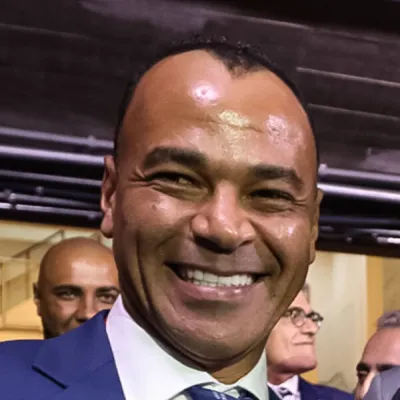
Cafu
Human Design Chart
Biography
At club level, Cafu won several domestic and international titles while playing in Brazil, Spain, and Italy; he is best known for his spells at São Paulo, Roma, and AC Milan, teams with which he made history, although he also played for Zaragoza, Juventude, and Palmeiras throughout his career. In 1994, Cafu was crowned South American Footballer of the Year, and in 2004, was named by Pelé in the FIFA 100 list of the world's greatest living players. He was additionally named to the FIFPro World XI in 2005, and in 2020 was included in the Ballon d'Or Dream Team.
Cafu represented his nation in four FIFA World Cups between 1994 and 2006, and is the only player in history to have appeared in three World Cup finals, both overall and consecutive, winning the 1994 and 2002 editions of the tournament, the latter as his team's captain where he lifted the World Cup trophy. With Brazil, he also took part in four editions of the Copa América, winning the title twice, in 1997 and 1999; he was also a member of the national side that won the 1997 FIFA Confederations Cup.
Cafu and his ex-wife Regina Feliciano had three children together, two sons (Danilo and Wellington) and a daughter (Michelle). On 4 September 2019, Danilo suffered a heart attack and died.
The Human Design of Cafu: Generator 6/2
Generator 6/2 — Design at a Glance
Cafus design showed a tendency towards high endurance, which however only became effective through reactions to external impulses and not through his own initiatives. As a Generator, he possessed strong sacral power – comparable to a powerful workhorse – that could only be used efficiently when responding to signals from life. The central mechanism of his design was the motto „Do not initiate, but react“. When Cafu acted impulsively, i.e., if his sacral center signaled a clear „Yes“, he entered a state of deep fulfillment and satisfaction.
This energy flow stood in stark contrast to two specific pitfalls. First, there was the risk of burnout when he continuously performed tasks that did not resonate internally; here, his intrinsic creative power was wasted. Second, frustration and lack of energy arose if he was prevented from pursuing his heart project despite still being full of power. If a Generator does not live by this reactive principle, he encounters persistent frustration. Cafus path to effectiveness consisted in waiting for the signal and then responding through action. Only in harmony with this design could nothing stop him, as the sacral energy only became free through this reactive stance.
Emotional Authority
Cafu showed decision-making that required time and emotional distance from the current mood. His design suggested that spontaneous reactions were risky; clarity emerged only after „sleeping on it“ and calming emotional waves. This resulted from his Emotional Authority: Whenever the Emotional Center is activated, it functions as an inner authority, regardless of which other centers are defined. Cafu was subject to a permanent wave of emotions – up and down. The world appeared colored by his current mood – sometimes enthusiastic, sometimes negative. His immediate feeling, however, was only a snapshot, not necessarily the truth. Quick decisions based on this emotion could have negative consequences. Through patience and „ripening“ of decisions over several days, Cafu could gain deeper insight. This process required him to hesitate and ask multiple times. Over time, intense feelings subsided, emotional distance gained strength, and calmness set in. Only then was the process complete. This mechanism was particularly relevant for long-term decisions that significantly influenced his life path. Emotional Authority thus did not demand immediate action but rather going through a cyclical clarification process to see through illusions caused by transient moods and reach the true inner truth.
The 6/2 Profile — Role Model / Hermit
Cafus design showed a clear developmental arc: from an early life marked by active experimentation and collecting diverse experiences, to a later phase of deep introspection and wide distance. Before his 30th year, the energy of Line 3 in Profile 6/2 dominated him. This meant that his path was determined through trial and error – a process of testing where mistakes served as necessary teachers for gaining life wisdom.
Around thirty years later, this dynamic fundamentally changed. Line 6 from Gate 35 became active. This configuration describes the transition from external action to internal withdrawal. Cafu showed a tendency to metaphorically retreat into a „cave“ – a state of isolation and intense reflection. Here he processed not only cognitively but on a deep, healing level the experiences gathered earlier. This withdrawal served self-knowledge and correction of earlier patterns.
The result of this process is wisdom that becomes visible for others. Line 6 functions as a role model: When Cafu emerged from this phase of distance, he carried an authenticity within him that attracted others. People sought his advice or presence to learn from his ability for deep introspection. The earlier „behavioral school“ of Gate 22, which often placed style over essence, gave way to this later depth gained through experience and correction. His design thus shows that true authority is not imposed but arises from the integration of youthful experiments and mature reflection.
Triple Split Definition — Defined & Open Centers
Cafu showed himself as a closed, autonomous unit with constant presence in all life areas. His design was fully defined, meaning he had no situational dependency on his environment and possessed a fixed inner rhythm. This structure shaped a person who clearly drew their own boundaries and did not rely on external validation.
The heart of this configuration formed the defined Sacral Center (status: defined), providing constant vitality. Cafu had a reliable energy source, which however only became accessible through correct reactions. Parallel to this, the defined Solar Plexus Center (status: defined) acted as an inner authority. Decisions matured in him not at the moment of impulse but after going through the emotional wave. This combination ensured that energy and emotional clarity were inseparably connected.
Further defining elements were the defined G-Center (status: defined) for a stable identity and direction, as well as the defined Heart Center (status: defined), enabling willpower and control over his own resources. Mental structure through Head and Ajna Centers, as well as intuition via Spleen Center, was firmly anchored.
In contrast stood open centers that exposed him to certain environmental factors. The open Throat Center (status: open) tended towards tension when Cafu tried to force attention or control the timing of his communication. Instead, his open throat naturally attracted attention if he waited. Similarly, the open Root Center (status: open) absorbed external stress and adrenalized pressure from the environment. Rather than succumbing to this foreign impulse and falling into hyperactivity, the mechanism was designed to recognize this as an external phenomenon and not misinterpret it as personal drive. These open centers demanded that he not resist the natural flow of his defined energy sources.
Channels for rhythm, care, community and mental clarity.
Cafus design showed a tendency towards powerful, mutative energy manifesting through constant rhythm stability. This configuration linked the Sacral Center with the G-Center and created an aura that brought others into their own direction or natural life flow without actively seeking it.
Beat 14-2 functioned as his individual tantric channel. It combined Gate 14, the key holder for material resources for mutation, with Gate 2 of higher knowledge. This connection allowed Cafu to bring innovative new directions and transform mutative impulses into material reality by simply trusting reactions from his sacral center. As a catalyst for the collective, he brought critical new perspectives that challenged the status quo and spurred further development.
Parallel to this, Rhythm 5-15 acted as a pillar of biological life processes. This channel linked Gate 5 of fixed rhythms with Gate 15 of extremes. It bound Cafu closely to the flow of the natural world and gave him a sense of timing determined solely by his inner rhythm. Through this electromagnetic connection, he magnetically drew others into his energy flow and set the course for groups by bringing them into their own rhythm and correct timing.
Additionally, juxtapositioned channels shaped his environment. Conservation 27-50 linked the Sacral Center with the Spleen through Gate 27 of care and Gate 50 of values, creating an aura that automatically attracted trust and support for the tribe. Community 37-40 connected Solar Plexus and Heart via Gate 37 of friendship and Gate 40 of solitude, thereby building bridges between individuals and waiting for emotional clarity in agreements.
In his design, Abstraction 64-47 acted as mental power filtering experience through a kaleidoscope of images. Through Gate 64 of confusion and Gate 47 of understanding, Cafus mind sought stories and perspectives to extract meaning from chaos, even if this process was often associated with mental unrest.
Collective Circuitry — Circuit Signature
Cafu moved in three parallel, non-directly connected energy fields. This arose from his triple definition: The groups were energetically isolated from each other but acted as equally powerful force fields.
The Knowledge and Understanding Circuit linked Cafus Identity Center with the Sacral Center. Here a pulsating acoustic energy was at work. The channel „Beat“ (2-14) promoted the expression of his individuality through rhythmic creativity, while the channel „Rhythm“ (15-5) connected logical strategies and future-oriented visions with this life force. It was about sharing insights both emotionally and rationally always in the present moment.
Parallel to this existed the Meaning Circuit linking Head and Ajna Centers. The channel „Abstraction“ (64-47) directed attention towards past experiences. Here a cyclical visual reflection took place: Emotions from the Solar Plexus were not directly included, but it was about understanding connections and learning from history free of immediate emotional coloring.
The third group consisted of tribe-related circuits Ego and Archer. In the Ego Circuit, the channel „Community“ (37-40) linked Heart and Solar Plexus Centers. This regulated giving and taking as well as cooperation without direct connection to sacral energy, necessitating rest periods. Simultaneously in the Archer Circuit, the channel „Conservation“ (27-50) secured the link between Sacral and Spleen Centers. This primordial energy served for genetic protection, care, and survival of the tribe through instinctive preservation.
Cafus design thus showed a separation of individual expression form (Knowledge/Understanding), intellectual reflection (Meaning), and tribal responsibility (Ego/Archer).
Left Angle Cross of Separation 1
Cafu displayed an underlying stance oriented towards clear delineation and inner self-determination. His design suggested that he did not define himself through external expectations but developed his own authentic standpoint. This tendency towards differentiation is known in Human Design as the left cross of separation.
This configuration connects the power of the inner compass with the ability for objective perception. It involves a process of breaking free from collective or familial frames. Cafu had to learn not to take projections of others onto himself but rather draw a clear line between his own essence and what was attributed to him externally.
The mechanism here describes a path towards individual identity. Through personal experience and inner knowledge, he discovered who he truly is – independent of external definitions. It was an ongoing process of self-discovery where it mattered to distinguish the voice of „I“ from that of „Not-I“. This inner clarity allowed him not to fall into roles others had planned for him but to walk his own path. The tension between inner knowledge and outer reality served as a catalyst for this development towards an independent personality.
Saturn Return · Uranus Opposition · Chiron Return — Life Cycles
Cafu showed himself as someone whose life structure was marked by clear phases of arrival and radical upheaval. His design tended toward positioning in defined cycles and later consciously dissolving old structures. This became concrete with his first Saturn return: 1995, at age 25, Cafu made his debut for Real Saragossa. In Human Design mechanics, this cycle often marks the transition from searching to stable professional anchoring; here his groundwork condensed into a solid European start.
The second defining turning point came with the Uranus opposition, a phase in design signifying deep changes and ending outdated patterns. 2009, at age 39, Cafu ended his career definitively. This event illustrates the mechanics of the Uranus opposition: It forces letting go of previous identities or roles to make space for new ones. For Cafu, this meant not only stepping down from sports but the sharpest cut in his professional biography. The sequence of these two astrological turning points – first building through Saturn, then dissolving through Uranus – defines the architecture of his life phases. It shows how his design guides him to lay foundations initially and later courageously leave behind what no longer serves.
Generator · Emotional Authority — Synthesis
Cafu navigates his life through a deep inner dynamic fueled by the combination of a defined sacral essence with strong emotional authority and a defining left cross. His energy source lies in the constant flow of the Sacral Center (Design), which drives him to react to impulses and shape through action. This reactive power, however, is modulated by the emotional wave (Authority) that brings clarity only after a phase of reflection. The left cross intensifies this tendency towards inner confrontation and weighing, giving him a deep ability to process experiences and draw wisdom from them – a process further fueled by the connection between Head and Ajna Centers (Centers). Thus emerges a life marked by a constant interplay between impulsive energy and careful evaluation.
Cafu seems caught in a central paradox: He is both a powerful Generator, destined for action, as well as someone who goes through deep emotional processes that require time and reflection. The Sacral Center urges him to immediate reaction (Design), while the Solar Plexus Center compels him to wait and gain clarity (Authority). This tension between the desire for immediate activity and the necessity of emotional maturity shapes his decisions and life path. He is a person who not only has the energy to set things in motion but also possesses the ability to deeply reflect on their consequences.
5 Defined Channels
Incarnation Cross - Left Angle Cross of Separation 1
Solar Return
The Solar Return shows the moment when the sun returns to its exact birth position - your personal solar year.
Life Cycles
Discover the life cycles with a detailed triple view (birth chart, cycle chart, composite).
Human Design Profile
- Type
- Generator
- Strategy
- To respond - wait for something to respond to
- Authority
- Emotional Authority
- Profile
- 6/2 - Role Model / Hermit
- Definition
- Triple Split
- Incarnation Cross
- Left Angle Cross of Separation 1
- Date of Birth
- 07.06.1970 14:30
- Place of Birth
- São Paulo, Brazil
Frequently Asked Questions
What Human Design Type is Cafu?
What Profile does Cafu have in Human Design?
What Authority guides Cafu in Human Design?
What Incarnation Cross does Cafu have in Human Design?
When was Cafu born?
Discover your own Human Design
Are you also a Generator? Find out in a personal reading how to use your sacral energy correctly and discover deep satisfaction.
More Personalities
Back to overviewAaliyah

Aldair

Alexia

Angèle

Anne-Marie

Arcángel