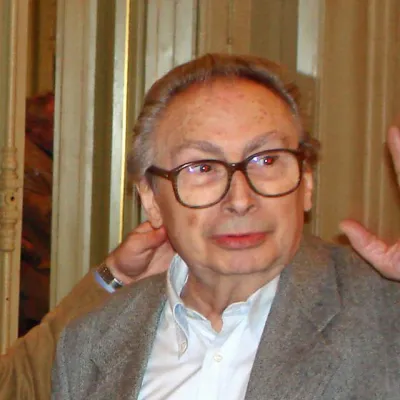
Jean-Charles Tacchella
Human Design Chart
Biography
Jean-Charles Tacchella died on 29 August 2024 at age 98 in Versailles, Yvelines.
The Human Design of Jean-Charles Tacchella: Reflector 2/4
Reflector 2/4 — Design at a Glance
Jean-Charles Tacchella's Human Design configuration showed a tendency towards extreme adaptability, as he lacked defined centers as a Reflector and thus had no constant, inherent energies. He appeared less as a fixed entity and more as a mirror of his environment. This setup meant that he perceived and reflected the energy of his surroundings – whether from other people or natural cycles like seasons and planetary constellations – particularly intensely.
For him, it was essential to live in harmony with these natural rhythms. His strategy involved waiting at least a month, a complete lunar cycle, before making important decisions. Through this patience, he automatically found people and environments that suited him. Living according to this guideline allowed him to observe the world without attachment and was rewarded with a sense of joyful surprise.
However, when he deviated from his design, a deep, persistent disappointment emerged. This disappointment was directed both at himself and the general state of the world. His internal state thus did not depend on a stable, personal identity but on how well he reflected the changing energies of his environment and whether he created the necessary space for this perception through waiting.
No Inner Authority
Jean-Charles Tacchella's Human Design showed a rare configuration: the absence of an internal, physical authority. This meant he did not have a fixed internal source for decisions, unlike other types. Instead, his nature was revealed through a high resonance in his open centers. In interaction with others, dormant potentials were activated, allowing him to view issues from numerous perspectives and express them diversely. This openness served as a tool to find the right environment and conversation partners for this necessary dialogue.
The evaluation of the collected information was a complex process requiring time and withdrawal. Only in silence could he discern the thread, separate meaningful content from irrelevant, and structure his specific knowledge. This ability to filter the essential from a mass of data formed his capital of success. A central aspect of his design was the need to be in an environment where he felt comfortable. There, in a trusting exchange with the right people, his sense of what was right deepened. His decision-making thus did not rely on inner firmness but on the qualitative processing of external impulses and the creation of a protective framework for this reflection.
The 2/4 Profile — Hermit / Opportunist
Jean-Charles Tacchella's Human Design showed a tendency towards a constant alternation between the need for withdrawal and the desire for community. He was someone who created a safe, loving environment to communicate clearly when he sought company and when he wanted to be alone. This dynamic stemmed from his Profile 2/4, which contained a tension between Line 2, the Hermit, and Line 4, the Community. In his 'Me-Time', he immersed himself in internal processes to calm down and gain clarity. Once this need was satisfied, he emerged from his 'cave' to spend time with his favorite people. This allowed him to reflect on and evaluate the knowledge of his network during his alone time and develop brilliant ideas. Line 2 contributed characteristics of a prima donna, showing an unconscious natural talent and developing much power when success and determination were confirmed. These traits attracted attention and could offend others due to unrealistic expectations. At the same time, Line 4 represented the wallflower, using modesty as protection against perceived inadequacies. Inadequacies could be partially obscured by Jupiter's elevation, but it was important to live them in the flow. Children with 15-4 often felt in a weak position and had to constantly defend themselves, giving them a sense of outsider status. Jean-Charles Tacchella lived this duality by fulfilling his expectations and anchoring himself in his community.
No Definition — Defined & Open Centers
Jean-Charles Tacchella's design was characterized by the absence of any defined centers. This resulted in a fundamental attitude of radical openness and permeability towards the environment. Without fixed energy centers, he was not shaped by a constant internal structure but rather functioned as a mirror for the fields of others.
His open centers shaped this mechanism. The open Head and Ajna centers allowed for a flexible, unstable mind that absorbed inspirations from all directions without having to hold them as personal truth. This fostered intellectual curiosity but also made him vulnerable to mental confusion when he tried to find answers that did not belong to him. The open G Center meant that he did not have a fixed identity or direction; he adapted to survive in various contexts and sought the right place to feel at home rather than following a predetermined life path.
The open Heart Center meant that he was not driven by willpower or the need to prove himself. Instead, he was vulnerable to the pressure to make promises to demonstrate value, which often led to exhaustion as he could not sustain this energy consistently. The open Sacral Center meant an unstable energy flow; he could amplify the energy of others but was not designed to generate it himself, leading to overload if he did not respect his limits.
The open Solar Plexus Center allowed him to absorb and amplify the emotions of his environment, making him a sensitive barometer for the emotional climate but also prone to identifying with the moods of others. The open Spleen Center brought a deep survival fear that could make him cling to unhealthy situations to feel secure. Finally, the open Root Center absorbed external stress and adrenaline, making him vulnerable to hyperactivity when he tried to escape this pressure.
Jean-Charles Tacchella lived in a state of constant adaptation and reflection, shaped by the wisdom of using his own inner authority to navigate these open fields rather than being determined by the conditioning of the environment.
Channels & Gates
Jean-Charles Tacchella's design was characterized by a deep rooting in the physical here and now and a strong orientation towards individual integrity. This configuration shaped the way he approached life: less through abstract planning, but through immediate experience and dedication.
Central to this was Gate 46, which embodied determination in the collective. It taught that happiness and success are not left to chance but result from full engagement in the process. The physical body was seen as the temple of the personality crystal, requiring care and respect. Through this physical presence and engagement in the moment, a kind of serendipity emerged – the constant presence at the right place and time.
This dedication was in tension and complement with Gate 25, the gate of spiritual innocence and individuation. Here, the mystical side showed the tribe unconditional love. The shaman in this gate tested innocence in the mystical process, which required a clear distinction from the mere collective. Together with Gate 10, the most complex gate in the G Center, this formed a basis for deep self-love and centering. Gate 10 fueled the integration process and anchored personal convictions that were genetically predetermined. As the dominant profile gate, it shaped life through behaviors aimed at survival through proper timing.
In addition to this individual depth, Gate 15, the logical gate of collective behavior, played a role. It established the flow in societies through adaptation to natural rhythms. The resulting humility helped to organize in groups without losing one's own center. Gate 15 functioned as part of the Magnetic Monopole, a principle found in all life forms that connects individual will and collective structure.
Overall, this resulted in a person who navigated between the mystical search for individual truth and the pragmatic adaptation to societal rhythms. His strength lay in the ability to unite these seemingly contradictory forces – dedication to the body and the innocence of the mind – in a coherent life path.
Circuit Signature
Jean-Charles Tacchella's design exhibited a tendency towards extreme openness and adaptability. He was someone who did not have any firmly established internal energetic structures that would have prestructured his behavior or perception. Instead, he functioned as a pure mirror medium for his environment.
This configuration corresponds to the type of 'No Definition'. In Human Design mechanics, this means that all centers of the chart are undefined. There are no energy flows connected by channels, no fixed character traits, and no automatic reaction patterns. Jean-Charles Tacchella was not driven by a specific internal logic or a particular will. His nature was to absorb and reflect the energy, mood, and information of the people and situations around him.
Without his own defined centers, he could take on any role and perspective that was brought to him from the outside. This gave him a unique ability to empathize and understand others, as he himself had no fixed beliefs that could act as filters. He lived in constant interaction with the outside world, as he could only define his identity and state through exchange with others. This total permeability made him a sensitive instrument that unfilteredly mapped the reality of his environment, without breaking it through his own rigid structure.
Right Angle Cross of the Vessel of Love 3
Jean-Charles Tacchellas Design reveals a tendency towards deep, often unspoken emotional engagement. He was someone who did not just maintain relationships superficially but understood them as a central place of life experience. This attitude stemmed from the configuration of the right cross of the Love Vessel. This aspect describes a specific way of processing emotions: intensively, personally, and strongly related to one's own inner resonance.
For Jean-Charles Tacchella, this meant that he sought a particular depth in interpersonal bonds. He did not live for the broad public but for the quality of connection with a few selected individuals. His energy flowed into these close circles, where he felt safe and understood. The right cross emphasized the subjective experience of love. It was less about societal norms or romantic ideals, but rather about what he felt internally as true and sustainable.
This mechanism shaped his actions. He often withdrew to sort out his feelings before he expressed them outwardly. This was not coldness, but a protective mechanism to preserve the intensity of his emotions. Jean-Charles Tacchella understood himself through this design as a guardian of emotional truth in his relationships. He demanded authenticity, not out of principle, but because only genuine feelings supported his inner stability. His life was thus marked by the search for a space where he could fully open up without losing himself.
Saturn Return · Uranus Opposition · Chiron Return · 2nd Saturn Return — Life Cycles
Jean-Charles Tacchellas Human-Design profile shaped a life path where inner clarity condensed into outer confirmation in later, mature years. This was concretely evident in 1973: At 48 years old, his first feature film "Voyage en grand Tartarie" was released. This timing fell during his Chiron Return, a cycle of fulfillment and blooming. During this phase, one's personal cross of incarnation unfolds increasingly; if the individual has followed their strategy and authority up to this point, the meaning of life becomes experiential and the essence finds its expression. Tacchellas' debut thus marked the beginning of this profound unfolding.
Six years later, in 1979, this process reached another stage. At 54 years old, he received the Grand Prix of the Jury at the World Film Festival for "Il y a longtemps que je t’aime". This corresponded to his second Saturn Return, a phase in which years of groundwork and structural maturity condense into substantial results. The success was no coincidence, but the logical consequence of a life path that had initially opened during the Chiron cycle and now stabilized during the Saturn cycle. His design thus described a development where inner truth was validated through outer recognition, not as a search for confirmation, but as a natural consequence of an authentic life approach.
Reflector · No Inner Authority — Synthesis
Jean-Charles Tacchella lived as a Reflector a life deeply influenced by the energies of his surroundings. Without defined centers, he perceived the world as a mirror, reacting to the cycles of nature and the energies of others. This openness, combined with the Profile of a Natural Talent and Networker, led to a constant interplay between the need for inner reflection and the desire for community. The ability to open up in relationships while simultaneously respecting the need for isolation shaped his approach to the world and created space for surprising encounters and experiences. He sought inspiration and engagement marked by Gate 46 (Engagement) and the associated body love and presence in the here and now.
Tacchella seemed to move in a paradox: on one hand, he was an open vessel that absorbed and reflected the energy of others, on the other hand, he sought individualization and spiritual centering (Gate 25). This tension was reflected in his work, which was characterized by a deep engagement with the collective and at the same time a focus on personal experience. The recognition for his work (1979) and the beginning of his career (1973) were thus not only results of effort but also expressions of the resonance he generated in his environment.
Incarnation Cross - Right Angle Cross of the Vessel of Love 3
Solar Return
The Solar Return shows the moment when the sun returns to its exact birth position - your personal solar year.
Life Cycles
Discover the life cycles with a detailed triple view (birth chart, cycle chart, composite).
Human Design Profile
- Type
- Reflector
- Strategy
- Wait a lunar cycle (approx. 28 days)
- Authority
- No inner authority - learn more
- Profile
- 2/4 - Hermit / Opportunist
- Definition
- No Definition
- Incarnation Cross
- Right Angle Cross of the Vessel of Love 3
- Date of Birth
- 23.09.1925 03:00
- Place of Birth
- Cherbourg, France
Frequently Asked Questions
What was Jean-Charles Tacchella's Human Design type?
What profile did Jean-Charles Tacchella have?
What authority did Jean-Charles Tacchella have?
What incarnation cross did Jean-Charles Tacchella have?
When was Jean-Charles Tacchella born?
Discover your own Human Design
Are you also a Reflector? Find out in a personal reading how to find the right environment and understand your unique mirror effect.
More Personalities
Back to overviewBaekhyun

Christian-Jaque
Jihyo

Marilyn

Pelé
Squeezie