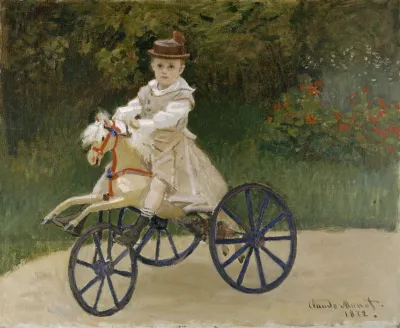
Jean Monet
Human Design Chart
Biography
The first portrait that Monet made of his son was of the four-month-old Jean Monet in His Cradle. Alongside Jean was a woman Julie Vellay, a companion of Camille Pissarro, rather than his mother.
His parents were married on 28 June 1870.
When Jean was a young child his mother and father had fled France during the Franco-Prussian War. They returned by the summer of 1872 when Claude painted his five-year-old son on a hobby horse in the garden of the home the family rented in Argenteuil near Paris. Claude Monet kept the painting, and never exhibited it, throughout his life.
Jean Monet trained to be a chemist in Switzerland. He married Blanche Hoschedé in 1897. They lived in Rouen, where Jean worked for his uncle Leon Monet as a chemist, and Beaumont-le-Roger until 1913. The couple visited Giverny on weekends.
Jean suffered an illness for a period of time and died on 10 February 1914, aged 46.
Jean Monet as a Generator 3/5 in Human Design
Generator 3/5 — Design at a Glance
Jean Monet revealed himself as someone with immense endurance and a fundamental tendency towards energy generation. His design was that of a Generator, a type often compared to workhorses: strong and durable as long as the task is right for them. This power was only fully available to him when he responded to impulses from his environment rather than initiating on his own. The motto of his design was clear: do not push but wait until life sends a signal.
This mechanism was closely tied to his sacral center. Its energy became free only when an inner confirmation - a gut feeling 'yes' - followed an external stimulus. If Jean Monet lived by this reactive strategy, it led to deep feelings of satisfaction and fulfillment. Initiating projects independently without this internal resonance or being hindered at his heart project despite the presence of energy resulted in frustration.
The danger lay in wasting this power through activities that did not inherently spark joy, which could lead to energetic burnout. Conversely, holding back from productive work was another stumbling block. His success depended on responding instinctively to life impulses and then fully acting upon them. Only by doing so could he effectively use his materialization power without falling into ongoing frustration or energy deficiency.
Emotional Authority
Jean Monet's design revealed a tendency towards emotional volatility. He appeared as someone whose perception of the world was strongly colored by his current mood. In one moment, he could be totally enthusiastic about something, in the next view it negatively. His feeling at the moment was merely a snapshot, an initial impression that did not necessarily represent his truth yet. Quick, spontaneous decisions based on emotion often had negative consequences for him.
This dynamic resulted from his emotional authority. Since his Emotional Center was defined, it functioned as inner authority - regardless of which other centers were also defined in his chart. He was subject to an emotional wave with constant ups and downs. The more time he took to let a decision mature, the deeper and broader could he see. This required patience and repeatedly sleeping on decisions. He should take pride in himself and ask himself multiple times. Over time, intense feelings subsided, he gained emotional distance, clarity and calmness set in. Then he was through the process. This mechanism primarily applied to long-term decisions with significant influence on his life path.
The 3/5 Profile — Martyr / Heretic
Jean Monet's design revealed a tendency towards experimental action paired with the need to be perceived as a hero or savior. As a 3/5 profile ("Experimentor/Hero and Savior"), he initially appeared skeptical of prefabricated truths; he believed nothing at face value but had to test everything himself. This was not merely a lack of trust, but an essential learning strategy: through personal experience - including failures - he gathered a rich trove of practical life knowledge. This wisdom made him attractive to others who wanted to learn from his experiences. The projection of the hero role flattered his ego but could be painful when public attempts failed.
Especially defining was his 7.3 line ("Experimentor"). It contributed to developing a growing pessimism towards any form of institutionalized leadership over time. His path involved finding an authentic leadership role through trial and error - not one where he was simply accepted as a member. Simultaneously, his 2.5 line ("Hero") emphasized strategic thinking and the use of intelligence for direction-finding. Here lay the challenge in using resources intelligently to achieve personal goals while unconscious projections on his ability to lead could influence his ego. Jean Monet lived this dynamic: he did not seek blind obedience but built authority through proven competence and personal experience.
Triple Split Definition — Defined & Open Centers
Jean Monet's design predisposes him to a constant mental pressure to question and develop concepts. His defined Head and Ajna centers create an ongoing state of inspiration and conceptual thinking. This mental engine was always active; he thought continuously, processed data, and created theories. However, since these centers do not have their own energy for implementation, fighting against this unresolved state often led to frustration or concern. The challenge was to accept the pressure without balancing it with hasty actions.
This intellectual process culminated in his defined Throat Center. It acted as a pivot point that translated mental concepts into communication and action. Jean Monet spoke what his mind conceptualized. His voice was reliable but limited by the nature of his thinking. Through this connection, he could clearly articulate his ideas, provided he trusted the right timing to avoid resistance.
At the same time, Jean Monet had a fixed sense of self through his defined G Center. He knew who he was and where he came from, which gave him a deep feeling of belonging. This inner security allowed him to comfort others or point out new directions without becoming dependent himself. His defined Solar Plexus added an emotional depth; his feelings served as internal authority. He had to wait for the emotional wave to gain clarity rather than act impulsively.
In contrast, his open centers revealed areas of conditioning. His open Heart Center tended to prove self-worth through promises and competition, often leading into a cycle of self-doubt when expectations were not met. This made him vulnerable to pressure to do more to be recognized. Similarly, his open Spleen Center generated a fundamental fear of survival and a need for security from others. Jean Monet tended to cling to people or situations that gave him a false sense of well-being rather than trust his own inner guidance. The combination of strong mental drive, clear identity, and emotional depth, paired with vulnerability in the realm of will and existential security, profoundly shaped his essence.
Channels for leadership, emotional depth, maturation and abstraction.
Jean Monet's design predisposes him towards logical, collective leadership. This orientation did not manifest as authoritarian rule but rather as the ability to gain trust and lead society through tested patterns into the future. The Alpha Channel 7-31 connects the G Center with the Throat Center: Gate 7 provided the strategic role behind the scenes while Gate 31 represented the voice of the collective leader. Jean Monet had to be invited by the majority to be effective; his authority depended on understanding existing trends and sensing people's needs.
Parallel to this, a strong emotional dynamic was at play. The Emotional Release Channel 39-55 connects Root with Solar Plexus. Here moods pulse between joy and melancholy. This mechanism provokes others' minds to reveal their true nature. Jean Monet lived in this wave movement; he could influence the emotions of his surroundings through his own mood. Authenticity was key: only by accepting his emotional depth rather than rationalizing it, could he radiate spiritual passion for life and encourage others.
The experience itself followed a strict maturation process. The Maturation Channel 42-53 connects Root with Sacral Center. Every new initiative – whether project or relationship – had to be fully run through before wisdom could be drawn from it. An early termination meant repetition. Jean Monet sought experiences for their own sake, without rigid expectations, so he could reflect and share the lessons learned at the end. This cycle from start to finish created collective history.
Mentally, he was permeated by the Abstraction Channel 47-64 between Head and Ajna Centers. His mind filtered every experience through a kaleidoscope of mental images, often accompanied by confusion (Gate 64), until clarity suddenly emerged (Gate 47). He was not there to understand his own life but to reveal inspiring stories or new perspectives for the collective.
Additionally, Gate 13 shaped continuity and collective memory while Gate 1 enabled creative mutation in the present moment without constraints. Gate 2 received evolutionary directions with grace (Gate 22). On the personal side, Gate 63 urged improvement through doubt, Gate 34 brought great sacral energy that needed guidance, and Gate 46 demanded total devotion to the process.
Collective Circuitry — Circuit Signature
Jean Monet's design presents three separate yet parallel operating energetic streams. The Knowledge Circuit connects his Solar Plexus with Root Center, generating a pulsating emotional wave aimed at releasing feelings and expressing individual identity through emotional intuition.
Independently, the Understanding Circuit links Throat with Identity Centers. This focuses on rational strategy: sharing logical insights free from conditioning to lead society into a better future – an 'emotionless ratio'.
The third stream, the Meaning-Finding Circuit, consisted of two unconnected parts. One part connected Head and Ajna Centers (Abstraction), fostering innovative mental sparks. The other part linked Sacral with Root Center (Maturation) and referred to cyclic past experiences for collective learning.
As a Triple Definition, these three systems were not directly interconnected. Thus, Jean Monet lived with three distinct yet coexisting power fields: emotional pulsation, rational future orientation, and reflection on the meaningfulness of the past – each as an independent experiential world.
Right Angle Cross of the Sphinx 3
Jean Monet's design carried the signature of the right cross of the Sphinx. This configuration combined a deep, often unconscious connection to spiritual or higher principles with the practical urge to translate these insights into material reality. It was not abstract mysticism but rather a concrete process: what was felt as sacred or true had to become tangible.
This mechanism created a tension between inner vision and outer reality. Jean Monet lived in a constant flow between what he intuitively recognized as right, and the necessity of realizing this through his own actions. There was no separation between mind and craft; both were inseparably intertwined. His energy focused on building bridges – not just metaphorically but also physically.
This pattern meant that his actions were always guided by an inner authority that went beyond pure rationality. He sought ways for higher truths to manifest in everyday life. The challenge lay in bringing these visions into existence through concrete steps, rather than merely dreaming them. His design challenged him to live his spiritual convictions with both feet on the ground and thus create a living connection between heaven and earth.
Saturn Return · Uranus Opposition — Life Cycles
Jean Monet's design tended towards deep, binding structures that often crystallized in personal relationships. This was evident in 1897 when he married Blanche Hoschedé at age 30. For his Human Design, this marked a typical moment of the first Saturn return. This cycle marks the transition from an experimental phase to consolidation and responsibility. What previously existed as possibility or intention now became a solid, sustainable reality.
The first Saturn return acts like a crystallization layer: years of inner development and external experiences coalesce into a clear foundation. For Jean Monet, this meant not only stepping into marriage but also embracing a long-term life task. The mechanics of this cycle promote stability and reliability; it demands the integration of past learning experiences into a lasting form. Through this marriage, his design anchored itself in a concrete relationship dynamic that served as a basis for future developments. It was a moment of maturity when the potential of his design became visible and tangible through real commitment. This phase shaped his further orientation towards enduring connections and structured life phases.
Generator · Emotional Authority — Synthesis
Jean Monet was a Generator whose life was marked by deeply rooted sacral energy. This power fueled an indefatigable work ethic and endurance, yet it always manifested in interplay with his emotional authority. He needed time to let feelings mature before making decisions – a process that was reinforced by the definition of his Head Center, which constantly generated mental pressure for analysis and understanding. This combination of sacral energy, emotional maturation, and intellectual depth shaped his ability to accumulate experiences and use them as a basis for solving problems for others, in line with his Profile as an Explorer/Leader and Rescuer.
A central paradox in Jean Monet's design lay in the tension between his need for deep emotional clarity and the logical leadership style prescribed by the Alpha channel. While he was internally swept by waves of feelings, he could simultaneously position himself as a collective leader, recognizing patterns and inspiring others with his vision. This combination of inner emotional world and external influence created a dynamic field where creativity and melancholy, individual expression and desire for transformation were interconnected.
4 Defined Channels
Incarnation Cross - Right Angle Cross of the Sphinx 3
Solar Return
The Solar Return shows the moment when the sun returns to its exact birth position - your personal solar year.
Life Cycles
Discover the life cycles with a detailed triple view (birth chart, cycle chart, composite).
Human Design Profile
- Type
- Generator
- Strategy
- To respond - wait for something to respond to
- Authority
- Emotional Authority
- Profile
- 3/5 - Martyr / Heretic
- Definition
- Triple Split
- Incarnation Cross
- Right Angle Cross of the Sphinx 3
- Date of Birth
- 08.08.1867 18:00
- Place of Birth
- Paris Arrondissement 17, France
Frequently Asked Questions
What was Jean Monet's Human Design type?
What Profile did Jean Monet have in his Human Design?
Which Authority determined Jean Monet's decision-making process?
What incarnation cross was Jean Monet assigned to?
When was Jean Monet born?
Discover your own Human Design
Are you also a Generator? Find out in a personal reading how to use your sacral energy correctly and discover deep satisfaction.
More Personalities
Back to overviewAaliyah

Alexia

Angèle

Anne-Marie

Arcángel

Arno