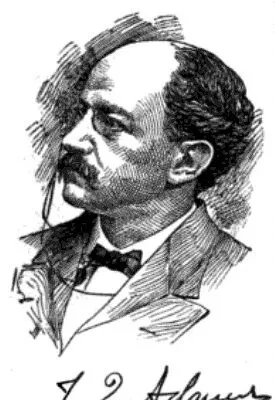
John Quincy II Adams
Human Design Chart
Biography
Adams was the son of Charles Francis Adams Sr and Abigail Brown Brooks, the grandson and namesake of President John Quincy Adams and the great-grandson of President John Adams. He graduated from Harvard University in 1853, studied law, attained admission to the bar, and practiced in Boston. He later established an experimental model farm near Quincy, Massachusetts. Adams married Frances (Fanny) Cadwalader Crowninshield (1839–1911).
During the Civil War he served on the staff of Governor John Andrew with the rank of Colonel.
Adams was elected to the Massachusetts state legislature as a Republican, but soon switched to the Democratic Party because of his disaffection with Republican Reconstruction policies. He served in the Massachusetts House of Representatives in 1865, 1867, 1870 and 1873.
Adams received one vote for the Democratic nomination for President of the United States at the 1868 Democratic National Convention. In 1872 the faction of Democrats that refused to support Horace Greeley nominated Charles O'Conor for president and John Quincy Adams II for vice-president on the "straight Democratic" ticket. They declined, but their names remained on the ballot in some states. After losing an election for lieutenant governor in 1876, Adams refused most further involvement in politics, though he was considered by Grover Cleveland for a cabinet position in 1893.
He died on August 14, 1894 in Quincy.
John Quincy II Adams as a Generator 2/4 in Human Design
Generator 2/4 — Design at a Glance
John Quincy II Adams possessed immense and enduring strength that made him seem like a powerful workhorse. His design suggested that he should channel this energy not through arbitrary initiation but solely as a reaction to external impulses. The central mechanics of his Generator type require 'reacting from the gut.' Only when his sacral center clearly signaled a 'Yes!' was full performance available.
If he initiated independently or suppressed his enthusiasm for tasks that did not interest him, this inevitably led to frustration and energy deficiency. Avoiding activities without inner resonance protected him from burnout; ignoring the urge to continue working while still full of power hindered his potential.
The motto 'Do not initiate but react' formed the key to his success. By waiting for signals from life and then acting only when an internal signal invited action, he avoided the typical pitfalls of his type. When John Quincy II Adams lived in harmony with his nature, he was rewarded with a deep sense of fulfillment. This strategy of waiting and reacting not only ensured endurance but prevented the constant feeling of exhaustion that arises when working against one's own energetic structure. His strength thus lay less in initiating processes than in powerfully and contentedly responding to what life presented him.
Sacral Authority
John Quincy II Adams displayed a decision-making process that did not begin in the head but was deeply rooted in the body. His design indicated that true clarity could only be achieved by waiting for physical signals in response to external stimuli. This mechanism is specific to the Generator type, whose strategy and inner authority are identical: sacral authority. It requires a pause to distinguish between impulsive reaction and genuine confirmation.
In John Quincy II Adams, this instance appeared as gut instinct or surge of power – audible through grunting or an internal 'Hmm.' Such signals marked the moment when his sacral motor engaged. This gave him vital energy and enthusiasm, enabling him to perform tasks with joy and without obsessive purposefulness. His goal was satisfaction in the act itself.
Supporting this was the spleen center. As it was activated and possibly directly connected to the sacral center, it allowed for quick, instinctive reactions. This provided immediate access to physical well-being. The challenge lay in differentiation: Only the sacral response – the clear 'Yes' or 'No' of the gut – was reliable. Mental decisions or spleen-induced impulsivity without this confirmation did not lead to desired satisfaction but rather friction. His process thus required discipline in waiting for the physical signal before acting.
The 2/4 Profile — Hermit / Opportunist
John Quincy II Adams showed a clear tension between his deep need for withdrawal for inner reflection and simultaneous drive towards community. As a 2/4-profile, 'Natural Talent / Networker,' his design dictated that he constantly oscillated between these poles: Line 2 with its tendency toward hermitage and Line 4, which relies on familiar networks.
This pattern required a secure environment where he could clearly communicate when he sought company and when he needed solitude. Only through this transparency could he effectively absorb the external knowledge of his surroundings. During his alone time, he processed these impressions, created clarity, and developed new ideas from them.
The Line 2 contributed traits often misunderstood as 'prima donna': natural talent that only unfolded with confirmation of success and determination. This generation showed a strong dedication to their goals, which sometimes provoked resistance in others due to high, often unrealistic expectations they set for themselves. Simultaneously, the Line 4 was modest, using this reticence almost as a protective mechanism against feelings of inadequacy or outsider status.
The success of his design depended on not concealing but actively steering between 'cave' and 'society.' When he openly expressed his needs for peace and connection, he could harness the power of both lines: the intensive inner work of solitude and the connecting power of networking. Thus, this apparent dilemma transformed into a productive dynamic where reflection and exchange enriched each other.
Single Definition — Defined & Open Centers
John Quincy II Adams was someone whose life was driven by a constant inner vitality. His defined Sacral Center acted as an engine providing a steady energy source. However, this power required a specific approach: success depended on not initiating things himself but waiting for external stimuli and responding with a clear yes or no. Only through such reactions could the full sacral power be mobilized; mental decisions alone were insufficient to sustainably release this energy.
This process was supported by his defined Root Center, which generated a set stress pressure. This pressure served forward movement and survival in the material world. It ensured that the energy generated from the Sacral Center did not stagnate but was continuously put into action. The combination of this vital source and driving stress created a robust foundation for his work.
At the same time, nearly all other centers were open: Head, Ajna, G, Heart, Solar Plexus, and Spleen. This meant that John Quincy II Adams did not have a constant inner source for mental clarity, identity, or emotional stability. He tended to be influenced by his environment. Thus, he could take on mental pressure without generating it himself or amplify foreign emotions rather than possessing stable feelings of his own. Instead of seeking a fixed identity that his open G Center could not provide, he relied on orientation through interaction and the right place in life. His open Heart Center also made him vulnerable to the pressure of proving his worth, despite lacking consistent willpower for this task. Therefore, his strength lay less in intellectual planning or emotional control than in reacting to life and efficiently using his vital energy.
Channels for evolutionary change through accepting boundaries.
John Quincy II Adams exhibited a fundamental disposition marked by a pulsating rhythm of chaos and order. His design inclined towards mechanical moodiness perceived as melancholy when this inner pulse ceased. This energy served evolutionary change through innovation; it conditioned the environment and forced adaptation.
This trait primarily resulted from Channel Mutation 60-3, connecting the Root Center with the Sacral Center via Gate Limitation (60) and Gate Order (3). The potential for transformation depended on accepting limitation and moving beyond the confusion of a new beginning. The powerful, pulsating on/off energy of this channel permeated his way of living out his design and profoundly influenced everyone around him.
It was necessary not to rationalize or dismiss this inner melancholy but to patiently trust in the natural reaction from the Sacral Center. Focus lay on accepting the limitation of Gate 60: he could not control when mutation would occur; only when energy was ready could it be brought forth.
Additionally, other energies operated in the background. Gate 46 promoted full devotion and body love as a temple for the personality crystal. Gate 25 introduced a spiritual stance of innocence and individuation. Gate 15 supported adaptation to natural rhythms through humility. Gate 10 contributed to integrating complex behavioral rules. On the personal level, Gate 39 acted as fuel for mutation through provocation, Gate 38 set boundaries to preserve individual integrity, and Gate 27 provided nurturing warmth. In his design, Gate 53 promoted the start of new developmental cycles, Gate 54 connected worldly success with mystical insight, and Gate 52 required concentrated pattern correction in silence.
Individual Circuitry — Circuit Signature
John Quincy II Adams exhibited a fundamental disposition characterized by a pulsating, acoustic expression of his unique identity. His design linked the Sacral Center to the Root Center through Channel Mutation (3-60), creating an energy that sought deviation from the known and blazed new trails.
The Knowledge Circuit focuses on acquiring and transforming new knowledge as well as expressing this individuality. For John Quincy II Adams, this was specifically marked by mutation – conscious or unconscious deviation from established structures to create something new. The energy is pulsating and creative, driven out of the sacral and finds its physical expression in the root center.
Given his Simple Definition, these connected centers formed a coherent, continuous flow. It was not separate forces but an integrated experience: inner motivation (sacral) flowed directly into endurance and resistance against the status quo (root). This allowed him to initiate changes by walking his own path. The expression was emotionally grounded and served as confirmation of his individuality to the world.
Right Angle Cross of the Vessel of Love 3
John Quincy II Adams carried the right cross of the Love Vessel 3. This configuration established a specific inner dynamics that relied less on intellectual analysis and more on a deep, often unconscious emotional resonance. His design pointed to his authenticity and influence being strongly dependent on how he interacted with others' emotions – not through deliberate manipulation but through a natural, almost magnetic attraction arising from his own emotional depth.
This cross describes a path of development centered around understanding love and connection. It is not about romantic idealism but the ability to understand oneself as a vessel for emotional currents. John Quincy II Adams had to learn to integrate this intensity without losing himself in others' emotions or projecting them. His challenge was to recognize his own emotional truth and deliver it in a way that genuinely resonated with others, requiring patience and self-observation since the process was often slow and marked by setbacks. The energy of this cross urges seeking and strengthening connections on an extremely personal, almost fateful level, profoundly shaping his entire experience and interactions.
Saturn Return · Uranus Opposition · Chiron Return · 2nd Saturn Return — Life Cycles
In 1873, at age 40, John Quincy II Adams returned to office as a member of the House of Representatives for Massachusetts. This return to political life marked a clear turning point in his design: The Uranus opposition became active, signaling a phase of destabilizing old patterns. Instead of clinging to established structures, this cycle promoted sudden changes and rebellion against the known in favor of new, often radical forms of expression.
This mechanical dynamic demands breaking with the status quo to make room for innovative solutions. Adams' renewed engagement was not mere repetition but an expression of his inner need for transformation. The opposition acted as a catalyst, breaking rigid conventions and enabling him to articulate his political voice in a new, unconventional way. It was about freeing himself from outdated bonds to adapt to changing demands of his time. Through this process, his role in the House was not just repetition but an instrument of necessary change driven by Uranus energy, leaving old structures behind.
Generator · Sacral Authority — Synthesis
A central red thread runs through this design: the dynamic interaction between inner energy and outer reaction. The pronounced sacral definition (with much power from the gut) demands a response to impulses while the open G-, Solar Plexus-, and Root Centers signal high sensitivity to others' energies. This leads to a life where authentic decisions can be made from the body, provided they are not overlaid by external influences – constant navigation between inner guidance and taking in environmental influences. The numerous open centers and channels indicate adaptability that holds potential but also emphasizes the need for clear boundaries to avoid losing oneself in others' energies.
The central paradox lies in the tension between the desire for solitude (Line 2) and the wish for community (Line 4), intensified by the undefined Heart Center. On one hand, there is the ability to withdraw deeply into inner processes and develop creative solutions from reflection. On the other hand, there is a strong need for connection and exchange with others, which without clear self-definition can easily lead to dependencies and loss of identity. The mutation (Channel 3-60) amplifies this dynamic by requiring constant changes and adaptations that are both liberating and destabilizing.
1 Defined Channel
Incarnation Cross - Right Angle Cross of the Vessel of Love 3
Solar Return
The Solar Return shows the moment when the sun returns to its exact birth position - your personal solar year.
Life Cycles
Discover the life cycles with a detailed triple view (birth chart, cycle chart, composite).
Human Design Profile
- Type
- Generator
- Strategy
- To respond - wait for something to respond to
- Authority
- Sacral Authority
- Profile
- 2/4 - Hermit / Opportunist
- Definition
- Single Definition
- Incarnation Cross
- Right Angle Cross of the Vessel of Love 3
- Date of Birth
- 22.09.1833 23:50
- Place of Birth
- Boston, MA, United States
Frequently Asked Questions
What is the Human Design type of John Quincy II Adams?
What profile does John Quincy II Adams have?
What authority does John Quincy II Adams possess?
What incarnation cross is assigned to John Quincy II Adams?
When was John Quincy II Adams born?
Discover your own Human Design
Are you also a Generator? Find out in a personal reading how to use your sacral energy correctly and discover deep satisfaction.
More Personalities
Back to overviewAaliyah

Alexia

Angèle

Anne-Marie

Arcángel

Arno