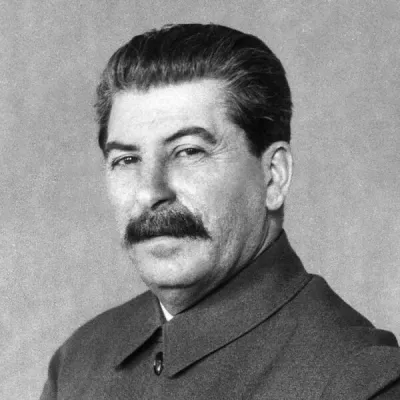
Joseph Stalin
Human Design Chart
Biography
Born into a poor Georgian family in Gori, Russian Empire, Stalin attended the Tiflis Theological Seminary before joining the Marxist Russian Social Democratic Labour Party. He raised funds for Vladimir Lenin's Bolshevik faction through bank robberies and other crimes, and edited the party's newspaper, Pravda. He was repeatedly arrested and underwent several exiles to Siberia. After the Bolsheviks seized power in the October Revolution of 1917, Stalin served as a member of the Politburo, and from 1922 used his position as General Secretary to gain control over the party bureaucracy. After Lenin's death in 1924, Stalin won the leadership struggle over rivals including Leon Trotsky.
What does Generator 5/1 mean for Joseph Stalin?
Generator 5/1 — Design at a Glance
Joseph Stalin possessed immense endurance and the ability to materialize things through sheer willpower. His Generator design suggested that this power was not most efficiently unleashed through independent initiative but solely as a reaction to external impulses. The mechanics of his Sacral Center functioned like an engine that only reached its full capacity when externally engaged – “react” rather than “initiate” was the key dynamic.
When Joseph Stalin responded to signals from his environment and felt his inner “yes,” nothing could stop him. In these moments of resonance, he experienced a deep sense of satisfaction and fulfillment. Conversely, ignoring this strategy led to significant problems. Attempting to invest energy in areas without internal approval or being hindered at his peak power resulted in frustration or an energy deficit.
His strength lay not in driving plans forward out of nowhere but in the powerful response to life itself. Only when he reacted from the gut rather than initiating could he utilize his enormous potential without self-destruction. Any deviation from this reactive principle cost him energy and led long-term to exhaustion, as Sacral energy then had to flow against its own resistance.
Emotional Authority
Joseph Stalin was subject to an emotional wave that profoundly shaped his perception and decision-making. His design indicated that the defined Solar Plexus Center functioned as internal authority – a mechanism that always took precedence over other defined centers. This meant he experienced the world through the filter of his current mood; enthusiasm could quickly turn into deep skepticism.
Emotional Authority requires patience, as spontaneous reactions often only reflect momentary snapshots and not deeper truth. For Joseph Stalin, it was essential to avoid making decisions in the heat of emotion and instead allow time for maturation. The process of sleeping on a decision served to let initial emotional intensity subside. Only when these waves had ebbed and emotional distance had been gained did clarity and calmness set in.
Quick judgments made out of immediate emotion were shown as potentially misleading in his design. The strategy involved taking the time to ask others multiple times to ensure that a choice was not just based on transient feeling but a well-considered insight. This path through emotional terrain was key to long-term stability in his decisions.
The 5/1 Profile — Heretic / Investigator
Joseph Stalin's design presented a tension between the magnetic projection of solutions for others and a deep, hidden research process. As a 5/1 (Hero/Researcher), he exhibited the trait that other people irresistibly sought his knowledge nuggets to solve their own problems. This Line-5 dynamic worked like a positive projection in crisis times where philanthropic or humanitarian ideas were developed but only accepted if they seemed valuable for the general public. Simultaneously, withdrawing from direct contact served as a defense mechanism; philosophers often protected their concepts through written fixation and avoidance of personal closeness.
The danger lay in exhaustion through uncontrolled inquiries with missing boundaries. Without clear “no-saying” competence, energy could drain out like an expert left drained after hours-long conferences while more questions poured in. Line 1 (Gate 46), however, demanded devotion in secrecy and experience in the here and now, independent of expectations or immediate recognition. Art and creative effort were valuable for their own sake here. Jupiter enabled recognizing others' potential and benefiting from it, with luck lying in staying true to one's own experience. Balancing sharing for others (Line 5) and retreating to protect ideas (Line 1) was crucial to optimally utilizing these gifts without falling into exhaustion through external demands.
Single Definition — Defined & Open Centers
Joseph Stalin's design indicated a tendency towards persistent, vital endurance driven by his defined Sacral Center. This center served as a constant energy source but only became effective when he responded to external requests rather than initiating action himself. The mechanics required him to wait until life posed a question before answering with full force – a strategy of reaction rather than proactive advancement.
Simultaneously, his defined Solar Plexus Center shaped his emotional authority. Here lay the challenge of patience: truth and clarity revealed themselves only at the end of an emotional wave, not in the moment of impulse. Joseph Stalin tended to delay or wait for decisions until the emotional heat cooled down to gain deep insights rather than succumbing to immediate actions.
This stable core system contrasted with several open centers that made him vulnerable to external conditioning. His open Head Center led to easy mental confusion or pressure to find answers to questions that were not his own. He tended to question whether he was inspired enough or if he had overlooked something important, rather than dismissing this mental noise as irrelevant.
His open Ajna Center also meant that conceptual thinking and theories did not represent a constant inner truth for him. He could easily be influenced by foreign concepts or feel the pressure to prove his ideas, despite his design being open to a flexible palette of intellectual stimulation.
Furthermore, lacking a defined Heart Center, he lacked consistent energy for willpower and ego showdowns. Instead, he was vulnerable to feeling the need to prove his worth or make promises to be accepted – a trap of non-self that could lead him into commitments he couldn't keep. His open G Center without fixed identity also made him strongly shaped by his environment and the people around him, often seeking direction shown by others rather than determining it himself. This openness made him sensitive to other's energies but also vulnerable to their expectations.
Channel 59-6: Mating — Channels & Gates
Joseph Stalin exhibited a fundamental disposition aimed at deep merging in relationships. His design indicated a strong urge towards intimacy that required emotional patience: decisions had to follow the wave cycle to gain clarity; spontaneous action instead led to confusion. This dynamic was shaped by Channel 59-6, connecting the Sacral Center with the Solar Plexus Center and linking the sexuality of Gate 59 with the emotional wave of pleasure and pain from Gate 6. Rooted in powerful quantum energy known as intimacy, this combination brought people into relationships that were deeply personal, penetrating, and potentially fruitful. Since a defined Solar Plexus always represents inner authority, this configuration required waiting for clarity to emerge over time. Ignoring the sacral response in favor of non-self spontaneity could lead to confusion and complicate social interactions severely, with long-term consequences like failed ventures. The true potential of this intimacy required patience and nurturing over longer periods; it was healthiest to first build a friendship before delving into deeper realms. Stalin's urge towards merging allowed him to quickly and easily penetrate the aura of others, easing confidentiality, which paved the way for fruitfulness in any creative endeavor. His emotional wave determined the timing of each release of intimate feelings by drawing him closer or pushing him away. Waiting for this cycle enabled him to perceive if something had developed between people. While individuals with this channel may appear emotionally stable, proximity or touch could activate their wave and prompt a reaction. A timely embrace helped them release pent-up emotions that words couldn't express, thus creating a healthy sense of emotional balance.
Tribal Circuitry — Circuit Signature
Joseph Stalin's design indicated a tendency towards primal, instinctive energy focused on protecting genetics and family. His structure linked the life force of the Sacral Center directly with the emotional waves of the Solar Plexus Center. This connection formed the heart of his Protector Circuit.
This circuit is timeless and fundamental. It integrates the instinctive energies of the Spleen – here represented through the pairing dynamics in Gate 59 – with the strong, wave-like emotions of the Solar Plexus (Gate 6). For Joseph Stalin, this primarily activated the Channel of Union. It was about what was necessary to ensure family survival and thus the continuation of his genetics.
The themes of this circuit are protection, defense, sustenance, care, and preservation. Archetypally, it embodies the energies of 'Mother and Father'. For Joseph Stalin, this meant a deep, timeless necessity for familial survival protection and genetic propagation as central drives. Given he had a Simple Definition, this energy worked clearly and coherently without being fragmented by other separate groups. The connection between Sacral and Solar Plexus Centers significantly shaped his inner dynamics, with the focus on instinctive security of the status quo.
Left Angle Cross of Education 2
Joseph Stalin's design carried the signature of the Left Education Cross Two. This configuration shaped a fundamental attitude characterized by a profound connection to the process of imparting knowledge and values. In Human Design, this cross describes a specific energetic alignment where learning and teaching are not seen as mere information transfer but as central life content. It is about structuring experiential wisdom and passing it on to subsequent generations or groups to establish continuity and orientation.
For Joseph Stalin, this meant an inner dynamic focused on understanding educational systems as the foundation for societal order. The mechanics of this cross suggest that the focus was on the quality and depth of what was taught rather than quantitative dissemination. It involved condensing complex connections into forms that could have a lasting impact. This orientation created a framework in which authority was legitimized through competence and the ability to shape others. The Left Education Cross Two grants a certain rigor and clarity in dealing with educational content, as it aims at preserving essential principles. Joseph Stalin thus moved within a field marked by the drive to solidify intellectual and cultural structures and establish them as guiding principles for collective action.
Saturn Return · Uranus Opposition · Chiron Return · 2nd Saturn Return — Life Cycles
Joseph Stalin's design showed a tendency towards structural consolidation, where planetary cycles acted as catalysts for political power maintenance. His first Saturn Return in 1905 at age 27 marked his first personal meeting with Lenin at the Bolshevik conference in Tampere – a moment when years of groundwork condensed into a viable relationship. The Uranus Opposition in 1918, when he was 40, led to his appointment as Political Commissar for the South Front after Zarizyn; this cycle often demanded career reorientation and crisis management under pressure.
The Chiron Return around age 50 is a fulfillment cycle where one's incarnation cross unfolds and meaning becomes experiential if strategy and authority are respected. In 1927, at age 49, Stalin prevailed against his opponents at the XV Party Congress; Trotsky was expelled from the Soviet Union. This marked a moment of flourishing when inner structure manifested its full impact outwardly. His second Saturn Return in 1935 (age 57) coincided with mutual aid treaties between the Soviet Union and France as well as Czechoslovakia – another phase of structural reinforcement and diplomatic security, typical for this cycle's maturation.
Generator · Emotional Authority — Synthesis
He was a Generator defined by his sacral energy (Sacral Center) and emotional authority (Emotional Center). This combination led to a life driven by deep engagement in tasks he truly consented to – an ongoing search for satisfaction through work and activity. The Profile as Hero/Researcher (5/1) amplified this drive, revealing a strong need for knowledge building and its dissemination to others. He lived the dynamics of the Archer Circuit, where themes like protection, defense, and preservation played central roles – especially in the context of family and the continuation of beliefs. Recurring cycles, evidenced by events in career and relationships, showed patterns of deep transformation and asserting one's positions.
A central paradox lay in the tension between his sacral energy source and the need for emotional clarity (Emotional Center). While he possessed immense endurance, his emotional wave required time for decision maturation – a process contrasting with the immediate, reactive nature of the Sacral. The Channel of Union (6-59) indicated a strong connection between life force and intense feelings, which could both unleash creative energy and potentially cause confusion if inner authority was not considered.
1 Defined Channel
Incarnation Cross - Left Angle Cross of Education 2
Solar Return
The Solar Return shows the moment when the sun returns to its exact birth position - your personal solar year.
Life Cycles
Discover the life cycles with a detailed triple view (birth chart, cycle chart, composite).
Human Design Profile
- Type
- Generator
- Strategy
- To respond - wait for something to respond to
- Authority
- Emotional Authority
- Profile
- 5/1 - Heretic / Investigator
- Definition
- Single Definition
- Incarnation Cross
- Left Angle Cross of Education 2
- Date of Birth
- 18.12.1878 12:00
- Place of Birth
- Gori, Russia
Frequently Asked Questions
What was Joseph Stalin's Human Design type?
Which Profile did Joseph Stalin have?
What authority did Joseph Stalin have?
What incarnation cross did Joseph Stalin have?
When was Joseph Stalin born?
Discover your own Human Design
Are you also a Generator? Find out in a personal reading how to use your sacral energy correctly and discover deep satisfaction.
More Personalities
Back to overviewAaliyah

Alexia

Angèle

Anne-Marie

Arcángel

Arno