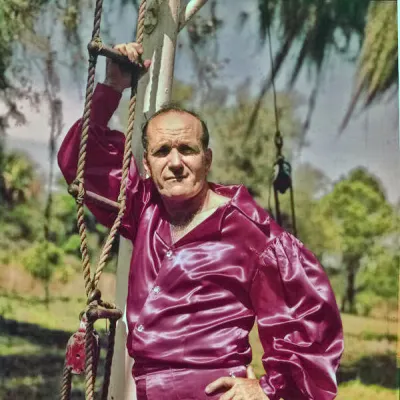
Karl Wallenda
Human Design Chart
Biography
Great-grandfather of famous current performer Nik Wallenda.
The Human Design of Karl Wallenda: Generator 5/1
Generator 5/1 — Design at a Glance
Karl Wallendas Design shows a tendency towards extreme endurance and inner strength, comparable to a workhorse that provides its energy for specific tasks. As a Generator, he had a lot of sacral energy, which was released not through self-initiated action but by responding to external signals. His strategy was to wait for impulses from life and then, when his sacral center gave a clear "yes," to respond with action. This principle of "reacting from the gut" was crucial for his functioning.
When he applied this energy in harmony with his design, by doing only what he felt an inner resonance for, it led to a sense of deep fulfillment. Conversely, frustration and a lack of energy threatened when he persistently did things he had no desire for, or when he was prevented from pursuing his heart's project, even though he was still full of power. The danger of burnout always lurked where he wasted his energy on tasks that did not align with his inner compass. His success thus depended less on sheer will than on the ability to recognize and respond to the right signals, thereby making his immense endurance effective.
Emotional Authority
Karl Wallendas design points to a tendency towards emotional intensity and fluctuating moods. He was someone whose perception of the world was strongly influenced by his current emotional state. In one moment, he could be totally enthusiastic about something, and in the next, he could view the same situation completely negatively. This configuration stemmed from his defined Solar Plexus Center, which also carried his inner authority.
In Human Design mechanics, emotional authority always takes precedence, regardless of which other centers are defined. They are subject to a constant emotional wave. The feeling in the moment is just a snapshot, a first impression, which does not necessarily represent the truth. Quick, spontaneous decisions based on such emotions could therefore have negative consequences.
The mechanics described a process of maturation: The more time Karl Wallenda took, the deeper and more comprehensive his understanding could become. This required patience and reconsidering decisions multiple times. He should take his time, ponder, and ask himself multiple times. Over time, the intense feelings subsided, he gained emotional distance, and clarity and calmness set in. Only then had he gone through the process. This mechanism was particularly important for long-term decisions that could have a significant impact on his life course.
The 5/1 Profile — Heretic / Investigator
Karl Wallendas Design inclined towards deep, methodical preparation, which he offered others as a practical solution. As a 5/1 (Hero/Researcher), he combined the intense, detail-oriented learning of Line 1 with the ability of Line 5 to attract others through his knowledge. This created a nearly magnetic presence: people sought answers from him, which quickly overwhelmed him if he did not set clear boundaries.
The mechanics behind this stance lay in the connection of Gate 60 (Line 5) and Gate 28 (Line 1). Gate 60 demanded leadership through dealing with limitations and offering practical solutions during crises. It was about finding the right moment for change to avoid confusion. Simultaneously, Gate 28 required a careful weighing of opportunities and dangers. Here, intuition served planning; aesthetic ideas had to be tested for their real feasibility through meticulous preparation.
For Karl Wallenda, this meant that he could only lead effectively once he had precisely calculated the risks. His strength did not lie in impulsive action but in the fusion of intuitive risk assessment and the resulting tangible strategy. When he learned to say no, he maintained the balance between his own research work and his role as a problem solver for others. Without this demarcation, exhaustion threatened from the endless demand for his expert knowledge.
Triple Split Definition — Defined & Open Centers
Karl Wallenda's Human Design profile indicated a tendency towards constant mental pressure and deep emotional processing. His defined Head and Ajna Centers created a persistent inner drive to question and form concepts. However, this mental process was not directly linked to energy for immediate implementation of ideas. Instead, his mind served as an inspiration source for others, while he himself had to learn to accept the unrest of unresolved thinking without falling into hasty actions.
This mental activity flowed into his defined Throat Center, which served as a pivot for communication and action. It conveyed what his mind thought, but also what his other defined centers felt. His defined G Center gave him a firm sense of self-identity and a clear sense of direction. He knew who he was and where he was going, which helped him show others new perspectives without being dependent on their expectations.
Additionally, Karl Wallenda had a defined Heart Center, which gave him willpower and the ability to keep promises. He controlled his resources and enjoyed working independently, valuing recognition and success. His vital energy came from his defined Sacral Center, which provided a constant energy source. However, this energy was only available when he responded to external stimuli rather than initiating on his own. By waiting and listening for his sacral response, he could use his energy effectively and fulfillingly.
Emotionally, Karl Wallenda was marked by his defined Solar Plexus Center. His inner authority lay in his feelings, which he did not act on impulsively. He learned to wait for the emotional wave to clear before making important decisions, protecting himself from chaotic reactions and allowing him to gain deep insights.
In contrast, his Root Center was open. This meant that he did not carry his own constant stress or pressure internally, but absorbed the adrenalized pressure from his environment. He tended to interpret this external stress as his own, which could lead to a feeling of being overwhelmed or restless. The challenge was to recognize that this pressure did not come from him and to find ways to experience it not as a personal necessity but as temporary environmental energy to use or avoid. Through understanding this mechanism, he could learn to deal with external stress without falling into a cycle of exhaustion.
Channels for community, self-expression, curiosity, care and abstraction.
Karl Wallenda's Human Design profile indicated a tendency towards radical self-confirmation, paired with an insatiable drive to explore and tell the unknown. This configuration created a person who not only lived their uniqueness but carried it as a narrative force into the world, while being deeply rooted in the responsibility for their environment.
The Channel of Exploration 34-10 connected his inner strength with self-acceptance. He possessed the energy to hold onto his beliefs and show through authentic reactions how to love and honor oneself without controlling others. This was complemented by the Channel of Curiosity 11-56, which made him a storyteller. He constantly sought new ideas and perspectives to formulate as inspiring parables that taught or entertained others, less interested in dry facts than in the emotional truth of a story.
Simultaneously, the Channel of Preservation 27-50 made him a natural provider and protector. He felt responsible for the values and well-being of his tribe, ready to take on responsibility and nourish others as long as he himself was properly cared for. His emotional life was shaped by the Channel of Community 37-40, which sent him on a search for the right place in a group. He sought fair agreements and emotional clarity in relationships to build bridges between individuals and work together.
Mentally, the Channel of Abstraction 64-47 drove him. His mind constantly searched experiences to recognize patterns and meaning, often accompanied by mental confusion until suddenly clarity broke through and a new perspective was revealed. Additional Gates like 28 (Risks in the Here and Now) and 60 (Acceptance of Limitations) underscored his ability to take risks and master transformations through pressure, while Gates like 22 (Openness) and 8 (Contribution) promoted his individual radiance and desire to make a unique contribution.
Tribal Circuitry — Circuit Signature
Karl Wallenda's Human Design profile presented three separate, parallel functioning energetic blocks. The Centering Circuit connected his Sacral with his Identity Center. This created an inner, individualistic strength and bold convictions, which, however, without connection to the Throat Center, were often hard to put into words.
The Meaning-Finding Circuit worked quite differently. It connected the Head, Ajna, and Throat Centers. Here, energy flowed cyclically and emotionally, driven by the need to reflect on past experiences and share insights with the collective. This stood in contrast to cool logic and focused on learning from history.
The third block, the Ego Circuit, connected the Heart and Solar Plexus Centers. It promoted cooperation and mutual giving and taking within a community. As the Sacral Center was missing, this dynamic support required regular rest periods for resource regeneration.
Additionally, the Protector Circuit connected the Sacral and Spleen Centers. This primal connection served the protection and preservation of genetics and family care. It anchored life force in instinctive survival mechanisms.
This triple definition meant that these four circuits did not overlap. Instead, they existed as independent, side-by-side energy fields. Karl Wallenda thus navigated between inner strength, emotional meaning-finding, communal cooperation, and instinctive protection, without these areas forming a direct, continuous energy flow.
Left Angle Cross of Distraction 2
Karl Wallendas Human-Design profile points to a specific tendency described by the left cross of Distraction 2. This configuration shaped a life approach where consciousness was often diverted from the main task, not due to lack of care, but through an inner dynamic that directed focus towards secondary matters or external stimuli. Instead of a linear, uninterrupted pursuit of goals, a structure emerged that constantly integrated new impulses, making the direct execution of complex undertakings more challenging. Energy flowed less into a single, continuous line and instead spread across various aspects, leading to a certain fragmentation of attention. This did not mean that Karl Wallenda was incapable, but rather that his path was marked by constant reorientation and the processing of distractions. The mechanics of this cross suggest that the greatest challenge lay in recognizing and pursuing the essence of the matter despite many distracting influences. It was a pattern that required patience and the ability to distinguish between what is essential and what is not, without being overwhelmed by the abundance of impressions. The structure created a tension between the desire for clarity and the reality of a multifaceted, often distracting inner landscape.
Saturn Return · Uranus Opposition · Chiron Return · 2nd Saturn Return — Life Cycles
Karl Wallendas Human-Design profile points to a tendency towards radical, structural renewal that breaks old boundaries. This attitude was not a random rebellion, but a deeply rooted need to break established patterns and take new, often risky paths. The Uranus position in his chart marked the energy that questions the status quo and forces innovative solutions when conventional paths fail.
This mechanism became concretely active in 1947, at the age of 42, when he developed a three-story pyramid with seven people – a clear success that underscored his ability to create complex, novel structures. This event served as evidence of the Uranus energy: it was not a gradual improvement, but a qualitative leap in complexity and risk. The development of this pyramid was the moment when the theoretical inclination towards innovation was translated into a tangible, public achievement.
The opposition in his chart indicated that this innovative power was often activated by external resistance or the pressure of circumstances. Karl Wallenda used this pressure to materialize his visions. The pyramid was not a coincidence, but the logical consequence of a design intended to attract attention through radical novelty and set new standards. His strategy was to open himself to these disruptive impulses and pour them into concrete, often spectacular projects that exceeded the expectations of his time.
Generator · Emotional Authority — Synthesis
Karl Wallenda was a Generator whose life was marked by a deep, sacral energy. This energy, combined with emotional authority, led him into a process of continuous reaction and maturation of decisions. The profile as a Hero and Researcher (5/1) reinforced this drive to deepen knowledge and make it available to others – a pattern evident in his readiness to take on complex challenges and find solutions. The defined Head and G Center, connected by the Channel of Research (34/10), pointed to an inner strength for self-confirmation and the necessity to perfect his behavior to succeed in the world.
A central paradox in his design lay in the tension between the enduring, sacral energy and the emotional wave. On one hand, he was able to achieve goals through persistence and reaction to life – evidenced by an event where he developed a three-story pyramid with seven people. On the other hand, his emotional authority required time and maturation, which contrasted with the potential spontaneity and immediate action of a Generator. This dynamic carried the risk of getting lost in endless emotional loops while simultaneously possessing the profound ability to make authentic decisions through reaction.
5 Defined Channels
Incarnation Cross - Left Angle Cross of Distraction 2
Solar Return
The Solar Return shows the moment when the sun returns to its exact birth position - your personal solar year.
Life Cycles
Discover the life cycles with a detailed triple view (birth chart, cycle chart, composite).
Human Design Profile
- Type
- Generator
- Strategy
- To respond - wait for something to respond to
- Authority
- Emotional Authority
- Profile
- 5/1 - Heretic / Investigator
- Definition
- Triple Split
- Incarnation Cross
- Left Angle Cross of Distraction 2
- Date of Birth
- 21.01.1905 07:15
- Place of Birth
- Magdeburg, GER
Frequently Asked Questions
What was Karl Wallenda's Human Design type?
What Profile did Karl Wallenda have in Human Design?
Which Authority guided Karl Wallenda's decisions?
What incarnation cross did Karl Wallenda have?
When was Karl Wallenda born?
Discover your own Human Design
Are you also a Generator? Find out in a personal reading how to use your sacral energy correctly and discover deep satisfaction.
More Personalities
Back to overviewAaliyah

Alexia

Angèle

Anne-Marie

Arcángel

Arno