
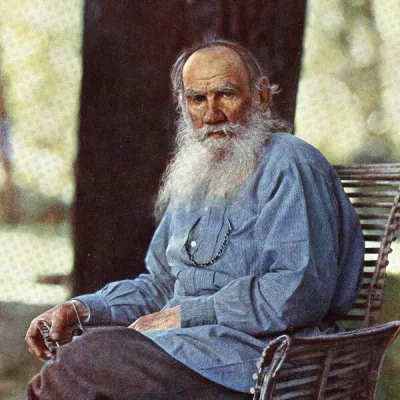
Leo Tolstoy
Human Design Chart
Biography
Born to an aristocratic family, Tolstoy achieved acclaim in his twenties with his semi-autobiographical trilogy, Childhood, Boyhood and Youth (1852–1856), and with Sevastopol Sketches (1855), based on his experiences in the Crimean War. His War and Peace (1869), Anna Karenina (1878), and Resurrection (1899), which is based on his "youthful sins," are often cited as pinnacles of realist fiction and three of the greatest novels ever written. His oeuvre includes short stories such as "Alyosha the Pot" (1911) and "After the Ball" (1911) and novellas such as Family Happiness (1859), The Death of Ivan Ilyich (1886), The Kreutzer Sonata (1889), The Devil (1911), and Hadji Murat (1912). He also wrote plays and essays concerning philosophical, moral and religious themes.
In the 1870s, Tolstoy experienced a profound moral crisis, followed by what he regarded as an equally profound spiritual awakening, as outlined in his non-fiction work Confession (1882). His literal interpretation of the ethical teachings of Jesus, centering on the Sermon on the Mount, caused him to become a fervent Christian anarchist and pacifist.
The Human Design of Leo Tolstoy: Generator 1/3
Leo Tolstoy is a Generator in Human Design – an energy type with a defined Sacral Center. Generators make up about 36% of humanity and possess an enormous, sustainable life force energy.
The Generator's strategy is to respond to impulses from life rather than initiating. When the Sacral Center responds with a clear "yes" (a gut feeling, an inner spark), that's the right path.
When Leo Tolstoy lives in alignment with their design, they experience deep satisfaction and fulfillment. The Generator's not-self theme is frustration – a sign that the sacral energy isn't following the right things.
Leo Tolstoy has Sacral Authority. The Sacral Center responds with a clear physical reaction – an "uh-huh" (yes) or "un-un" (no). This gut response is spontaneous, direct, and reliable. The key is responding to the right question or impulse.
Leo Tolstoy carries the profile 1/3 – Investigator / Martyr. The 1st line represents the Investigator: a deep need for a solid foundation and thorough knowledge before feeling secure. The 3rd line represents the Experimenter: learning through trial and error, embracing life as a practical experiment and growing wise through experience.
The incarnation cross "Right Angle Cross of Rulership 3" describes the overarching life purpose and direction of Leo Tolstoy in Human Design. It consists of the four gate activations of Sun and Earth (personality and design) and only becomes felt when one lives their strategy and authority.
In Leo's Bodygraph, we find a Single Definition.
Of the 9 centers in the Bodygraph, 4 are defined for Leo: Heart Center, Splenic Center, Root Center and Sacral Center. 5 centers remain open.
Circuit distribution: Tribal (Ego): 2 channels, Individual (Knowing): 1 channel, Collective (Sensing): 1 channel. Leo is particularly shaped in the "Tribal" area - family, community and material security.
4 Defined Channels
Incarnation Cross - Right Angle Cross of Rulership 3
Solar Return
The Solar Return shows the moment when the sun returns to its exact birth position - your personal solar year.
Life Cycles
Discover the life cycles with a detailed triple view (birth chart, cycle chart, composite).
Human Design Profile
- Type
- Generator
- Strategy
- To respond - wait for something to respond to
- Authority
- Sacral Authority
- Profile
- 1/3 - Investigator / Martyr
- Definition
- Single Definition
- Incarnation Cross
- Right Angle Cross of Rulership 3
- Date of Birth
- 09.09.1828 22:52
- Place of Birth
- Yasnaya Polyana, Russia
Frequently Asked Questions
What Human Design type is Leo Tolstoy?
What Human Design profile does Leo Tolstoy have?
How does Leo Tolstoy best make decisions?
When and where was Leo Tolstoy born?
What is Leo Tolstoy's incarnation cross?
Discover your own Human Design
Are you also a Generator? Find out in a personal reading how to use your sacral energy correctly and discover deep satisfaction.
More Personalities
Back to overviewAaliyah

Alain-Fournier

Alexia

Angèle

Angeli

Anne-Marie
