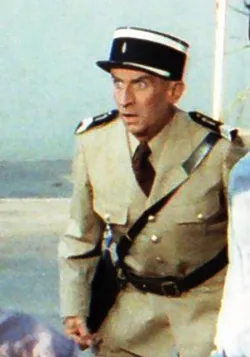
Louis de Funès
Human Design Chart
Biography
His second wife died at the age of 101 (1914-2015).
Louis de Funès as a Generator 6/2 in Human Design
Generator 6/2 — Design at a Glance
Louis de Funés possessed enormous endurance and functioned as a powerful “workhorse,” endowed with abundant sacral energy. His design suggested that he optimally utilized this power not through self-initiated actions but rather through reactive behavior. The mechanics of his Generator type demanded that he wait for signals from life before acting, only proceeding when his inner core – the sacral center – provided clear confirmation.
This strategy was crucial to his satisfaction. Reacting to impulses that resonated internally filled him with deep fulfillment and vigor. Conversely, ignoring these internal responses or continuously initiating actions without inner consent led to persistent frustration and a noticeable energy deficit. Two specific pitfalls defined his potential: first, the wastage of power on tasks for which he felt no internal enthusiasm, making him prone to exhaustion. Second, holding back from projects when he was still full of energy and eager to continue.
His success depended on not planning from the head but reacting from the gut. When he responded to a life signal and his inner self said “yes,” nothing could stop him. Living against this nature, by constantly seeking out occasions himself or sacrificing his energy for others’ goals, led to the frustration of not being understood and the feeling of wasting his power. His strength lay in listening and reacting, not in pushing forward.
Emotional Authority
Louis de Funés exhibited a fundamental stance that protected him from impulsive actions by allowing his feelings time to settle. His design indicated that immediate reactions often were illusions driven by fleeting mood swings rather than deeper truth. This resulted from his emotional authority: With his Emotional Center defined, he was subject to constant ups and downs of emotions. The world appeared colored by the current mood – sometimes totally enthusiastic, in the next moment negative. Yet this feeling in the moment was just a snapshot, not yet his true reality. Quick decisions based on such emotion often had negative consequences.
The mechanics of his inner authority demanded patience as a tool for gaining clarity. The more time he took, the deeper he could see. This required consciously sleeping over important decisions and being willing to procrastinate. Over time, intense feelings subsided, emotional distance set in, followed by calmness and clarity. Only then was the process complete. This strategy primarily applied to long-term decisions with significant influence on life trajectory. Louis de Funés lived this necessity of observing emotions rather than immediately following them. His inner authority carried his defined Emotional Center; regardless of other definitions, this emotional wave took precedence in decision-making. He used time to emerge from the fluctuation and reach stable insight.
The 6/2 Profile — Role Model / Hermit
Louis de Funés showed a clear developmental line: In his youth, impulsive experimentation dominated, later evolving into a phase of intense self-reflection and withdrawal. This pattern stems from his 6/2-Profile, the “Role Model.” Before his thirtieth year, the sixth line acted like a third: Here it was about trial and error. Louis de Funés learned through direct experience, withdrew after mistakes, and sought new paths. The second line promoted spontaneous adaptation to new situations, often without deeper internal comparison. This could lead to projections based on external expectations rather than secure knowledge.
After his thirtieth year, this dynamic fundamentally changed. The sixth line became active. Louis de Funés metaphorically retreated into a “Cave,” observing his past experiments with great distance. This period served for healing and gaining deep self-knowledge. For him, it was crucial to achieve absolute certainty about the future. Action and speech had to align; without this assurance and the feeling of adequate support, he withdrew. Only when this inner alignment was reached did he re-emerge – now as a trustworthy model whose wisdom rested on genuine introspection, no longer superficial adaptation.
Split Definition — Defined & Open Centers
Louis de Funés revealed himself as someone who was constantly under mental pressure to ask questions and form concepts. His defined Head and Ajna centers generated a constant mental activity that did not offer direct energy for implementation; this often led to inner unrest when he tried to immediately turn these thoughts into actions. At the same time, he had a strong, defined Heart Center, which gave him continuous willpower and the need for control over his resources. He sought confirmation of his ego through work and success.
His actual energy source lay in his defined Sacral Center, which provided immense vital force – but only as a reaction to external impulses. This required him to wait rather than initiate to avoid frustration. Additionally, his defined Solar Plexus center shaped an emotional wave movement; he needed time for his feelings to clarify before making decisions. The defined Root Center also delivered a constant survival and progress drive.
In contrast, his Throat, G, and Spleen centers were open. His communication was situational and spontaneous, not consistently controllable. His open G Center meant that identity and direction were initiated by the environment; he tended to find himself in various roles rather than having a fixed one. The open Spleen Center made him vulnerable to conditioned fears about health and well-being, which led him to seek security from others instead of trusting his own intuitive system. This configuration created a person who was mentally strong and willful but dependent on external validation for expression and orientation.
Channels & Gates
Louis de Funés showed himself through a dominant tendency to transfer leadership and identity directly onto the collective. This mechanism, anchored in the Sun at Gate 31 (Line 6), determined his impact: It was not about logical persuasion but pure energy transmission to set others in motion and achieve common goals. His presence served to prescribe a collective direction where individual identity merged with the group.
This leadership claim was reinforced by the Synthesis Channel 19-49, which connected the Root Center with the Solar Plexus, creating an emotional glue for the tribe. Louis de Funés sought belonging based on loyalty, honor, and mutual protection. He clearly distinguished between those who belonged to the group and had their basic needs met from those who violated the principles of the collective. This emotional frequency of acceptance or rejection was crucial for him to maintain cohesion.
Simultaneously, the Community Channel 37-40 worked by connecting the Solar Plexus Center with the Heart. Here, the focus was on fair agreements and building trust through direct interaction. Louis de Funés needed clear arrangements based on mutual benefit to establish stable bonds. He sought his place in the whole by building bridges between individuals, where willpower and emotional clarity formed the foundation for each partnership.
The Maturity Channel 42-53 propelled him to go through experiences fully and gain wisdom from them. Each situation had to reach a conclusion before a new cycle could begin. This gave his actions a cyclical depth as he learned from past events to shape future steps firmly.
Finally, the Abstraction Channel 47-64 shaped his mental processing. He filtered each experience through a kaleidoscope of images and sought hidden connections. Although this sometimes led to inner confusion, it allowed him to develop complex stories and perspectives that he could then share with others to distill meaning from the chaos of daily life.
Circuit Signature
Louis de Funés revealed himself through a split definition, which meant his energetic systems were not permanently active but had to be stimulated situatively by the environment. His design was marked by two dominant circuits: the Meaning circuit and the Ego circuit.
The Meaning circuit connected his Head with Ajna centers as well as Sacral with Root centers in separate segments. This generated a wave-like emotional confrontation with the past. Louis de Funés reflected on past experiences to grasp their meaning and share these visual, emotional insights with the collective. The energy followed a cycle of beginning, middle, and end, driven by the Abstraction and Maturity channels.
Parallelly, the Ego circuit directly connected Heart, Solar Plexus, and Root centers. Here it was about traditional tribal cooperation and resource management through the Community channel (Giving and Taking) as well as Synthesis. Since this circuit lacked a connection to the Sacral Center, there was no constant life force. This required mandatory rest periods to build new energy for collective creation.
Together, these mechanisms created a profile that used emotional waves from the past to promote collective learning while relying on mutual support and necessary recovery phases in social interaction. The activation of these forces always depended on external impulses as his definition was split.
Left Angle Cross of the Alpha 1
Louis de Funés had the design “Left Alpha 1 Cross.” Since the specific mechanical effect of this configuration is not defined in the given material, no derived character traits or behavioral patterns can be described. The Human Design system does not provide an interpretive framework for a psychological classification here. It must be noted that this structure was part of his chart without further qualitative statements about its impact on his personality being possible. Any assumptions about resulting characteristics would be speculative and unsupported by the provided facts. The analysis is therefore limited to naming the configuration as part of his energetic map, without adding interpretative layers. This ensures that no uncontrolled information influences the reading. Focus remains solely on the presence of this element while its content meaning is considered undefined. Thus, attributing qualities to Louis de Funés that do not directly arise from the provided mechanics is avoided. The presentation stays neutral and fact-based, constrained by the lack of a description for this specific cross.
Saturn Return · Uranus Opposition · Chiron Return · 2nd Saturn Return — Life Cycles
Louis de Funés' life was marked by three clear cyclical turning points structuring his career and health. In 1956, at age 42, he received a supporting role alongside Jean Gabin in “Two Men, One Pig and the Night of Paris.” This corresponded to the Uranus opposition, a phase of new beginnings and expansion where new professional horizons opened up.
The Chiron return, a fulfillment cycle between ages 49 and 51, marked his peak period. During this time, the incarnation cross increasingly unfolded; meaning and purpose became experiential. In 1964, at age 50, Louis de Funés filmed three movies in four months. This intense productivity led to his breakthrough as a film star and confirmed the effectiveness of this cycle of self-actualization.
The second Saturn return around age 57 brought consolidation but also stress limits. In 1971, he reduced his film work due to health reasons. At this point, it signaled the need to review structures and set boundaries. The sequence of these cycles—from expansion through peak to necessary reduction—drew out his design as someone whose life energy worked in clear phases, with each turning point carrying a specific mechanical quality: opening, fulfillment, and finally structuring.
Generator · Emotional Authority — Synthesis
He was a Generator guided by emotional authority. This combination shaped a profound process of weighing and feeling before he turned to decisions—an inner dynamic that played out in a life marked by intense work but also phases of withdrawal and reflection (Centers, Authority). The defined Head-Head Channel (Synthesis) points to constant mental pressure to understand and question things, driving him deeper into the themes of his gates. This led to an ability to inspire others through inspiration while also pressuring them to think independently.
A central paradox lay in the tension between his sacral drive (Generator) and the cyclical nature of his sense circuitry. He had the endurance to stick with projects as long as they fulfilled him energetically, yet he needed periods of emotional maturation to make decisions and learn from experiences (Cycles). Events like reducing film work after success (Saturn Return) underscore this pattern of alternating between activity and withdrawal—a model that ranged from youthful experimentation to the wisdom of a withdrawn observer (Profile).
4 Defined Channels
Incarnation Cross - Left Angle Cross of the Alpha 1
Solar Return
The Solar Return shows the moment when the sun returns to its exact birth position - your personal solar year.
Life Cycles
Discover the life cycles with a detailed triple view (birth chart, cycle chart, composite).
Human Design Profile
- Type
- Generator
- Strategy
- To respond - wait for something to respond to
- Authority
- Emotional Authority
- Profile
- 6/2 - Role Model / Hermit
- Definition
- Split Definition
- Incarnation Cross
- Left Angle Cross of the Alpha 1
- Date of Birth
- 31.07.1914 01:00
- Place of Birth
- Courbevoie, France
Frequently Asked Questions
What was Louis de Funés' Human Design type?
What Profile did Louis de Funés have?
What kind of Authority did Louis de Funés have?
What incarnation cross was assigned to Louis de Funés?
When was Louis de Funés born?
Discover your own Human Design
Are you also a Generator? Find out in a personal reading how to use your sacral energy correctly and discover deep satisfaction.
More Personalities
Back to overviewAaliyah

Alexia

Angèle

Anne-Marie

Arcángel

Arno