
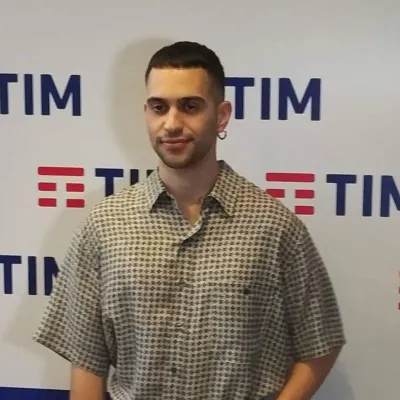
Mahmood (singer)
Human Design Chart
Biography
Born in Milan to an Italian mother from Sardinia and an Egyptian father, he was raised around Gratosoglio, a Milano suburb. When he was five years old, his parents divorced and he was subsequently raised by his mother. Mahmood is a portmanteau of Alessandro's surname Mahmoud and the English expression "my mood". Despite his father's origins, Mahmood does not speak Arabic but is fluent in Sardinian. He is Catholic and considers himself 100% Italian.
Mahmood (singer) — Manifestor with Profile 3/5
Manifestor 3/5 — Design at a Glance
Mahmood (singer)'s Design establishes him as a pioneer and visionary. He is destined to lead the world into a new future, much like an emperor of ancient Rome who had the vision for a great empire but did not wage war himself; instead, he sent his soldiers out to conquer foreign lands on his behalf. This metaphor illustrates the importance of delegation rather than personal execution when implementing large plans.
Not everyone appreciated these visionary designs. A central pain point in Mahmood (singer)'s configuration was the risk of being misunderstood due to his thinking often surpassing that of his environment. This inevitably led to polarization: Some people loved his big dreams and followed him, while others rejected or even hated him because of those grand visions.
To ensure the right followers found him, it was crucial for him to inform others about his intentions early and accurately. This informing formed the ideal strategy for him. By adhering to this approach and following his inner authority, he was rewarded with a sense of internal peace. Conversely, if he lived against his design, he felt an enduring, deep-seated anger within himself. The dynamics between this visionary nature, the risk of polarization, and the necessity of informing thus significantly shaped his path toward inner balance.
Emotional Authority
Mahmood (singer) exhibited a fundamental stance that dismissed spontaneous reactions as misleading. His Design suggests that current moods are only snapshots and do not provide reliable long-term orientation. This stems from his emotional authority: Since the Emotional Center is defined, he experiences constant waves of emotional ups and downs. The world appears colored by the prevailing mood – sometimes enthusiastic, other times negative – making quick decisions risky.
The mechanics of his inner authority therefore demand cycle distance. Mahmood (singer) must take time to let decisions mature, often through multiple nights' reflection. Only when intense feelings subside and emotional distance is gained does clarity and calmness set in. This process of patience is crucial for life-changing decisions with significant impact. Emotional Authority takes precedence over all other defined Centers in his Chart; it determines access to truth regardless of further configurations. By waiting, he gains the calm needed to recognize deeper connections rather than being led by initial impressions.
The 3/5 Profile — Martyr / Heretic
Mahmood (singer) showed himself as someone who did not accept knowledge theoretically but gained it through personal, often painful experimentation. His Design indicated that he was initially skeptical about prescribed paths and had to experience everything firsthand to develop practical solutions for others. This attitude stemmed from Profile 3/5, the experimenter and hero: Line 3 demands learning through mistakes and adapting, while Line 5 presents this acquired knowledge as authority.
The dynamics between these two Lines created a natural attraction. Other people sought his proximity because they saw in his experiences a treasure from which they could learn themselves. Yet, this process was ambivalent: While success made him a respected leader figure, failure became publicly visible and thus particularly hurtful. Line 3 tends to internalize guilt and shake self-worth through failures; recognizing that one is okay despite mistakes here was crucial. Simultaneously, Line 5 demanded of him to offer clear solutions in crises – the role of a genetic leader who acts intuitively and is respected. Mahmood (singer) therefore had to learn to accept his experiments as necessary parts of his development without self-condemnation to authentically exercise his authority. His path involved bridging the gap between personal failure and public expectation by transforming his mistakes into lessons that served others.
Split Definition — Defined & Open Centers
Mahmood (singer)'s Human Design profile revealed a tendency towards constant mental pressure, coupled with the necessity to wait for emotional clarity. His defined Head and Ajna Centers generated a steady stream of inspiration and concepts; however, without any direct connection to motor centers, there was no energy available for immediate implementation of these thoughts. This required accepting the mental pressure without alleviating it through hasty actions. The defined Throat Center allowed reliable communication of what had been conceptualized, while the defined Solar Plexus Center acted as an emotional authority: decisions could not be made in the moment but rather required navigating the emotional wave until clarity was reached.
Simultaneously, his design revealed a high vulnerability to external conditioning through his open centers. His open G Center meant no fixed identity; Mahmood (singer) tended to orient externally and appear direction-seeking without possessing a stable inner core. His open Heart Center made him susceptible to the need to prove his worth through promises or willpower demonstrations, often ending in cycles of overextension. The open Sacral Center led to taking on foreign energy and becoming easily exhausted due to lacking constant vital force. Additionally, his open Root Center absorbed external stress while his open Spleen Center made him vulnerable to spontaneous, fear-driven decisions. This configuration emphasized the mechanics of waiting: rather than fighting against mental pressure or emotional impulses, it was about awaiting initiation through the environment and respecting personal boundaries.
Channels for emotional depth and mental abstraction.
Mahmood (singer) exhibited a fundamental disposition where emotional authenticity and mental abstraction merged. His voice served as a tool to express inner truths once the emotional wave provided the right timing. This dynamic was shaped by two central channels.
The Channel of Openness 22-12 connected the Solar Plexus with the Throat Center. It translated moodiness, melancholy, and romantic drama directly into vocal expression. Gate 22 brought in the individual's emotional wave while Gate 12 created a necessary restraint that directed this openness towards people with high mutational potential. This channel required patience: social interaction had to occur within the flow of one’s own mood. Forced action led to harshness; proper timing allowed transformative impact through music or words and encouraged others to experience their emotions.
Parallel, the Channel of Abstraction 64-47 between Head and Ajna Centers operated. This active, experiential mind filtered every life experience through a kaleidoscope of mental images. It sought a story or perspective that made sense. Often this resulted in internal confusion – the feeling of a “drunken monkey.” Yet with patience, space condensed between thought points until clear inspirational sequences emerged. This channel was unsuitable for solving personal problems but powerful in sharing new perspectives with the collective.
Additionally, individual gates worked: Gate 45 gathered energy on tribal levels and expressed willpower; Gate 26 enabled the ego to sell innovations; Gate 11 used visual memories to assess situations; Gate 6 regulated emotional waves in the context of fertility; and Gate 43 promoted spontaneous personal insights.
The synthesis of emotional mood dependency and narrative clarity characterized Mahmood (singer)'s design: his voice became a channel for conveying inner truth and resulting life stories once emotional wave and mental abstraction aligned.
Individual Circuitry — Circuit Signature
Mahmood (singer) was marked by two separate, parallel operating energy fields. One field propelled the pulsating, acoustic expression of new identity and transformation; the other processed cyclical past experiences into visual realization. This separation created an internal tension between the urgent impulse to create something new and the necessary reflection on meaning.
The Knowledge Circuit connected Mahmood (singer)'s Throat Center with his Solar Plexus specifically through the Channel of Openness (Gates 12-22). This connection generated an emotional wave that acted as pulsating, acoustic energy. It promoted creativity and individuality by allowing direct expression of identity from the emotional center. The energy was grounded in the present moment and served transformation through authentic expression.
Completely independently, the Meaning Circuit worked. It connected his Head Center with Ajna (the Eye) via the Channel of Abstraction (Gates 64-47). This involved a cyclical, visual energy dealing with the past rather than rational future planning. Instead of projecting into the future, it was about reflecting on past events and grasping their deeper significance. Such insight often followed an inexplicable wave rhythm of beginning, middle, and end.
Since there was no direct connection between these two circuits, they existed side by side in different rhythms: one pulsating-acoustically, the other cyclically-visual. Mahmood (singer) had to learn to integrate these separate forces without one stifling the other. The challenge lay in not blocking emotional expression through excessive analysis and vice versa interrupting visual reflection with impulsive expression.
Right Angle Cross of Rulership 3
Mahmood (singer) revealed himself as someone influenced by an inner authority that did not rely on external validation. His design features the Right Authority Cross, which describes a specific life dynamic: The ability to steer situations and make decisions arises only through trust in one's own internal compass.
This pattern means that Mahmood (singer) had to learn to wait for his own 'yes' or 'no', rather than being guided by external expectations. The mechanics of this cross emphasize individual sovereignty over the collective. It is not about power in a traditional sense, but about the integrity of one's nature. When he followed this inner guidance, his presence was natural and convincing; when he contradicted himself, resistance appeared.
The challenge lay in hearing this inner voice and giving it space without suffocating it through overthinking or adapting to others. The Right Authority Cross demands authenticity as a foundation for effective action. Mahmood (singer) thus faced the task of embodying his own truth, which allowed him to instill clarity and direction in his environment without having to dominate. This dynamic shaped his essence as someone who led by insisting on himself.
Saturn Return — Life Cycles
Mahmood (singer) was seen during his first Saturn Return around age 27, transitioning youthful experimental freedom into a defined adult structure. This cycle marks the first serious confrontation with one's identity and responsibility. Instead of continuing to feel out possibilities, his potential coalesced into a solid result.
In 2019, Mahmood (singer) won the Sanremo Music Festival with the song 'Soldi'. This success was no coincidence but rather the concrete effect of the Saturn cycle: Years of groundwork and searching for his voice found confirmation and form in this moment. The first Saturn Return cycle forces one to break free from fleeting phases and take a clear stance. Mahmood (singer) used this pressure to solidify his artistic identity. What began as a search became now a shown reality. The mechanics of the first Saturn return demand structure and consistency; precisely this was reflected in his breakthrough. He no longer appeared merely as an explorer but as an established force with clear direction.
Manifestor · Emotional Authority — Synthesis
Mahmood's design reveals a central thread of profound inner processing, fueled by a combination of emotional authority (Solar Plexus Center) and an activated mental center (Head & Ajna). He perceives the world intensely – both emotionally and intellectually – and transforms these experiences through the Channel of Openness (Gate 22/12) and Abstraction (Gate 64/47) into something new, which he then communicates. This ability for inner condensation followed by articulation seems to be a defining element of his expression, reinforced by Gates 45 and 26 in the cross, hinting at a genetic line of leadership and influence.
A central paradox lies in the tension between his open Sacral Center and defined Throat Center. He is not designed for constant energy generation or continuous activity, yet he possesses the ability to express his thoughts and feelings once they have ripened through emotional waves. This creates a dynamic where he remains receptive to external influences but also finds an authentic expression when he listens to his inner authority – a give-and-take interplay that shapes his creative process.
2 Defined Channels
Incarnation Cross - Right Angle Cross of Rulership 3
Solar Return
The Solar Return shows the moment when the sun returns to its exact birth position - your personal solar year.
Life Cycles
Discover the life cycles with a detailed triple view (birth chart, cycle chart, composite).
Human Design Profile
- Type
- Manifestor
- Strategy
- To inform others before acting
- Authority
- Emotional Authority
- Profile
- 3/5 - Martyr / Heretic
- Definition
- Split Definition
- Incarnation Cross
- Right Angle Cross of Rulership 3
- Date of Birth
- 12.09.1992 02:40
- Place of Birth
- Milano, Italy
Frequently Asked Questions
What is Mahmood's Human Design type?
What Profile does Mahmood have in Human Design?
What authority guides Mahmood?
Which incarnation cross is active for Mahmood?
When was Mahmood (singer) born?
Discover your own Human Design
Are you also a Manifestor? Find out in a personal reading how to use your initiation power peacefully and dissolve resistance.
More Personalities
Back to overviewAaliyah

Alexia

Alizée

Angèle

Anne-Marie

Arcángel
