
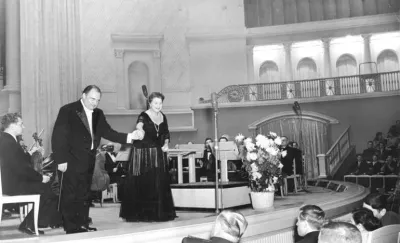
Margarete Klose
Human Design Chart
Biography
Klose worked with all the great singers and conductors of her time and was a favourite of Wilhelm Furtwängler, who engaged her for his famous last recording, Wagner's Die Walküre in 1954.
She was engaged alternately at Berlin State Opera (1932 to 1949 and 1955 to 1961) and Deutsche Oper Berlin (1949 to 1958).
She died in Berlin on 14 December 1968, aged 69.
The Human Design of Margarete Klose: Manifesting Generator 1/4
Manifesting Generator 1/4 — Design at a Glance
Margarete Klose was someone who acted with remarkable speed and often juggled multiple threads simultaneously. Her manifesting Generator design combined the constant energy source of the sacral center – typical for Generators – with the ability to skip steps and quickly bring results to life. This hybrid nature allowed her to set things in motion rapidly, but it also carried the risk of missing important stages or overextending herself through parallel projects.
Her life task was not to initiate herself but to respond to inner impulses. Only when the sacral center gave a clear 'yes' did her actions yield lasting satisfaction. If it didn't, frustration – her specific form of exhaustion – would arise as speed without direction could lead nowhere. With proper alignment, through constant querying of internal approval, Margarete Klose found deep fulfillment in her work. She benefited from variety and a playful approach to tasks; the demand to focus strictly on one thing would have slowed rather than boosted her energy. Her path was marked by the dance between rapid implementation and the need to pause repeatedly to ensure she followed the right impulse.
Sacral Authority
Margarete Klose demonstrated a direct, body-based way of decision-making. As a Generator, her design fundamentally simplified this process: her strategy and inner authority aligned. She possessed sacral authority, meaning she didn't act through prolonged deliberation or emotional weighing but trusted immediate physical reactions.
A prerequisite for clear leadership was her open emotions center. Without quick emotional impulses, she could clearly perceive her sacral response – often as gut feeling, surge of energy, or a loud 'mmh' in agreement versus a disapproving sound in disagreement – when her system responded to an external stimulus. She felt vital and energized, enabling her to dive into activities with great enthusiasm without them needing to fulfill a strict purpose; the joy of doing stood foremost.
Additionally, her activated spleen acted as supportive authority. This connection allowed Margarete Klose to react particularly quickly and spontaneously. She had direct access to her instinctive perception and physical well-being. This mechanism enabled her to make real-time decisions guided by a deep inner sense for what felt right and sustainable. Her life energy thus ignited not through planning but through spontaneous engagement with what her senses perceived as fitting and alive.
The 1/4 Profile — Investigator / Opportunist
Margarete Klose, showing herself through her 1/4 profile known as 'Researcher / Networker', was a person deeply driven by thorough knowledge. Line 1 conveyed to her the desire to grasp and understand things in detail. Simultaneously, she sought a familiar community to share these insights – a core trait of Line 4.
This interplay shaped her way of authority: She exercised leadership through careful research and reliance on facts (Thor-7 Line 1). Yet Line 4 also brought significant fear of being exposed before loved ones if her knowledge was still insufficient. This potential heartache made a loving environment with deep trust essential for her. Only in such safe spaces could her networking ability fully come into play, developing her into an authority on her heart themes.
Line 4 further promoted discretion and focus on higher goals rather than external recognition (Venus elevated). Proper timing when changing direction was crucial for her to avoid conflicts and protect spiritual insights. Thus, her design balanced the strict research spirit of Line 1 with the sensitive, network-oriented nature of Line 4.
Single Definition — Defined & Open Centers
Margarete Klose was someone who possessed a reliable internal identity and direction, connected to a constant source of vital energy. Her defined G Center gave her stable self-esteem and the ability to speak her own truth, while her also defined Sacral Center equipped her as a Generator: She had an enormous energy source that was activated through reactions to external impulses. Her communication, guided by her defined Throat Center, flowed directly from these inner resources – whether it was from her identity or her sacral response – making her expression clear and honest.
At the same time, Margarete Klose was open in several areas to environmental influences. Her open Head and Ajna Centers meant that she did not have a constant mental inspiration; instead, she tended to engage with questions that were not her own concern or sought answers to other people's problems, which could lead to mental confusion. The open Heart Center made her vulnerable to the pressure of proving her worth through promises and willpower, even though this energy source was not anchored in her. Additionally, her open Solar Plexus absorbed the emotions of the environment, leading her to experience foreign feelings as her own and often avoid confrontation out of fear of emotional escalation. Finally, her open Spleen Center made her susceptible to survival fears and clinging to unhealthy situations to gain a false sense of security, while her open Root Center inclined her to take on and amplify external stress and pressure from the environment rather than generating it herself.
Channels for logical leadership, inner truth and reflection.
Margarete Klose was someone who sought leadership not through authority but through logical classification and collective trust. Her design included the Alpha Animal Channel 7-31, which connected the G Center with the Throat Center. This gave her the ability to recognize patterns and clearly articulate them, provided she was invited by her environment to take on this role. She was designed to act as a 'power behind the throne' by offering logical structures that others could follow rather than exercising absolute control.
Parallel to this, the Research Channel 34-10 determined her inner stance. Connecting the Sacral Center with the G Center, this configuration promoted deep self-acceptance and independence. Margarete Klose learned to trust in her own convictions and react authentically without being pressured by external expectations. This energy strengthened her self-confidence and allowed her to live out her uniqueness, which in turn encouraged others to value themselves.
Another defining aspect was the Lost Son Channel 13-33, also between G Center and Throat Center. Here there was a tendency towards reflection and listening. She gathered experiences and secrets but then withdrew to process them before passing them on. This process of patience and waiting for truths to reveal themselves helped her bring life stories into meaningful context.
Additionally, Gates like 59 (genetic bonding strategy), 46 (surrender in the here and now) as well as 9 (detail work) influenced her personality, while Design Gate 15 supported collective rhythms. The combination of these elements created a profile based on patient observation, logical leadership when invited, and authentic self-being.
Collective Circuitry — Circuit Signature
Margarete Klose was someone with deep inner strength. Her design connected the Sacral and Identity Centers directly through the Research Channel. This connection created a stable foundation of life energy and self-esteem that allowed her to clearly define her own individuality. She had a strong internal compass that enabled her to rest within herself and trust in her own convictions.
Parallel to this, two additional circuits operated separately from each other. The Understanding Circuit connected her Throat with the Identity Center through the Alpha Animal Channel. This gave her the ability to clearly articulate logical strategies and future-oriented insights. She could share rational insights free of emotional distortion to improve structures.
At the same time, the Finding Meaning Circuit also connected her Throat with the Identity Center, this time through the Lost Son Channel. Here it was not about cool logic but processing past experiences emotionally. Margarete Klose reflected on emotional waves from her history and sought their deeper meaning. She shared these insights with her environment so others could learn from them.
Although both circuits touched upon the Identity Center, the energetic flows of logic (future) and emotion (past) were not directly connected to each other. They existed as parallel forces: one side strategic clarity for tomorrow, the other emotional depth of the past. Both flowed into her expression power while her core remained in constant inner centering through the connection between Sacral and Identity.
Right Angle Cross of the Sphinx 3
Margarete Klose carried the design of the right Sphinx 3 cross. This configuration shaped her inner stance through a deep connection to what is considered sacred or inviolable. In Human Design, this cross describes the ability to clearly distinguish between the profane and the sacred and to preserve that distinction. It was not about imposing dogmas but rather about maintaining the integrity of the Inner Space – an area that must be protected from external contamination.
This structure endowed her with a quiet authority in spiritual or ethical questions. She was destined to act as a guardian of inner truth without needing to loudly proclaim it. The focus was on preserving boundaries and respecting the unseen. In her life, this often manifested as a reserved but persistent presence that helped others define and protect their own sacred spaces. It was less about active engagement in the material world and more about quietly securing internal foundations. Margarete Klose lived this role through how she anchored values and protected them from distraction. Her design challenged her to vigilantly guard the threshold between the mundane and the transcendent, often serving as a stabilizing force for others during uncertain times.
Saturn Return · Uranus Opposition · Chiron Return · 2nd Saturn Return — Life Cycles
Margarete Klose made her stage debut in Ulm in 1926 at the age of 27. For her design, this marked the first Saturn Return, a cycle that often only crystallizes into a tangible and visible result after years of inner and outer preparation work. This moment was not a spontaneous impulse decision but rather the concrete crystallization of a long-term development line. The first Saturn Return functions in Human Design as a test for one's own structure: what previously existed merely as potential or uncertain direction now gains substance and durability. For Margarete Klose, this meant that her artistic orientation in Ulm was not just a beginning but the moment when her path solidified and received a sustainable foundation. The debut thus stood for the consolidation of her identity as an artist, supported by the maturity brought about by this planetary cycle. It represented the transition from preparation to established practice, a process depicted in her chart as a necessary phase of stabilization.
Manifesting Generator · Sacral Authority — Synthesis
Margarete Klose lived a life marked by profound inner dynamism. Her constitution as a Manifesting Generator (MG) with sacral authority points to someone who possessed abundant energy and could quickly set things in motion but always relied on gut instinct to find the right direction. The profile as Researcher/Networker underscores this trait: she sought thorough knowledge (Line 1), then shared it with others through her connections (Line 4). Her defined Throat, connected to the G Center and Solar Plexus, indicated a voice that embodied logical leadership while being grounded in inner values.
A central paradox in her design lay in the interplay between MG energy and the need for thorough research. While she could potentially push things forward quickly, her profile required deep engagement with topics to truly feel secure and share this knowledge. This likely led to an internal tension between a desire for swift action and the necessity of gathering all information – a dynamic that shaped her decisions and forced her to constantly reassess.
3 Defined Channels
Incarnation Cross - Right Angle Cross of the Sphinx 3
Solar Return
The Solar Return shows the moment when the sun returns to its exact birth position - your personal solar year.
Life Cycles
Discover the life cycles with a detailed triple view (birth chart, cycle chart, composite).
Human Design Profile
- Strategy
- To respond - wait for something to respond to
- Authority
- Sacral Authority
- Profile
- 1/4 - Investigator / Opportunist
- Definition
- Single Definition
- Incarnation Cross
- Right Angle Cross of the Sphinx 3
- Date of Birth
- 06.08.1899 21:45
- Place of Birth
- Berlin, Germany
Frequently Asked Questions
What is Margarete Klose's Human Design type?
What profile did Margarete Klose have in her Human Design?
Which authority determined Margarete Klose's decision-making process?
What incarnation cross was assigned to Margarete Klose?
When was Margarete Klose born?
Discover your own Human Design
Are you also a Manifesting Generator? Find out in a personal reading how to unfold your multi-talents and direct your energy wisely.
More Personalities
Back to overviewAaliyah

Aldair

Alexia

Alizée

Angèle

Angeli
