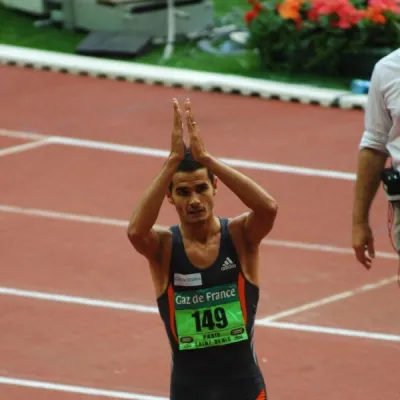
Mehdi Baala
Human Design Chart
Biography
Human Design Analysis: Mehdi Baala as Generator 6/2
Generator 6/2 — Design at a Glance
Mehdi Baala's design sets a tendency for great endurance and inner strength, comparable to that of a workhorse. This energy was not released through arbitrary initiation but required an external impulse from life upon which he could react. The central dynamics of his system lay in waiting for signals from the outside and then responding from the gut once his inner center gave a clear "yes."
This mechanism of reacting rather than initiating was key to the efficiency of his energy. When Mehdi Baala acted in this way, it led to deep satisfaction and a sense of true fulfillment. Conversely, ignoring this strategy—whether through forced initiatives or suppressing his own pleasure in a project—quickly resulted in frustration. Particularly risky for him was doing things that he did not feel an inner enthusiasm for; this led to wasting his considerable energy and threatened burnout. Equally problematic was holding back on tasks where he still had plenty of power left to work with. His design rewarded him only with inexhaustible strength when he respected the natural rhythm of his system: waiting for the impulse, then responding to it powerfully and contentedly.
Emotional Authority
Mehdi Baalas design points to a tendency towards emotional calmness when making decisions; spontaneous impulses appeared as unreliable guidance points. His inner authority is Emotional Authority, carried by the defined Solar Plexus Center. This mechanism means: Mehdi Baala was subject to a constant emotional wave with continuous ups and downs of his feelings. The world always seemed colored by his current mood – one moment totally excited about something, in the next completely negative about the same thing.
However, his feeling in the immediate present was only a snapshot, a first impression that did not necessarily represent his truth yet. Quick, spontaneous decisions based on such emotion could therefore have very negative consequences. The more time Mehdi Baala took to let a decision mature, the deeper and more comprehensive he could perceive the situation. This required patience and repeatedly "sleeping on" decisions. He should take his time and ask himself multiple times. Over time, intense feelings subsided, he gained emotional distance, clarity emerged, as well as calmness. Only then had he gone through the process. This mechanism was particularly relevant for long-term decisions with a significant impact on his life course. Emotional Authority always took precedence over other defined centers in his chart, regardless of what else was defined.
The 6/2 Profile — Role Model / Hermit
Mehdi Baal's design sets a biphasic life development: A first phase until the age of 30, characterized by experimental "trial and error", followed by a second phase around thirty years old, marked by intense withdrawal, distancing, and healing.
This dynamic stems from his Profile 6/2 (Role Model/Natural Talent). Before Saturn's return, the sixth line acted like a third: Mehdi Baal sought answers through direct experience, where repeatedly overstepping boundaries led to punishment and thus development. This required patience and served to build self-discipline through experience.
Around thirty years of age, his actual sixth line activated. Mehdi Baal then showed a tendency for deep withdrawal – metaphorically into a "cave" – to look back at the earlier experiments from a distance. This period of intense reflection was also a phase of healing and deeper self-awareness, necessary to find the right answers from the excesses of youth.
The second line underscored this through his natural talent for selfless service to the collective. His contribution often occurred inconspicuously or unusually. Only when Mehdi Baal emerged from his withdrawal could he act as a wise role model whose introspection attracted others. The dilemma of this line lay in the fact that his individual contribution to group goals was not always recognized, potentially leading to crises if the service was not performed or understood.
Triple Split Definition — Defined & Open Centers
Mehdi Baala's Human Design signals a high level of internal structure and energy capacity through seven defined centers. He is someone with a stable identity (defined G Center) and clear direction, coupled with strong willpower (defined Heart). His mental clarity (defined Ajna) flows directly into reliable communicative manifestation over (defined Throat), allowing him to consistently carry his concepts and opinions outward. As a Generator, Mehdi Baala has the defined Sacral Center, a massive energy source for work and life that is strictly reactive: Only by waiting for the right invitation can he avoid frustration and effectively deploy his vital force.
Additionally, his defined Solar Plexus and defined Spleen determine his emotional depth as well as an intuitive, momentary perception. The Solar Plexus functions as internal authority, requiring the emotional wave to be waited out before decisions are made; the Spleen provides spontaneous, instinctive judgments in the here and now.
In contrast, his Head and Root Centers were open. These open centers made him sensitive antennas for external pressure. The open Head Center tends to absorb mental inspiration or doubt from the environment without being responsible for it; here it was necessary to protect one's own process from unnecessary questions. Similarly, the open Root Center absorbed adrenalized stress and chaos from the surroundings. Mehdi Baala was not designed to carry or resolve this pressure but had to learn to recognize it as foreign and guard against falling into an endless cycle of overcompensation. His strength lay in utilizing his defined structure while protecting the open areas from conditioning influence.
Channels for intimacy, inspiration, acceptance and devotion.
Mehdi Baala's design tends towards constant, authentic radiance that arises through individual role modeling. His attention is not generated by explanations but by presence and the courage to be unique. This effect relies on the Inspiration Channel 1-8 in his design: Gate 1 allowed him to creatively express his mutative perspective, while Gate 8 brought this contribution into the group. The mechanics describe this as a public outlet for creative potential and leadership; the effect came through living his individual direction, not through words. He was designed to act as a living example and inspire others towards their own uniqueness, provided that authority comes from inner authenticity.
At the same time, the Pairing Channel 59-6 in his personality shapes how he handles relationships. Here intimacy is experienced as an emotional wave, connected with a strong merging drive. Gate 59 steers sexual energy while Gate 6 determines the emotional wave movement of pleasure and pain. This configuration requires patience and correct timing for clarity; without waiting out the emotional cycles, confusion or misinterpretations of intensity by others are at risk. The mechanics show that true connection only arises when one lets the emotional wave subside to see if a lasting bond exists. Thus, his inspiring public presence complements a private dynamic that needs time and emotional maturity to deepen relationships.
Tribal Circuitry — Circuit Signature
Mehdi Baala's design reveals three separate, parallel operating energy streams. The Knowledge Circuit connects his Throat with the Identity Center through the Inspiration Channel (Gate 8-1). This creates a pulsating acoustic energy aimed at directly expressing individual creativity and new insights. Parallel to this, the Understanding Circuit works through the Acceptance Channel (Gate 17-62), which links Ajna and Throat. Here it is about focused visual logic: sharing rational strategies for improving the future free from emotional coloring.
A third independent stream forms in the Ego Circuit. The Devotion Channel (Gate 26-44) connects Heart with Spleen. This connection promotes cooperative resource building through mediation and traditional values, without direct life force from the Sacral Center. Finally, the Archer Circuit links the Sacral with Solar Plexus Center over the Pairing Channel (Gate 59-6). This brings primal protective energies: instinctive care and emotional bonding for genetic preservation.
As Mehdi Baala has a Triple Definition, these systems do not exist as a continuous flow but as separate energy fields. The inspiring individuality of the Knowledge Circuit stands alongside the strategic clarity of understanding and ego's cooperative resource security. This separation requires conscious navigation between spontaneous expression, logical analysis, and tribal support, with each level pursuing its own rhythms and demands.
Left Angle Cross of Revolution 2
Mehdi Baala's Human Design suggests a tendency towards profound transformation characterized by breaking old structures and initiating new orders. This configuration represents the archetypal power of the left cross of Revolution 2, describing not just a predisposition to unrest but a driving energy that systematically questions and transforms the status quo. The focus is on the ability to break established patterns to make room for innovative perspectives. It's an inner dynamic that doesn't merely allow change but actively propels it forward. This force acts as a catalyst for processes where the old must step back to make way for new creation. In this context, Mehdi Baala was marked by revolutionary energy, always ready to overcome existing boundaries and pave new paths. The mechanics of this cross underscore the importance of transformation as a central life principle, often radical and comprehensive in nature. It's more than superficial adaptation; it's a fundamental shift affecting both the individual and their environment. This energy challenges one not to remain on the surface but to address the roots of problems and develop sustainable solutions.
Saturn Return · Uranus Opposition — Life Cycles
Mehdi Baala's design points towards consolidation of identity as youth ends, showing him taking responsibility for his life path once he transitions into adulthood. This development marks a shift from dependency to true self-determination.
This process corresponds with the first Saturn return, typically occurring around age 29. In this cycle, years of experience and groundwork solidify into a stable foundation. The inner structure is reinforced so that clear alignment with one's path becomes possible. It’s not about external pressure but internal maturity in recognizing and consistently applying personal authority.
In 2006 at the age of 28, Mehdi Baala clearly marked this point in his career by successfully defending his European Championship title in Göteborg. This success was no coincidence but evidence for the mechanics of Saturn return. The previous phase of searching and learning culminated here with a confirmed position. Through this concrete achievement, newly gained self-determination became visible. Winning the title underscored that he had established his identity not just theoretically but through tangible results. Thus, Saturn return acted as a catalyst by linking inner maturity with external recognition. Baala used this moment to secure his position and conclude the transition into adult self-responsibility.
Generator · Emotional Authority — Synthesis
Mehdi Baala navigates life with a deeply rooted inner authority that manifests in emotional waves. His ability to find clarity only after waiting shapes his decisions and actions, supported by a defined G Center suggesting strong self-understanding and direction – an internal compass guiding him through the complex terrain of experiences. The connection to Heart Center enhances this inner strength and the will to walk one's own path while the defined Ajna Center ensures consistent thought structures. This combination points towards a personality that is both deeply introspective and goal-oriented in pursuing visions – a role model gaining wisdom through experience and sharing it.
However, Baala seems to operate within a tension field between the need for inner clarity and impulsive bodily energies. A defined Sacral Center indicates immense work capacity but one activated only by reacting to external impulses. Simultaneously, his mind is strongly pronounced and tends towards initiating things, which contradicts sacral strategy. This interplay between the drive to act and the necessity of waiting could be a central dynamic in his life – an ongoing balance between inner guidance and outer action.
4 Defined Channels
Incarnation Cross - Left Angle Cross of Revolution 2
Solar Return
The Solar Return shows the moment when the sun returns to its exact birth position - your personal solar year.
Life Cycles
Discover the life cycles with a detailed triple view (birth chart, cycle chart, composite).
Human Design Profile
- Type
- Generator
- Strategy
- To respond - wait for something to respond to
- Authority
- Emotional Authority
- Profile
- 6/2 - Role Model / Hermit
- Definition
- Triple Split
- Incarnation Cross
- Left Angle Cross of Revolution 2
- Date of Birth
- 17.08.1978 04:45
- Place of Birth
- Strasbourg, France
Frequently Asked Questions
What is Mehdi Baala's Human Design type?
What Profiles does Mehdi Baala have in Human Design?
What authority does Mehdi Baala have?
Which incarnation cross is active for Mehdi Baala?
When was Mehdi Baala born?
Discover your own Human Design
Are you also a Generator? Find out in a personal reading how to use your sacral energy correctly and discover deep satisfaction.
More Personalities
Back to overviewAaliyah

Aldair
Alexia

Angèle

Anne-Marie

Arcángel