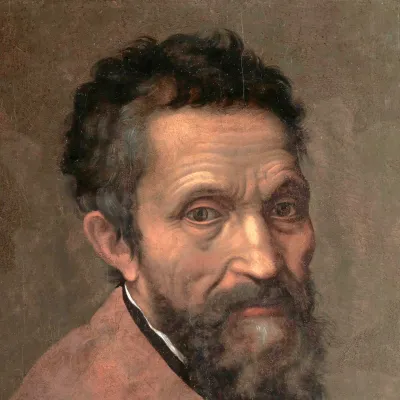
Michelangelo
Human Design Chart
Biography
The son of an official, Michelangelo Buonarotti was sent at age 13 as a pupil to the Ghirlandaio brothers, who were noted artists. He painted his first picture in their studio. At 15, some of his early sculptures drew the attention of Lorenzo de Medici. Michelangelo went to live with Lorenzo, and during his two-year stay there, became acquainted with some of the leading Renaissance artists and writers.
In 1496, Michelangelo went to Rome, and over the next five years created the magnificent Pieta in St. Peter's Church, a sculpture of the dead Jesus in the arms of his mother Mary at the foot of the cross. After the creation of the Pieta, Michelangelo was considered the greatest sculptor of his day.
His statue of David, which established him as a master of human anatomy, was created from 1501 to 1504. It was the largest marble state to be carved in Italy since the end of the Roman Empire.
In 1508, he began what was to be his greatest painting. He had been ordered by Pope Julius II to decorate the ceiling of the Sistine Chapel in the Vatican. The painting took over four years to complete because he worked totally alone, most of the time on his back on a scaffolding. The painting shows different Biblical scenes.
Between 1536 and 1541, he painted the "Last Judgment" on the altar wall of the Sistine Chapel.
His final years were devoted to architecture. In 1546, he was appointed chief architect of St. Peter's Church in Rome, and designed its dome. He received no pay for this work, believing that it was his religious duty. He also devoted time to poetry in his later years.
Human Design Analysis: Michelangelo as Manifesting Generator 4/1
Manifesting Generator 4/1 — Design at a Glance
Michelangelos design featured a hybrid nature: the lightning-fast action capability of a Manifestor combined with the constant energy source of a Generator. This configuration allowed him to skip steps and achieve results in the shortest time possible. Yet, this speed harbored an inherent paradox. Often, haste led to important intermediate steps being skipped, inevitably causing setbacks and frustration – his specific non-self theme. Alternatively, he pursued multiple projects simultaneously through his responsiveness to numerous impulses. Without constant validation, this creative drive quickly turned into overextension.
The key to his effectiveness lay not in mere initiative but in responding. Only when his Sacral Center – the source of his energy – signaled a clear “Yes!”, could he proceed. This process of continuous verification ensured that his energy was not wasted. When applied correctly, this strategy led to a playful mode. Variety and fun then became the fuel for his creativity. Instead of proceeding linearly, Michelangelo thrived in dynamic parallelism across various tasks as long as each one was backed by inner consent. His speed thus transformed from an obstacle into a tool for deeper satisfaction, provided he remained in the flow of reaction rather than the compulsion to anticipate.
Sacral Authority
Michelangelos design featured a tendency towards spontaneous, physically grounded decisions. As a Generator, he possessed sacral authority, meaning his strategy of responding was also his inner decision-making instance. This configuration simplified his process: He reacted not through abstract planning but through immediate resonance with external stimuli.
His inner guidance manifested in physical signals – a gut feeling or a palpable surge of energy. Externally, this could be heard as grunting, humming, or a loud “Mhm”. As long as his emotional center was open, this sacral response served as a reliable compass. When his internal motor latched onto something, he felt vital and alive. Then, an almost inexhaustible energy became available to him, enabling him to tackle tasks with great enthusiasm.
This design marked him as someone born to walk through life with joy and satisfaction. He could immerse himself in his work without the need for a purpose-driven approach. The energy arose from the act itself, not from an external goal. Through this direct connection between stimulus and physical response, Michelangelo acted authentically, guided by an inexhaustible life force that automatically activated upon suitable input.
The 4/1 Profile — Opportunist / Investigator
Michelangelos design featured a profound unchangeability of his essence. As a 4/1 (Networker/Researcher), he was the only fixed profile whose character was so deeply rooted that he rarely deviated from his individual path. This marked the transition from “I” to “You”. His large heart sought connection but rigorously protected itself against criticism. Well-meaning impulses towards change were valued as non-acceptance; such people were quickly excluded. Externally, this often appeared like stubbornness or a lack of critical thinking, which internally could nurture self-doubt. The 4-line promoted fixation on details and comparisons along with the externalization of doubts to others for answers. This generated pressure through comparison with background knowledge. Simultaneously, the 1-line emphasized achievement and possession relative to unattainable goals. Dreams should be enjoyed without getting lost in hopeless possibilities. Those who recognized his essence and rested stably within it became a “rock in the storm” and could teach others magnificently. Michelangelo showed this tension between the need for validation through the network and the inner firmness of what was already achieved. His life task lay in this juxtaposition: protecting his core from external attempts at change while simultaneously asking precise questions to secure safety for the future.
Triple Split Definition — Defined & Open Centers
Michelangelos design featured a tendency towards constant internal drive, paired with high vulnerability to external emotional and identity-forming influences. His defined Head and Ajna centers generated a permanent mental pressure: Questions arose anew constantly, concepts were continuously processed. This state was not a fleeting inspiration but a structural given that predisposed him to suffer under the burden of unresolved thoughts if he tried to implement them immediately rather than waiting for the right moment.
Simultaneously, Michelangelo possessed defined centers for willpower (Heart), vital energy (Sacral) and intuition (Spleen). This meant he had a reliable source for action capability and survival instinct. His Throat was also defined, which allowed him to consistently communicate his thoughts and will into the world – provided these actions aligned with his inner authority rather than mental pressure alone. The connection between Heart and Sacral gave him the strength to fulfill promises and provide energy for work as long as he responded rather than initiated.
In contrast, his G-Center and Solar Plexus Center were open. Michelangelo had no fixed, unchanging identity or life direction; these reflected their environment. He tended to question whether he was in the right place or who he actually was when the environment did not match. Additionally, his open Solar Plexus absorbed others' emotions like a barometer. Without his own emotional wave, he relied on recognizing and letting go of these foreign feelings rather than personalizing them out of fear of confrontation or suppressing them. This openness made him sensitive to social climates while the defined centers provided a strong foundation of energy and mental focus.
Channels for success, instinct, growth and clear vision.
Michelangelos design featured a tendency towards material sovereignty through will expression. He was someone who took responsibility for resources and sought control over his life rhythm. This stance stemmed from the channel of the Money Line 21-45, which connected Heart with Throat. Gate 21, the Hunter’s Gate, pressed for control to ensure peace, while Gate 45, the Voice of the Collector, authoritatively decided whether something was realized or not. This channel demanded independence; Michelangelo worked best as his own boss who determined what and when he acted to protect his Heart from stress.
Additionally, the channel of Devotion 44-26, which linked Spleen with Heart, came into play. Here, the awareness of Gate 44 combined with the ego strength of Gate 26. This gave him an instinctive sense for what the tribe needed before it knew itself. He could sell products or ideas persuasively by using historical memories and his willpower to steer the tribe towards his benefit. Success here required a balance between hard work and rest, as he accomplished more in compressed timeframes than others did over entire days.
The channel of Maturity 53-42 connected Root with Sacral Center. Through Gate 53 of Beginnings and Gate 42 of Growth, Michelangelo cycled through experiences until completion. He had to fully complete each cycle and reflect on it to gain wisdom before embarking on new paths. This created a deep connection to history and demanded patience as premature ending of cycles led to repetitions.
Mentally, the channel of Abstraction 64-47 shaped his experience. Gate 64 of Confusion and Gate 47 of Understanding filtered every experience through mental images. His mind constantly sought meaning in past and present, which could lead to inner unrest until clarity suddenly emerged. This mental energy served to discover inspiring stories or new perspectives that he then shared rather than using them for his own problems.
Collective Circuitry — Circuit Signature
Michelangelos design showed a divided structure: two independent, side-by-side energy blocks without direct connection to each other. This created high situational openness; he strongly reacted to external impulses as his inner compass was not consistently set.
One block connected Head-, Ajna- and Sacral centers with the Root Center (Soul-Finding Circuit). Here, past energy cycled cyclically like an emotional wave. Michelangelo reflected on past experiences to understand their meaning and shared these emotionally colored insights with others. This process proceeded in waves: Phases of intense processing followed by calm phases until insight matured.
The second block connected Throat-, Heart- and Spleen centers (Ego Circuit). Here, it was about cooperation and building collective resources. Through the channel of Devotion (26-44), he showed himself communicative and supportive while the Money Line (45-21) steered the accumulation of material values. Crucial was the lack of connection to the Sacral Center in this block: Without a constant life force source, Michelangelo had to take regular rest pauses to regenerate his resources for exchange with others. These two systems – emotional soul-finding and cooperative resource creation – existed parallel without directly overlapping.
Juxtaposition Cross of Doubt
Michelangelos design established a fundamental stance constantly confronting contradictory truths. He appeared as someone whose inner landscape was marked by deep dissonance, as his chart bore the so-called Juxtaposition Cross of Doubt. This configuration indicated that clarity for him could not be found through simple answers but only in the coexistence of extremes and opposites.
The mechanics of this doubt served no mere state of confusion but functioned as an integrative process. The goal was never complete resolution of all questions or attainment of absolute certainty. Instead, his life task lay in developing the ability to exist within the tension field between opposing positions. From this persistent ambivalence, he could gain deeper insight even if it remained constantly accompanied by uncertainty. It was about accepting contradictions as a necessary part of his perception. Michelangelo lived not despite but through doubt; his identity formed through constant confrontation with what excluded yet simultaneously existed. This structure allowed him no calm certainty but offered the possibility to a more complex, albeit uncertain truth.
Saturn Return · Uranus Opposition · Chiron Return · 2nd Saturn Return — Life Cycles
Michelangelos artistic career followed a clear cyclical structure where planetary phases marked concrete milestones. The first Saturn Return around age 28 condensed years of groundwork: In 1503, his sculpture was largely complete. This phase signaled the transition from apprenticeship to established mastery, a moment when inner discipline became visible externally.
At age 37, the Uranus Opposition began, a time of rupture and expansion. In 1512, he completed the ceiling execution. This cycle often promoted radical innovations or the completion of large visionary projects, where transformational pressure led to breakthroughs.
The Chiron Return around age 49 ushered in a phase of fulfillment as his incarnation purpose deepened. In 1524, he received an assignment for the Laurentian Library staircase. Here, healing was not therapeutic but the maturation of his unique gift: creating space-defining structures that instilled meaning and order.
The second Saturn Return around age 58 brought further validation through authorities. In 1533, Sebastiano del Piombo wrote about a spectacular commission from Pope Clement VII. This cycle affirmed his position and responsibility within established structures by entrusting him with prestigious tasks based on proven competence. Each of these cycles correlated directly with papal commissions and the creation of his works.
Manifesting Generator · Sacral Authority — Synthesis
Michelangelo was a Manifesting Generator whose life was marked by deep, sacral-driven energy. The constant availability of power (Sacral Center) enabled him an impressive work style – he could seemingly effortlessly initiate and push projects forward (Manifestor aspect). Yet, his definition in Head- and Ajna Centers pointed to an unceasing mental process, a continuous questioning and understanding. This combination of sacral reaction and mental pressure led to a working style characterized by phases of intense activity followed by necessary moments of reflection and contemplation (Channel 21-45, Maturity Circuit). His profile as Networker/Researcher (4/1) amplified this tendency further, as he was deeply rooted in his convictions while simultaneously seeking connection with a larger collective.
A central paradox in Michelangelos design lay in the tension between his ability for quick initiation and the need for cyclical maturation (Channel 53-42). He could begin something with great energy, yet it required time and completion of full cycles to gain wisdom from experiences. This discrepancy between impulsive power and the need for deep reflection created an inner dynamic that propelled him to continually take on new challenges while trying to let acquired insights flow into his work (Cross of Doubt).
4 Defined Channels
Incarnation Cross - Juxtaposition Cross of Doubt
Solar Return
The Solar Return shows the moment when the sun returns to its exact birth position - your personal solar year.
Life Cycles
Discover the life cycles with a detailed triple view (birth chart, cycle chart, composite).
Human Design Profile
- Strategy
- To respond - wait for something to respond to
- Authority
- Sacral Authority
- Profile
- 4/1 - Opportunist / Investigator
- Definition
- Triple Split
- Incarnation Cross
- Juxtaposition Cross of Doubt
- Date of Birth
- 06.03.1475 01:45
- Place of Birth
- Caprese Michelangelo, Italy
Frequently Asked Questions
What Human Design Type was Michelangelo?
What Profile did Michelangelo have in Human Design?
What Authority did Michelangelo possess?
What Incarnation Cross did Michelangelo have?
When was Michelangelo born?
Discover your own Human Design
Are you also a Manifesting Generator? Find out in a personal reading how to unfold your multi-talents and direct your energy wisely.
More Personalities
Back to overviewAlain-Fournier

Aldair

Alizée

Angeli

Arletty

Artus