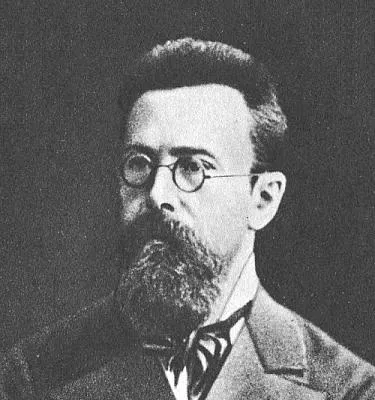
Photo: Wikimedia Commons
Nikolai Rimsky-Korsakov
Human Design Chart
Biography
He married Nadezhda Purgold in July 1872, with Modest Mussorgsky serving as best man. The Rimsky-Korsakovs had seven children. He died on 21 June 1908 in Lubensk, Russia.
Nikolai Rimsky-Korsakov as a Projector 6/2 in Human Design
Projector 6/2 — Design at a Glance
Nikolai Rimsky-Korsakov's design shows a tendency towards focused and penetrating perception. As a projector, he did not have a constant intrinsic source of life energy but rather acted like a bright flashlight that was directed specifically to weak spots in his environment. This mechanism allowed him to immediately recognize systematic errors or inconsistencies in others. However, directly addressing these deficits risked resistance; it was more elegant for him to attract others through his own harmony and thus encourage them to actively seek out his insights. His strategy involved waiting for value-based invitations rather than independently pushing forward. Due to his undefined Sacral Center, his energy fluctuated rhythmically: phases of intense productivity had to be balanced with necessary rest periods to avoid exhaustion. The conventional work model often ignored this need. Living by this principle rewarded him with success; deviating from it led to the theme of bitterness. His influence did not manifest through mere presence but through the quality of his targeted, inviting leadership.
Emotional Authority
Nikolai Rimsky-Korsakov demonstrated that he never made decisions immediately but always subjected them to an internal maturation period. His inner authority was Emotional Authority carried by the defined Emotional Center. This mechanism determined his decision-making process independently of all other definitions in his chart: it followed an emotional wave, a permanent up and down of feelings. The world appeared colored by his current mood; what excited him one moment could appear negative the next. Nikolai Rimsky-Korsakov understood that such first impressions did not represent truth. Quick, spontaneous actions based on transient emotions often proved harmful. Instead, he took time to let decisions mature. This process required patience and multiple reconsiderations of important questions. Only when intense feelings subsided and emotional distance was gained did clarity set in. This calm marked the end of his internal process. Particularly for long-term decisions that significantly influenced his life course, Nikolai Rimsky-Korsakov consistently followed this strategy. He consciously delayed, asked himself repeatedly, and waited until the emotional tide receded. Only then would he act confidently in his true direction, not driven by a passing mood but guided by the deep, time-matured insight of his Emotional Center.
The 6/2 Profile — Role Model / Hermit
Nikolai Rimsky-Korsakov's design as a 6/2 profile ("Role Model / Natural Talent") shaped a life path that distinctly divided into two phases. In early years, before Saturn returned around age 30, the energy primarily functioned along the third line. This fostered an attitude of experimenting and intensive learning through trial and error. Mistakes were not seen as final destinations but as necessary steps for correction; after each failure followed a retreat to realign.
After turning 30, the sixth line was fully activated. The focus shifted from external experimentation to deep introspection and distancing. This phase served healing and self-awareness by looking back at his earlier experiments from great heights. The second line contributed to filtering this reflection through painful experiences. It was crucial to recognize and master the natural tendency towards exaggeration or unconscious distortion of one's own memories.
From this long period of inner work, a wise attitude eventually developed. Nikolai Rimsky-Korsakov did not emerge as an isolated hermit but became a leadership figure who learned from the past to ask new questions. His ability to transform nostalgia into constructive mutation enabled him to serve as a role model for others and introduce them to the art of deep self-reflection.
Single Definition — Defined & Open Centers
Nikolai Rimsky-Korsakov was characterized by a profound emotional authority that required patience and waiting for clarity. His defined Solar Plexus Center acted as an inner compass: decisions were made effectively only after navigating the emotional wave, not in impulsive highs or lows. This mechanism fostered a sensitive, multi-layered perception that needed time to unfold. Simultaneously, his defined Root Center established a persistent internal pressure that propelled him forward and nourished existential and emotional awareness. However, this constant drive was in tension with his open centers.
His open Head and Ajna Centers made him vulnerable to mental confusion and the pressure of finding answers for others' questions or regarding concepts as personal truth. He tended to be guided by inspiring thoughts without always critically assessing them, which could lead to inner unrest. His open G Center meant a lack of stable identity; he often sought direction and love through adapting to his environment rather than acting from a stable sense of self, leading him to lose himself in relationships or places that were not correct for him to find security.
Additionally, his open Heart and Sacral Centers influenced him: He tended to want to prove his worth by making promises or overworking, despite lacking the consistent energy needed. His open Sacral Center made him sensitive to others' life force, which could lead to exhaustion if he did not set boundaries. His open Spleen Center amplified fears of survival security and well-being, causing him at times to cling to unhealthy structures just for a sense of safety. Overall, his design showed a person marked by emotional depth and inner drive but always learning to avoid misinterpreting mental and energetic influences from the environment as personal authority.
Channels for impulsive drive and intuitive emotional energy.
Nikolai Rimsky-Korsakov was someone whose internal urge towards innovation was strengthened by emotional waves. This resulted from Channel of Recognition 41-30: The Root pressure of Gate 41 generated restlessness and daydreaming, while Gate 30 emotionally heated these impulses up. The result was a strong desire for new experiences that required patience to gain clarity.
His mental striving was marked by doubt and the wish for security (Gate 63) as well as interpreting past experiences to form clear concepts (Gate 64). This combination fostered an imaginative thought process, resolving uncertainties through contemplation.
In the realm of will and social dynamics, Gate 26 combined a weak ego with the ability to sell innovations in a conservative environment, while Gate 45 represented tribal energy and hierarchy. These gates emphasized a focus on collective cohesion and material structuring.
Additionally, Gate 58 contributed to an energy that drove experiments and the refinement of patterns, always aiming to improve life processes and secure safety for the future. Gate 49 in the Solar Plexus Center added that emotional waves steered discernment regarding principles and resource distribution, with compliance towards tribal rules playing a role.
Overall, Nikolai Rimsky-Korsakov's design was marked by a tension between an impetuous desire for experience and the need for emotional reflection, supported by mental striving for clarity and social orientation toward innovation within existing structures.
Collective Circuitry — Circuit Signature
Nikolai Rimsky-Korsakov showed himself as someone whose inner processing was strongly influenced by emotional wave movements. His experiential world did not follow a linear, cool logic path but rather a cyclical pattern with clear beginning, middle, and end. This structure resulted from his simple definition: The energy flowed directly between the Solar Plexus and Root Centers.
This specific channel, Recognition (Gates 30 and 41), connected the emotional intuition of the Solar Plexus to the deep, instinctive processing speed of the Root Center. While other areas of the design might look towards the future, this connection pointed backwards toward the past. Nikolai Rimsky-Korsakov did not just analyze past events but felt their meaning through an emotional wave-like movement. This realization was often inexplicable to pure reason as it arose from the feeling world.
The goal of this energetic configuration was to share these emotionally gained insights with the collective. Through this sharing, lessons were meant to be learned collectively from the past. Since both centers lay in a single group, there emerged an unbroken, uninterrupted flow. There were no separate or conflicting energy poles within this circuit; instead, the connection worked as a cohesive force that merged emotional depth with the urgency of the Root Center. This shaped his way of integrating experiences and conveying them in a form that could emotionally touch others without relying on dry rationality.
Left Angle Cross of Dominion 1
Nikolai Rimsky-Korsakov's design suggests a tendency towards a clear and structured approach to questions of authority and personal influence. This configuration, known as the left cross of the domain of power, shaped his way of dealing with power structures: not through chaotic rebellion or blind obedience, but through a conscious, often analytical engagement with them, where true authority lies.
In Human Design, this cross describes a specific energetic alignment that deals with defining boundaries and hierarchies. It is not about striving for dominant control in a negative sense, but rather the need to understand the rules of a system and act effectively within these conditions. Nikolai Rimsky-Korsakov thus appeared as someone who always clearly defined his position relative to others. He sought an order that took into account both his own self-understanding and the expectations of his environment.
This mechanism affected him in such a way that he did not avoid conflicts over power or influence, but saw them as necessary parts of his development. Through the left cross of the domain of power, he learned to internalize authority beyond just receiving it from others. This allowed him to act with a certain calmness and strategic distance in situations requiring clear decisions. His path was characterized by the pursuit of balance between personal will and the demands of the environment, without compromising his integrity.
Saturn Return · Uranus Opposition · Chiron Return · 2nd Saturn Return — Life Cycles
Nikolai Rimsky-Korsakov's design suggests a tendency towards stable anchoring that intensified particularly during his second decade of life. In 1872, at age 28, he married Nadezhda Nikolayevna Purgold. For his Human Design, this was not just coincidence but a typical expression of the first Saturn Return cycle. This astronomical return marks the transition from experimental youth to structural maturity. During this phase, years of internal groundwork often crystallized into durable life decisions. The marriage signaled in Rimsky-Korsakov's design readiness to take responsibility for long-term commitments and secure his personal foundation. It was a period of consolidation where individual strategies were oriented towards durability. The Saturn Return functioned here as a catalyst for establishing a stable partnership that should serve as a stabilizing factor in the further course of life. This configuration underscores how cosmic cycles can accompany concrete biographical milestones by aligning inner maturity with external commitments. Rimsky-Korsakov used this moment to strengthen his private sphere and lay a foundation for future developments.
Projector · Emotional Authority — Synthesis
Nikolai Rimsky-Korsakov lived deeply within the perception of past cycles and their significance for the collective. His defined Emotional Center (and the associated emotional authority) as well as the Channel of Recognition (Gate 30/41) pointed to a nature constantly seeking meaning behind things – not in the present moment, but through processing experiences and feelings. This ability to recognize patterns in the past and draw conclusions from them was central to his essence and shaped his approach to creative processes. He was destined to gain insights from the waves of his emotions and share these with others.
A fundamental paradox lay in the combination of his Projector type and Role Model Profile. As a Projector, he possessed the ability to recognize the potential of others and 'shed light into darkness,' yet his emotional authority required time for decision maturation. This could lead to tension between the impulse to give immediate feedback (through recognizing errors) and the necessity to wait out the emotional wave to grasp deeper truth. The early years of experimentation, followed by withdrawal for reflection, reinforced this cycle of activity and contemplation.
1 Defined Channel
Incarnation Cross - Left Angle Cross of Dominion 1
Solar Return
The Solar Return shows the moment when the sun returns to its exact birth position - your personal solar year.
Life Cycles
Discover the life cycles with a detailed triple view (birth chart, cycle chart, composite).
Human Design Profile
- Type
- Projector
- Strategy
- Wait for the respectful invitation
- Authority
- Emotional Authority
- Profile
- 6/2 - Role Model / Hermit
- Definition
- Single Definition
- Incarnation Cross
- Left Angle Cross of Dominion 1
- Date of Birth
- 06.03.1844 16:53
- Place of Birth
- Tichvin, Russia
Frequently Asked Questions
What was Nikolai Rimsky-Korsakov's Human Design type?
What profile did Nikolai Rimsky-Korsakov have?
What authority did Nikolai Rimsky-Korsakov have?
What incarnation cross did Nikolai Rimsky-Korsakov have?
When was Nikolai Rimsky-Korsakov born?
Discover your own Human Design
Are you also a Projector? Find out in a personal reading how to unfold your leadership qualities and recognize the right invitations.
More Personalities
Back to overviewSissy Spacek
Aaliyah

Alain-Fournier
Alexia

Alizée

Anémone