
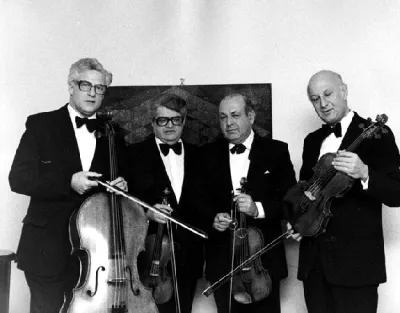
Norbert Brainin
Human Design Chart
Biography
Human Design Analysis: Norbert Brainin as Manifestor 5/1
Manifestor 5/1 — Design at a Glance
Norbert Brainin was someone who moved forward with a clear vision that not everyone immediately understood. As a Manifestor, he was a pioneer whose task was to lead the world into a new future. His design worked similarly to that of a Roman Emperor: He had the big idea, but he did not fight the necessary battles himself; instead, he sent others out to achieve the goals.
This kind of leadership polarized people. Because he often thought ahead of his environment, he was misunderstood. Some people loved his big dreams and followed him, while others disliked him because of these visions or even hated him. This pain point of being misunderstood was a central aspect of his experience.
To find the right followers, it was crucial for him to inform others about his plans in a timely and precise manner. This strategy of informing was the key to his success. If he followed this strategy, he was rewarded with a feeling of inner peace. If he lived against his design, however, he felt a persistent, deep anger. His path was thus marked by the tension between the necessity to communicate his vision and the inevitable reaction of his environment.
Emotional Authority
Norbert Brainin was someone who did not make decisions immediately but let them mature. His inner authority was Emotional Authority, carried by the defined Emotional Center. In Human Design mechanics, if this center is defined, it determines decision-making, independent of other defined centers. Norbert Brainin was subject to an emotional wave, a permanent up and down of feelings. The world appeared to him always colored by the current mood; enthusiasm could quickly turn into negative evaluation. A feeling in the moment was, however, only a snapshot, not necessarily the truth. Quick, spontaneous decisions based on emotions often had negative effects on his design. Instead, clarity required patience and the multiple reconsideration of a decision. The more time he took, the deeper he could see. Through hesitation and asking himself multiple times, intense feelings subsided, emotional distance gained strength. Only then did calmness set in and the process was complete. This mechanism was especially important for long-term decisions that could have a significant impact on his life course. Norbert Brainin lived the necessity of emotional distancing to find true clarity.
The 5/1 Profile — Heretic / Investigator
Norbert Brainin's design laid out the structure of a 5/1 profile, acting as a Hero and Investigator. He used the depth of his personal knowledge base to provide concrete solutions for other people's problems. This configuration gave him almost magnetic qualities: Others actively sought the insights he had to offer.
His Line 5, marked by Gate 22, stood for directness and practical solutions in crisis times. This allowed him to break established behavioral rules when the mood did not fit, which was perceived as a mutative, unconventional action and could trigger negative projections in others. At the same time, his Line 1, connected to Gate 11, provided Serendipity – the gift of being in the right place at the right time. Here, the focus was on acceptance and cooperation with like-minded people who served as mental nourishment.
However, the Consciousness Center around Gate 11 also connected fears of darkness and anonymity, if his ideas were not recognized. Norbert Brainin thus found himself in a tension field between research for himself and problem-solving for others. The challenge was to set clear boundaries to maintain the beneficial balance and not be drained by constant requests from others. His design marked him as someone who deepened knowledge to then apply it directly and purposefully.
Single Definition — Defined & Open Centers
Norbert Brainin was characterized by a consistent and reliable way of expression that arose from a deep emotional resonance. His defined Throat Center, in conjunction with his defined Solar Plexus Center, marked him as someone who did not react impulsively but spoke and acted after processing his feelings. This configuration meant that his voice was driven by the emotional wave; he communicated what he felt, not just what he thought. His defined Root Center provided the necessary existential pressure to maintain this emotional intelligence in the material world without falling into stress.
At the same time, Norbert Brainin was open to external influences in several areas. His open G Center meant that he did not carry a fixed, unchanging identity but reflected himself in appropriate environments and relationships. He did not actively seek a direction but waited for the right place and the right people to come to him. His open Heart Center made him vulnerable to the pressure to prove himself, yet he was not designed to be willfully competitive. Instead, he took on the egos of others to learn who was trustworthy. His open Sacral Center also meant that he did not have a constant generative energy but reacted to the energy of his environment, making it difficult for him to set boundaries if he did not trust his inner authority. His open Head and Ajna Centers allowed him a flexible mind that was open to inspiration but could also confuse him when trying to solve mental problems that were not his.
Channels for focused intuition, emotional openness and cathartic release.
Norbert Brainin's design was characterized by deep emotional intensity and a strong desire for authentic expression, always guided by the inner emotional wave. This tendency resulted from the configuration of his channels, which describe a close connection between emotional authority and communicative impact.
The Openness Channel 22-12 connected his Solar Plexus Center with his Throat Center. This connection allowed him to articulate his feelings – from passion to melancholy – creatively and expressively. Crucial was the inner restraint of Gate 12, ensuring that this openness only came into play when the emotional wave was high and the counterpart had the potential for transformation. He did not act impulsively but waited for the right moment when his voice and timing could have the greatest impact.
Parallel to this, the Recognition Channel 30-41, connecting his Root Center with his Solar Plexus Center, was at work. Here, the drive for new experiences (Gate 41) fueled his imagination while the emotions of the Solar Plexus (Gate 30) ignited this impulse. This created a strong desire to deeply feel life and explore new situations, always accompanied by the need to give the emotional wave time before making decisions.
Additionally, the Channel of Emotional Release 39-55 shaped his way of interacting with others. Through provocation and acceptance of his own moodiness, he could address the minds and emotions of other people. Whether he brought joy or sorrow depended on whether he was in the right mood. This mechanism allowed him to convey a seductive warmth or passionate depth through music or art, as long as he did not force himself against his inner truth.
Individual Gates like Gate 47 (Sense Connection), Gate 11 (Visual Memory), and Gate 52 (Focused Silence) complemented this picture: They promoted a reflective, sometimes reserved attitude aimed at gaining clarity from past experiences and correcting patterns before they manifested outwardly.
Individual Circuitry — Circuit Signature
Norbert Brainin's design showed a tendency towards emotional processing and the expression of individual identity. As a Simple Defined, he possessed a coherent energetic flow connecting the Throat Center, the Solar Plexus Center, and the Root Center. This direct connection within a single group allowed him to translate inner emotional waves immediately into expression without blocking interruptions.
The Knowledge Circuit significantly shaped this dynamic. Through the Openness Channel (Gates 12-22), he connected the Throat Center with the Solar Plexus, fostering the ability for acoustic and pulsating communication. Additionally, the Channel of Emotional Release (Gates 55-39) linked the Solar Plexus with the Root Center. This gave his expressions a certain urgency and emotional depth arising from immediate reactions to stimuli. His goal was to go his own unique way and bring new knowledge into the world through this emotional pulse.
Parallel to this, the Meaning Circuit was at work. The Recognition Channel (Gates 30-41) also connected the Solar Plexus with the Root Center. This flow directed energy towards the past: It helped to find meaning in past experiences and share these insights with others. Since both circuits ran through the Solar Plexus and Root Centers, a coherent pattern emerged where emotional reflection and immediate expression intertwined. Norbert Brainin used this structure to not only privately process felt insights but to carry them outward as part of a shared learning curve.
Left Angle Cross of Informing 1
Norbert Brainins Human-Design profile indicated a tendency towards clear, direct, and often impulsive communication. As someone marked by the left cross of Communication 1, he was a person who not only processed information but actively and with a certain urgency passed it on. This configuration describes a life task of uncovering hidden connections or new insights and conveying them in a way that others can actually take in. It was not about passive transmission but an active process of sharing, often with a certain intensity. The mechanics of this cross emphasize the importance of clear and unmistakable communication to unleash its impact. Norbert Brainin lived this dynamic by sharing his insights and experiences with others, the way he did this being determined by the specific energy of this cross. It was less about pure knowledge itself, but about the way this knowledge could be transported and understood. His communication was thus a central aspect of his personality, shaped by this specific Human-Design configuration.
Saturn Return · Uranus Opposition · Chiron Return · 2nd Saturn Return — Life Cycles
Norbert Brainin experienced his calling to become a professor for chamber music at the Cologne Conservatory in 1971 at the age of 48. This career step marked the beginning of his Chiron Return cycle, a phase of fulfillment and flourishing. In Human-Design mechanics, this period signals that the individual's Inkarnation Cross – assuming the person lives according to their strategy and authority – increasingly unfolds in everyday life. The inner sense and life purpose become tangible and graspable. This is not a phase of wound healing or overcoming old injuries, but a time when the true destiny comes into full bloom. Norbert Brainins design showed a deepening of his role and responsibility at this age. Taking over the professorship was not a random event, but an expression of this cyclical dynamic. The Chiron Return acts as a catalyst, bringing the previous life into a coherent framework. Norbert Brainin used this energetic opening to anchor his expertise institutionally. The mechanics describe a transition from pure action to the conscious radiance of one's essence. Through his teaching at the conservatory, his specific contribution to the community became visible and lasting. This cycle shaped his later years through an increased clarity about his place in the world.
Manifestor · Emotional Authority — Synthesis
Norbert Brainin lived a life marked by a profound inner dynamic that showed in the connection of visionary pioneer role and emotional depth. As a Manifestor, he was destined to give impulses and take new paths, yet his decisions were always prepared by careful emotional maturation (emotional authority). This interplay of initiation and reflection shaped his approach, manifesting in the ability to enable transformation through the articulation of his own insights (Channel 22-12) – especially in his creative work, as evidenced by his transition to professorship. The knowledge circuitry strengthened this process by encouraging him to always seek new insights and express them authentically.
A central tension in his design lay in the interaction between the urge to act as a hero (Line 5) spreading knowledge and the necessity to first deeply engage with the topics as a researcher (Line 1). This constellation led to a magnetic attraction to others who benefited from his knowledge, but also harbored the risk of being drained by constant inquiries and expectations. He navigated between the need to share his expertise and the protection of his own energy to maintain the creative process.
3 Defined Channels
Incarnation Cross - Left Angle Cross of Informing 1
Solar Return
The Solar Return shows the moment when the sun returns to its exact birth position - your personal solar year.
Life Cycles
Discover the life cycles with a detailed triple view (birth chart, cycle chart, composite).
Human Design Profile
- Type
- Manifestor
- Strategy
- To inform others before acting
- Authority
- Emotional Authority
- Profile
- 5/1 - Heretic / Investigator
- Definition
- Single Definition
- Incarnation Cross
- Left Angle Cross of Informing 1
- Date of Birth
- 12.03.1923 23:50
- Place of Birth
- Vienna, Australia
Frequently Asked Questions
What was Norbert Brainin's Human Design type?
What profile did Norbert Brainin have in Human Design?
Which authority determined Norbert Brainin's decision-making process?
What incarnation cross was Norbert Brainin assigned to?
When was Norbert Brainin born?
Discover your own Human Design
Are you also a Manifestor? Find out in a personal reading how to use your initiation power peacefully and dissolve resistance.
More Personalities
Back to overviewAaliyah

Alexia

Alizée

Angèle

Anne-Marie

Arcángel
