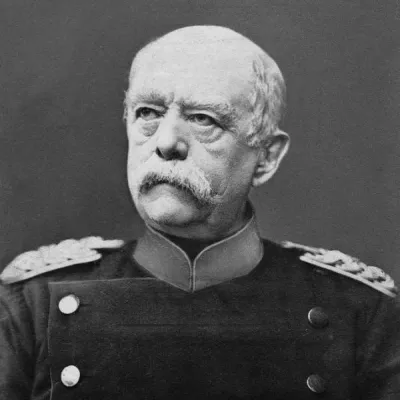
Otto von Bismarck
Human Design Chart
Biography
What does Generator 2/4 mean for Otto von Bismarck?
Generator 2/4 — Design at a Glance
Otto von Bismarck possessed immense and enduring power that characterized him as an energetic actor. As a Generator, he had abundant sacral energy and was known for great endurance, comparable to a strong workhorse that could only fully unleash its capabilities when it felt inner resonance with the task at hand. His central mechanics did not lie in initiating but rather in responding to life impulses. Success came when he responded to signals from his environment and confirmed his sacral center with a clear 'yes'; then he acted from the gut and found deep satisfaction.
Two main challenges shaped his energy profile: The wastage of power on tasks without inner joy led to exhaustion, while suppressing the urge to work on heart projects also proved obstructive. In harmony with his design, he was hard to stop. Deviating behavior – particularly constant initiating instead of waiting for impulses – resulted in persistent frustration and a noticeable lack of energy. His strength lay therefore not in anticipating but in waiting and then powerfully responding.
Sacral Authority
Otto von Bismarck demonstrated decision-making based on the wait time for an immediate physical signal. As a Generator, his strategy aligned with his inner authority: sacral authority. This mechanism required him to wait for external stimuli and then listen to his body's reaction – often as gut feeling, surge of energy or sounds like grunts and hmm. When this resonance occurred, he felt a vital increase in energy and acted with great enthusiasm. His actions were not goal-driven but motivated by fundamental joy that gave him inexhaustible power.
This ability for spontaneous response was supported by his active spleen center. This center served as an auxiliary instance enabling him quick, instinctive access to his physical well-being. Otto von Bismarck could thus particularly swiftly and directly decide, guided by a reliable inner perception. Crucial here was always distinguishing between this reactive energy following the external stimulus and impulsive action without such confirmation. Only through waiting for this sacral response did he manage to preserve his vitality and engage in his tasks with satisfaction. An open emotional state was necessary for the clear manifestation of sacral authority. His design thus suggested that his success depended on not anticipating but trusting the inner impulse arising after contact with the outside world.
The 2/4 Profile — Hermit / Opportunist
Otto von Bismarck exhibited a pronounced rhythm between the need for isolated reflection and integration into his social environment. His design as Profile 2/4, the Natural Talent-Networker Profile, shaped this cyclical dynamic: He withdrew to process experiences gathered in the network before seeking contact again. This structure required clear communication of boundaries – when he needed company and when silence – to create a safe environment.
During the withdrawal phase, he immersed himself in internal processes, created clarity, and developed brilliant ideas from analysis. Satisfied with the need for solitude (Line 2), he sought exchange with familiar people (Line 4). Line 2 brought an extreme reactive mechanism: Persistent interference often triggered overwhelming harshness that appeared intimidating and was accompanied by inner regret.
Line 4 focused on analysis and waiting for suitable alliance partners. Here, trust was crucial; aggression hindered the building of connections and necessary investigative depth. Bismarck's design indicated that his work was determined by this alternation between hermitage and network integration, with the ability to order internal processes and strategically enter alliances central to his strategy.
Single Definition — Defined & Open Centers
Otto von Bismarck was characterized by a constant inner drive. His design indicated a tendency towards inexhaustible vitality and an ongoing survival pressure. The defined Sacral Center generated enormous daily energy, which he burned through activity; his well-being depended on using this power for fulfilling tasks. Simultaneously, the defined Root Center acted as a permanent motor driving him forward and helping him cope with stress to survive materially. His defined Spleen Center gave him spontaneous intuition in the present moment, allowing him to make health-promoting decisions intuitively.
In contrast, Otto von Bismarck was strongly dependent on his environment in other areas. His open centers – Head, Ajna, Throat, G, Heart and Solar Plexus – meant that he did not have a constant internal source for inspiration, conceptual thinking, communication, identity, willpower or emotions. Instead, he absorbed these energies from the environment. He tended to put mental pressure on himself by trying to find answers that were not his own, or wondering who could give him the right inspiration. His open G Center led him to often seek identity and direction through reflection in others; he adapted to see if a place or relationship was correct for him.
The open Heart Center made him vulnerable to wanting to prove his worth by making promises, leading to frustration when he couldn’t keep them. His open Solar Plexus absorbed the emotions of others, causing him to be pulled between foreign moods without recognizing them as his own. This configuration created a person with immense inner energy and instinct but who was constantly at risk of being conditioned by external mental, emotional, and identity influences rather than trusting in his own authority.
Channels for focus, logical scrutiny and caring values.
Otto von Bismarck showed himself to be someone who advanced logical analysis and meticulous perfection through calm pressure and stillness. This attitude resulted from the Channel of Concentration 52-9, a Format energy connecting the Root Center with the Sacral Center. The Gate of Non-action (52) provided a passive urge for stillness, while the Gate of Focusing (9) maintained focus on facts and details. This combination allowed him to correct patterns and perfect processes through concentrated attention by keeping distractions at bay and using his energy precisely.
This ability for intense concentration was complemented by Judgment in the Channel of Judgment 58-18. This channel connected Liveliness (Gate 58) with Correction (Gate 18). It drove an insatiable urge to question and improve any patterns. The Gate of Liveliness urged on “better and more,” while the Gate of Correction checked what was in balance or needed correction. This created a mechanism aimed at achieving satisfaction through perfect patterns for the collective, often only reacting when asked for his solution.
Additionally, the Channel of Preservation 27-50 operated in Juxtaposition. This channel connected Care (Gate 27) with Values (Gate 50). It represented situational available energies of care and protection for tribal values but was not a constant feature of his design; it appeared only under certain conditions as a supportive force.
Collective Circuitry — Circuit Signature
Otto von Bismarck's design inclined towards strategic structuring and rational analysis, driven by the Mind Circuit. This circuit directly connected his Sacral, Root, and Spleen Centers in him. The energy of this flow aimed at improving society through logical insights, free from emotional conditioning. It was an “emotionless ratio” seeking visual clarity and focus for future developments. The Channels Concentration (9-52) and Judgment (18-58) enabled filtering information and making strategic decisions based on structure rather than feelings.
Parallel to this, the Archer Circuit operated separately from the Mind flow. Here only the Channel of Preservation (27-50) connected his Sacral with Spleen Center. This created a second independent energetic line focusing on protecting and preserving resources or close individuals. As Otto von Bismarck had a Simple Definition, these two circuits together formed a coherent flow within the group of Sacral, Root, and Spleen Centers. The mechanism showed as a combination of future-oriented strategy and instinctive care, with rational planning dominating while emotional waves from Solar Plexus were consciously excluded.
Right Angle Cross of Tension 1
Otto von Bismarck revealed himself as someone for whom internal tension was the driving force and motor of his actions. His design indicated a tendency not to perceive pressure as an obstacle but rather as necessary fuel. This configuration describes a life task in which maintaining tension generates energy and propels forward.
The right cross of Tension 1 operates here as a fundamental principle: Otto von Bismarck lived in a state where calm often felt like stagnation, while friction and resistance gave him the sense of truly being at the pulse of things. This mechanism does not necessarily mean external conflict but an inner readiness to be spurred on by challenges. The tension served as a compass; it pointed to where attention and energy were needed.
Without these internal tensions, the characteristic dynamism of his design would have faded. Instead, Otto von Bismarck used this state to gain clarity and set impulses. The configuration promoted an attitude in which resolving all problems was undesirable because it would have removed the drive. Rather, his system sought ways to channel tension productively rather than avoid it. This shaped his way of dealing with situations: not through immediate calming but by leveraging existing energy to tackle tasks. Inner restlessness thus was not a flaw but the actual source of his effectiveness and engagement in various life domains.
Saturn Return · Uranus Opposition · Chiron Return · 2nd Saturn Return — Life Cycles
Otto von Bismarck's life followed a clear pattern of cyclical maturation processes, closely linked to structuring and assuming authority. His first Saturn Return marked 1841 at age 26 as a turning point: the election of his father Bernhard as Landrat led to the division of property. This event illustrated how family upheavals often lay the groundwork for later personal responsibility areas.
The phase around his Chiron Return in his mid-40s corresponded to an achievement cycle, during which his personal purpose increasingly unfolded. In 1864, this was evident through his separation from General Friedrich von Wrangel. This moment was not a traditional healing process but a blooming period when Bismarck's influence became concrete and he solidified his role within existing structures.
His second Saturn Return around age 57 brought further structural challenges. In 1872, Bismarck prompted Wilhelm I to appoint additional House of Lords members to implement a reform of the district order. This underscored his ability to act purposefully on political mechanisms during crises or necessary changes to restore order. Through these recurring cycles, he not only shaped his own life but also institutional frameworks of his time.
Generator · Sacral Authority — Synthesis
Otto von Bismarck was a Generator whose life was marked by a deep inner urge to respond to external impulses with his immense sacral energy (rather than initiating himself). This reactive mechanism, coupled with an acute ability for concentration and correction (Channel 52-9/18-58), manifested in a consistent pattern of action as a response to circumstances – a continuous adaptation to the given situation to shape it. The openness of his centers for identity and emotions intensified this reactive approach: he perceived others' energies and adapted to them while simultaneously deciding through his sacral authority when and how to act.
A central paradox in Bismarck's design lay in the tension between his ability for deep analysis and correction (Gate 38/48) and his need for validation and recognition from others (open Heart Center). He was a master of strategy, recognizing and correcting patterns, yet simultaneously sought approval from others to legitimize his actions. This duality led to a life marked by pragmatic calculation and the desire for influence – a combination of inner strength and external pressure.
3 Defined Channels
Incarnation Cross - Right Angle Cross of Tension 1
Solar Return
The Solar Return shows the moment when the sun returns to its exact birth position - your personal solar year.
Life Cycles
Discover the life cycles with a detailed triple view (birth chart, cycle chart, composite).
Human Design Profile
- Type
- Generator
- Strategy
- To respond - wait for something to respond to
- Authority
- Sacral Authority
- Profile
- 2/4 - Hermit / Opportunist
- Definition
- Single Definition
- Incarnation Cross
- Right Angle Cross of Tension 1
- Date of Birth
- 01.04.1815 13:00
- Place of Birth
- Schönhausen, Germany
Frequently Asked Questions
What was Otto von Bismarck's Human Design type?
Which Profile did Otto von Bismarck have?
Which Authority guided Otto von Bismarck?
What incarnation cross did Otto von Bismarck have?
When was Otto von Bismarck born?
Discover your own Human Design
Are you also a Generator? Find out in a personal reading how to use your sacral energy correctly and discover deep satisfaction.
More Personalities
Back to overviewAaliyah

Alexia

Angèle

Anne-Marie

Arcángel

Arno