Rachilde
Human Design Chart
Biography
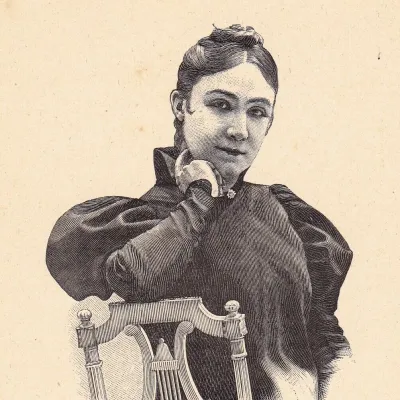
Dubbed “Mademoiselle Baudelaire” by Maurice Barres and called a distinguished pornographer by Jules Barbey d’Aurevilly, Rachilde is one of the most complex literary figures to emerge at the tipping point between the nineteenth and twentieth centuries. Her most famous work includes the fictional novels Monsieur Vénus/Monsieur Venus (1884) and La Jongleuse/The Juggler (1900, rev. 1925), and a nonfictional work called Pourquoi je ne suis pas féministe/ Why I am not a feminist (1928) in which she famously claims, “I have never had any confidence in women since the eternal feminine first betrayed me in maternal guise.” Scandalous in her youth, reviled by moralists as well as early feminists, her work ignored or forgotten in the years after her death, Rachilde balances between decadence and literary modernism, and between a virulent misogyny and deeply held belief in her own feminine worth.
She died 4 April 1953.
Human Design Analysis: Rachilde as Projector 4/6
Projector 4/6 — Design at a Glance
Rachilde had a focusing aura that acted like a bright flashlight, revealing systemic errors immediately. Her design indicated that she intuitively recognized where processes in her environment were not functioning or "in the dark." This ability to see weaknesses directly was her natural state.
As a Projector, Rachilde did not have a defined Sacral Center, meaning she lacked constant intrinsic life energy. Instead, she went through phases of high activity followed by necessary rest periods to avoid burnout. A steady work rhythm would have been too demanding for her system.
Her strategy involved waiting for an honest invitation rather than addressing her observations directly. If Rachilde had expressed her insights immediately and unsolicited, it often provoked resistance or defensiveness in others – comparable to shining a light directly into someone's face. Instead, she was most effective by radiating her own harmony. This presence attracted others who would then seek her advice on their own initiative. Through this patience and waiting for the invitation, Rachilde avoided feelings of bitterness that arise from not feeling valued or swimming against the current. Her success depended on being acknowledged by her environment, which sought her leadership once she had been invited.
Emotional Authority
Rachilde was governed by an internal decision-making authority that did not present itself as immediate certainty but rather as a wave-like process. Her Emotional Authority dictated her inner guidance, independent of other defined centers in her design. This meant she was constantly exposed to a perpetual emotional wave that moved her feelings up and down continuously. The world appeared filtered through her current mood; what seemed inspiring for a moment could turn negative the next.
These fluctuations were merely snapshots and not necessarily her deeper truth. Spontaneous decisions stemming directly from such transient emotions often proved risky, as they were based on incomplete impressions. For Rachilde, it was essential to take time to let decisions mature. Patience and consciously "sleeping on" important questions allowed her to let intense feelings subside. Only with this distance did the necessary clarity and calmness emerge. This process was especially crucial for long-term life decisions, ensuring that her choices were based on comprehensive understanding rather than a fleeting emotional state.
The 4/6 Profile — Opportunist / Role Model
Rachilde's design marked a clear developmental line: In her first thirty years, she experimented intensively with relationships and friendships. This phase of searching for belonging corresponded to Profile 4/6, where Line 6 in youth still acts like a Line 3. Rachilde sought validation primarily in social circles.
With the activation of Line 6, an inner conflict came to light. The deep desire for intimacy and community (Line 4) clashed with the intellectual drive for distance, wisdom, and a new order (Line 6). Rachilde faced the tension between heart and head: She wanted to be grounded but felt called to contemplate the meaning of life and rise above it.
Her design carried a party program with revolutionary changes and human rights (Gate 49). Rachilde worked to embody these principles outwardly and find support. At the same time, she sought breakthroughs through knowledge and transformation (Gate 43). She engaged only with those who supported this mutation. In her later years, it was expected of her to serve as a wise role model. While doing so, she had to protect her heart from being hurt by false people while embodying her principles outwardly and working cooperatively.
Split Definition — Defined & Open Centers
Rachilde revealed herself through a consistent mental structure and reliable expression ability. Her defined Ajna Center ensured continuous, specific thinking, while the connected Throat Center translated these concepts into clear communication. Her identity was set in the G Center, which gave her a secure self-worth and inner direction. Emotional decisions were under the authority of her Solar Plexus; she needed time to wait out the emotional wave and gain clarity. Spontaneous intuition guided her momentary judgments from the Spleen Center, while the Root Center provided a specific, consistent stress pressure for her progress.
In contrast, Head, Heart, and Sacral Centers were open as mirrors of the environment. Without mental inspiration in the Head Center, Rachilde tended to engage with foreign questions or doubts rather than being guided by inner clarity. The open Heart Center lacked persistent willpower; she was vulnerable to the pressure of proving her worth through promises or competition, often ending in a cycle of self-doubt when these commitments were not met. Her open Sacral Center meant no constant energy availability. She absorbed vital force from others and amplified it, risking overexertion and exhaustion as her body was not designed to carry this "borrowed" pressure indefinitely. Healthy action required recognizing these limits and trusting in her emotional authority to take breaks before the energy was completely depleted. This constellation shaped a life between inner firmness in thinking and feeling and situational sensitivity to the will and energy of her environment.
Channel 49-19: Synthesis — Channels & Gates
Rachilde revealed herself as someone whose actions were strongly influenced by the search for emotional belonging and tribal loyalty. This fundamental attitude stemmed from solar influences in the Ajna Center (Gate 49), which made up about seventy percent of her energy. Gate 49 is part of the Synthesis Channel 19-49, a personality configuration that describes deep emotional bonds to principles and the need for clear definition of "we-feeling". For Rachilde, this emotional urgency was a driving force but had to be balanced with other aspects of her design.
Her design offered tools to process this intensity. The Structuring Channel 23-43 connected the Ajna Center to the Throat Center and allowed her to clearly articulate innovative insights. Here it was about expressing new perspectives in such a way that they could be embraced by others, rather than being perceived as off-putting. Simultaneously, the Wavelength Channel 16-48 linked intuitive depth with the perfectionist experimentation, driving a step-by-step refinement of her skills where patience and repetition were necessary to transform talent into mastery.
The greatest challenge lay in timing. The Lost Son Channel 13-33 promoted reflective distance and the gathering of life wisdom through listening and retreating. Rachilde had to learn to connect the emotional immediacy of her tribal belonging (Gate 49) with the patient maturation of this channel. Only by waiting until the truth of an experience was revealed could she effectively share her innovative ideas (23-43) and refined talents (16-48), without appearing prematurely or being misunderstood.
Individual Circuitry — Circuit Signature
Rachilde's design featured a tendency towards structured, individual knowledge transmission characterized by emotional waves and strategic clarity. As someone with split definition, she had two independent energy blocks: one for cognitive processes and another for emotional impulses that did not directly flow into each other but existed parallel to one another.
In the first block, the Knowledge Circuit connected Ajna Center (Intuition/Strategy), Throat Center (Expression), and Spleen Center (Instinct). Channels "Structuring" and "Flash of Insight" enabled her to pour innovative ideas into clear structures and express them authentically. Additionally, the Understanding Circuit also linked Throat and Spleen Centers via Channel 16 ("The Wavelength"), enhancing her ability to communicate logical insights precisely.
The second block included Solar Plexus Center (Emotion) and Root Center (Pressure/Energy), connected by the Ego Circuit Channel "Synthesis". This created a rhythmic interaction between emotional inspiration and energetic pressure, serving the support of the collective. Since there was no connection to Sacral Center, conscious rest for resource regeneration was essential.
Furthermore, the Meaning Circuit linked Throat Center with Identity Center via Channel 31 ("The Lost Son"). This promoted her ability to process past experiences emotionally and share these insights to strengthen identity. Thus, Rachilde emerged as someone who combined intellectual clarity with emotional depth, where both areas appeared separate but together shaped her unique expression form.
Right Angle Cross of Explanation 1
The raw content only mentions the 'right cross of statement 1' for Rachilde, without any substantive description or mechanical specification. Without factual information about its effects, strategy, or psychological manifestations, it's impossible to derive a specific personal characterization from this element. It is not possible to illustrate how this configuration manifested in Rachilde's life due to the lack of necessary foundational data. Any assumptions about her stance, behavior, or life mission would be pure invention and would violate the rule of using only provided facts. Without a description of the mechanics – such as which centers were involved, which channels were activated, or what energetic dynamics were associated with it – this element remains an empty concept. It cannot be explained what it meant for Rachilde since its definition in the raw content is zero. Therefore, it's impossible to place it within a larger context. The text must limit itself to holding this gap: the design element was named but its substance remained undefined. Thus, no coherent chapter about the impact of this cross on Rachilde can be written without relying on external knowledge, which is strictly forbidden. The absence of data inevitably leads to an absence of statement power in this context.
Saturn Return · Uranus Opposition · Chiron Return · 2nd Saturn Return — Life Cycles
Rachilde's design showed a tendency towards rebellion against established structures, coupled with a drive for individual freedom. This configuration appeared as an inner impulse to reject old bonds or societal expectations to follow a more authentic and often unconventional life form. The Uranus opposition marked a phase of deep transformation in which the desire to break free from conventional constraints became effective.
This mechanism came to light concretely in 1900 when Rachilde, at age forty, published the novel *La Jongleuse*. This event served as evidence for the described dynamics: The publication was not merely a career step but an expression of the separation promoted by Uranus influence from existing norms. The text itself and its reception reflected the rejection of traditional norms and established a new personal form of expression. Through this act, her inner drive towards individual fulfillment became visible externally. Here, the opposition did not work as destruction but as necessary separation from old patterns to make space for the self. Rachilde followed the logic of her design: she rejected what limited her authenticity and instead created something that aligned with her inner truth. This moment illustrated how astral influences in Human Design can shape concrete life decisions by strengthening the courage to deviate.
Projector · Emotional Authority — Synthesis
Rachilde lived a life marked by a profound ability to recognize patterns and grasp their deeper meaning (Gate 4). Her energy flowed through the connection of intuition and rational analysis (Channel 20-57), allowing her to uncover hidden truths and present them in understandable forms. This gift was inseparable from an inner drive to defend principles and live out her own understanding of correctness (Gate 49). She perceived the world through a filtered lens, always seeking authenticity and harmony – a process that led her through recurring cycles of emotional clarity and reevaluation (emotional authority).
A central tension shaped Rachilde's life: the necessity to share her deep insights (Throat Center defined) versus natural reticence and the need for inner validation (Gate 33). She was destined to act as a lighthouse for others, yet simultaneously needed space to process the complexity of the world at her own pace. This dynamic led to a search for authentic connections and a profound understanding of the cyclical nature of experiences (Channel 13-33), always seeking meaning behind events.
5 Defined Channels
Incarnation Cross - Right Angle Cross of Explanation 1
Solar Return
The Solar Return shows the moment when the sun returns to its exact birth position - your personal solar year.
Life Cycles
Discover the life cycles with a detailed triple view (birth chart, cycle chart, composite).
Human Design Profile
- Type
- Projector
- Strategy
- Wait for the respectful invitation
- Authority
- Emotional Authority
- Profile
- 4/6 - Opportunist / Role Model
- Definition
- Split Definition
- Incarnation Cross
- Right Angle Cross of Explanation 1
- Date of Birth
- 11.02.1860 06:00
- Place of Birth
- Château-l'Évêque, France
Frequently Asked Questions
What was Rachilde's Human Design type?
Which Profile did Rachilde have in Human Design?
What authority did Rachilde possess?
What incarnation cross did Rachilde have?
When was Rachilde born?
Discover your own Human Design
Are you also a Projector? Find out in a personal reading how to unfold your leadership qualities and recognize the right invitations.
More Personalities
Back to overviewSissy Spacek

Alain-Fournier

Anémone

Angeli

Ann-Margret

Bourvil