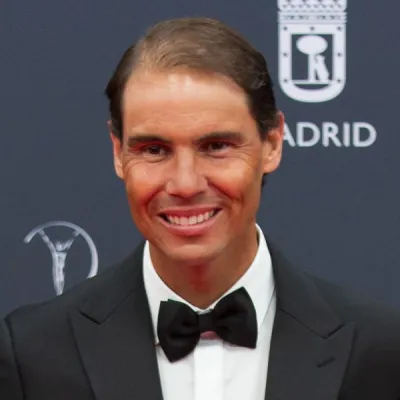
Rafael Nadal
Human Design Chart
Biography
For nearly two decades, Nadal was a leading figure in men's tennis, alongside Roger Federer and Novak Djokovic, collectively known as the Big Three. Early in his career, Nadal became one of the most successful teenagers in ATP Tour history, reaching No. 2 in the world and winning 16 titles before turning 20, including his first major title at the 2005 French Open. Nadal became the world No. 1 for the first time in 2008 after defeating Federer in a historic Wimbledon final, his first major championship off clay, which he followed with an Olympic singles gold at the 2008 Beijing Olympics. By defeating Djokovic in the 2010 US Open final, Nadal became the then–youngest man in the Open Era to complete a career Grand Slam at 24, and the first man to win majors on three different surfaces in the same year.
What does Manifestor 2/4 mean for Rafael Nadal?
Manifestor 2/4 — Design at a Glance
Rafael Nadal's design marked him as a pioneer and visionary who was supposed to lead the world into a new future. His nature resembled that of an emperor in ancient Rome: He had the vision of a great empire, but instead of leading the necessary wars himself, he sent others to conquer lands for him. This superior way of thinking often led to misunderstandings and polarization. While some loved his big dreams and followed him, others either liked or disliked him precisely because of these visions.
To find the right followers, it was crucial that he informed people in a timely and precise manner about his plans. This formed the ideal strategy for his design. If he followed this information strategy, he was rewarded with an inner sense of peace. Living against his design, however, left him feeling a persistent, deep-seated anger. The necessity to avoid misunderstandings through clear communication and thereby achieve inner peace fundamentally shaped his life task as a Manifestor.
Emotional Authority
Rafael Nadal's design tended towards patient decision-making: He showed himself to be someone who achieved internal clarity only after emotional waves had subsided. This attitude stems from his emotional authority, anchored in the defined Emotional Center. In Human Design mechanics, this center always carries inner authority, regardless of other definitions in the chart – a priority rule that fundamentally shaped his decision-making processes.
His feelings were subject to constant ups and downs; the world appeared colored by the current mood. What seemed inspiring at one moment could appear negative the next. Since immediate feeling was only a snapshot and not necessarily the truth, quick, spontaneous reactions to these emotional fluctuations led to poor decisions. Instead, his design required time for decisions to mature.
Rafael Nadal had to take his time and ask himself several times before acting. By consciously sleeping on decisions, intense feelings gradually subsided. This process created the necessary emotional distance that ultimately led to calmness and deeper insight. Only when this peace was established did he complete the decision-making process and could see his true direction – a mechanism of particular importance for long-term, life-defining steps.
The 2/4 Profile — Hermit / Opportunist
Rafael Nadal's design tended towards alternating phases of intense withdrawal and close network engagement. His Profile 2/4, the 'Natural Talent / Networker', describes an internal rhythm between the need for solitude (Line 2) and the desire for familiar community (Line 4). This configuration requires clear communication: Rafael Nadal had to clearly signal when he sought company and when he wanted to be undisturbed. During his 'Me-Time', he immersed himself in internal processes to find peace and clarity. Only after satisfying this hermit's need did he return from his 'cave' to spend time with favorite people. This structure allowed him to reflect on network knowledge during solitary times, generating brilliant ideas. Line 2 brings a strong desire for change as well as an aura of boredom; creativity and progress depend here on phases of ebb and flow. If this energy is lived incorrectly, creative blockages threaten. At the same time, Line 4 supports through its memory capacity and precision in handling details a secure future. Doubts are externalized to receive answers, with Mercury as the planet of intelligence promoting detailed documentation. Thus, Rafael Nadal's design shows how the balanced interplay of isolation and connection is used to process external knowledge internally and generate creative solutions.
Split Definition — Defined & Open Centers
Rafael Nadal's Human Design profile suggests a tendency towards consistent and reliable manifestation paired with deep emotional authority. His defined Throat Center served as a stable anchor for communication and action, while the defined Solar Plexus required waiting out an emotional wave before making decisions. This combination created a structure where outer actions were based on inner clarity rather than impulsivity.
The mechanics of his open centers acted as mirrors to the environment. The open Head and Ajna Centers meant that mental inspiration only arrived situationally; consistent conceptual thinking was not his nature. Instead, he tended to wonder if he needed to find answers that actually belonged to others, making him vulnerable to mental confusion when succumbing to this pressure. Similarly, his open G Center reflected identity and direction through interaction; it was not set but initiated by context. This led to feeling secure in relationships or environments only once the place felt right.
His open Heart Center showed a lack of consistent willpower in terms of ego competition. He tended to wonder if he needed to prove himself to be valuable – a classic non-self pattern of this center. In fact, his energy availability through the open Sacral Center was variable; it fluctuated and required rest phases rather than continuous endurance pressure.
In contrast, the defined Spleen Center provided spontaneous intuition in the present moment, an immediate instinct for health and safety. Together with the defined Root Center, which supplied set stress pressure for forward movement, these centers formed his constant foundation. While Head, G, Heart, and Sacral were open to taking on environmental signals, Throat, Solar Plexus, Spleen, and Root guaranteed a reliable base: clear communication after emotional maturity, intuitive presence in the moment, and a consistent inner drive not dependent on external expectations.
Channels for emotional openness, life purpose and change.
Rafael Nadal's design suggests a tendency towards emotional unrest driven by his Personality Sun in Gate 35. This manifested through the channel of Transience 36-35 as restless longing to explore feelings and use crises for movement. The connection between Solar Plexus and Throat Center resisted logical caution; instead, he sought new experiences often by provoking crises to break stagnation. This emotional wave served as a motor for change and sharing heroic stories that inspired others to seize the moment.
Parallelly, the channel of Openness 22-12 bound social interaction strictly to current mood. Only when the emotional ebb and flow aligned did warmth and transformative communication occur. Gate 22 expressed passion and drama while Gate 12 brought cautious reserve ensuring words fell only if they could mutate potential in others. Social attempts outside this inner resonance led to harshness; at the right timing, however, his voice became a catalyst for deep emotional experiences in listeners.
Against this fluctuation stood the channel of Life Struggle 38-28, providing stubborn determination. It connected the pressure of Root Center (Gate 38) to defend individual integrity against external distractions with the intuitive sense of Spleen (Gate 28) for the value of a struggle. This channel drove him to find life meaning in resistance and stubbornly resist expectations when it came to personal truth. Inner stubbornness served to assert his unique identity against the status quo.
Additionally, Gates like 53 (Freedom for new cycles) and 55 (extreme mood swings) shaped this dynamic. Gate 64 sought clarity from past while Gate 58 generated pressure towards pattern perfection. Thus, Rafael Nadal was someone who sought emotional depth through experience, engaged social connections only in the right emotional moment, and fought with stubborn determination for his individual meaning.
Individual Circuitry — Circuit Signature
Rafael Nadal's design suggests a tendency towards pulsating individual expression strength that manifests as a clear separation of two energetic fields. Through Split Definition, these forces existed parallelly, not as a continuous flow.
The Knowledge Circuit in him connected Throat Center with Solar Plexus and Spleen and Root Centers. This created a pulsing energy of personal identity. Through the channel 'Openness', emotional inspiration directly influenced voice while the channel 'Life Struggle' between Spleen and Root Center fostered intuitive, survival-related creativity. This configuration favored awakening new knowledge through deviation from existing norms and its acoustic publication.
Simultaneously, the Meaning Circuit presented with a connection between Throat and Solar Plexus Centers via the channel 'Transience'. Here cyclic, reflective energy dominated. It was about processing emotional waves from the past and finding meaning in past events. These insights were not only privately processed but served to share with the collective so others could learn together.
The tension thus lay between the innovative, present-oriented transformation of the Knowledge Circuit and the profound, visual reflection of the Meaning Circuit. Rafael Nadal was someone who expressed his unique identity through courage for change while simultaneously analyzing emotional patterns from the past and sharing this wisdom. Both circuits used Throat Center as an expression organ but with different energetic qualities: once pulsating-active, once cyclic-reflective.
Right Angle Cross of Consciousness 2
Rafael Nadal's design carried the signature of the Right Consciousness Cross. This configuration established a specific inner dynamics that shaped his perception and decision-making process. In Human Design, this cross marks a deep structural imprint in the energetic system, often associated with a certain sense of destiny or an unshakable internal compass. It is not a superficial trait but rather a fundamental aspect of identity that significantly influenced how Rafael Nadal understood himself and experienced reality.
The Right Consciousness Cross points to a complex interplay between various energetic centers that create a clear, though perhaps difficult to articulate, inner truth. For Rafael Nadal, this meant moving on a level beyond pure consciousness into deeper layers of existence. This structure fostered an attitude of internal stability and a certain unyielding nature towards external influences that did not align with his inner logic. It was a design feature that provided stability, even though the exact mechanisms behind it are not further specified in the raw content. Rafael Nadal thus appeared as someone guided by this deeply rooted energetic structure, which gave him a unique aura and clear focus stemming from the core of his design.
Saturn Return · Uranus Opposition — Life Cycles
Rafael Nadal's development was characterized by a clear cyclical structure: initially the phase of confirmation and peak performance, followed by a turning point towards new appreciation and social integration. This dynamic was significantly shaped by two astrological transits.
The first Saturn Return marked the moment when years of groundwork condensed into a stable foundation for future achievements. For Rafael Nadal, this effect became concrete in 2014 at age 28: he won his ninth title at Roland Garros and his fourteenth Grand Slam title. This success confirmed previous efforts and solidified his position at the peak of his career, exactly as this transit had foreseen for his design.
Following this came the Uranus Opposition as a phase of realignment. This transit often signaled a detachment from purely performance-driven structures towards broader social recognition and new values. In 2025 at age 39, Rafael Nadal received the title Marqués de Llevant de Mallorca from King Felipe VI, marking this transition. This honor underscored the shift from a pure sports focus to a changed societal positioning and a form of appreciation that transcended competition.
Manifestor · Emotional Authority — Synthesis
A central red thread runs through the design: the dynamic interaction between inner maturity and external expression. Emotional authority (Authority) demands time for decision-making, while the Manifestor type (Design View) urges action and initiation. This interplay is reinforced by the open channel of openness (Channels/Gates), which transforms fluctuating emotional states into communication – an expression of authenticity that can be marked by moodiness. Belonging to the Knowledge Circuit (Circuit) underscores a drive for transformation through individual insights and their articulation, while the Profile as Natural Talent/Networker (Profile Role) highlights the pendulum between withdrawal and social interaction.
The central paradox lies in the tension between the need for inner clarity and the urge towards immediate manifestation. Emotional wave (Authority) demands maturity, while the design as a pioneer (Design View) seeks rapid implementation. This leads to an internal dynamic where creative impulses (Circuit) must pass through emotional filtering to be authentically expressed. A documented event illustrates this rhythm: success (Saturn Return 2014), followed by recognition (Uranus Opposition 2025).
3 Defined Channels
Incarnation Cross - Right Angle Cross of Consciousness 2
Solar Return
The Solar Return shows the moment when the sun returns to its exact birth position - your personal solar year.
Life Cycles
Discover the life cycles with a detailed triple view (birth chart, cycle chart, composite).
Human Design Profile
- Type
- Manifestor
- Strategy
- To inform others before acting
- Authority
- Emotional Authority
- Profile
- 2/4 - Hermit / Opportunist
- Definition
- Split Definition
- Incarnation Cross
- Right Angle Cross of Consciousness 2
- Date of Birth
- 03.06.1986 19:20
- Place of Birth
- Manacor, Spain
Frequently Asked Questions
What is Rafael Nadal's Human Design type?
What Profile does Rafael Nadal have in Human Design?
What Authority does Rafael Nadal possess?
What is Rafael Nadal's incarnation cross?
When was Rafael Nadal born?
Discover your own Human Design
Are you also a Manifestor? Find out in a personal reading how to use your initiation power peacefully and dissolve resistance.
More Personalities
Back to overviewAldair

Cafu
Christian-Jaque
Joelinton

Kaká

Kesha