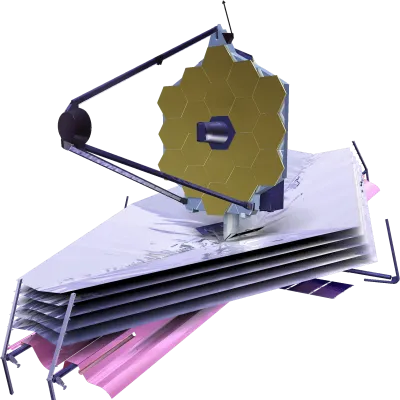
Foto: NASA / Public domain — Wikimedia Commons
Space: James Webb Space Telescope
Human Design Chart
Biography
JWST was launched on 25 December 2021 on Ariane flight VA256. It is designed to provide improved infrared resolution and sensitivity over Hubble, and will enable a broad range of investigations across the fields of astronomy and cosmology, including observations of some of the most distant events and objects in the Universe such as the formation of the first galaxies, and allowing detailed atmospheric characterization of potentially habitable exoplanets.
The primary mirror of JWST, the Optical Telescope Element, consists of 18 hexagonal mirror segments made of gold-plated beryllium, which combine to create a 6.5 m (21 ft)-diameter mirror – considerably larger than Hubble's 2.4 m (7.9 ft) mirror.
Unlike the Hubble telescope, which observes in the near ultraviolet, visible, and near infrared (0.1–1.0 μm) spectra, JWST will do so in a lower frequency range, from long-wavelength visible light (red) through mid-infrared (0.6–28.3 μm). This will enable it to observe high-redshift objects that are too old and too distant for Hubble.
The telescope must be kept very cold to observe in the infrared without interference, so it will be deployed in space near the Sun–Earth L2 Lagrange point, about 1.5 million kilometers (930,000 mi) from Earth (0.01 au – 3.9 times the average distance to the Moon). A large sunshield made of silicon- and aluminium-coated Kapton will keep its mirror and instruments below 50 K (−223 °C; −370 °F).
Human Design Analysis: Space: James Webb Space Telescope as Manifesting Generator 1/3
Space: James Webb Space Telescope is a Manifesting Generator in Human Design – an energy type that combines the sacral power of the Generator with the manifestation ability of the Manifestor. Manifesting Generators are multi-talented and often work on several things simultaneously.
The Manifesting Generator's strategy is to respond to impulses, inform others, and then act. Unlike pure Generators, they can skip steps and take shortcuts – this isn't a mistake but part of their design.
When Space: James Webb Space Telescope lives in alignment with their design, they experience deep satisfaction and fulfillment. The not-self theme is frustration and anger – frustration when the sacral energy is blocked, and anger when the manifestation power can't flow freely.
Space: James Webb Space Telescope has Emotional Authority – the most common authority. Decisions should never be made in an emotional high or low, but only when emotional clarity settles in. "Sleep on it" is meant literally here. The emotional wave needs time to run its course.
Space: James Webb Space Telescope carries the profile 1/3 – Investigator / Martyr. The 1st line represents the Investigator: a deep need for a solid foundation and thorough knowledge before feeling secure. The 3rd line represents the Experimenter: learning through trial and error, embracing life as a practical experiment and growing wise through experience.
The incarnation cross "Right Angle Cross of Service 4" describes the overarching life purpose and direction of Space: James Webb Space Telescope in Human Design. It consists of the four gate activations of Sun and Earth (personality and design) and only becomes felt when one lives their strategy and authority.
Energetisch arbeitet Space: James Webb Space mit einer Einfache Spaltung (Split Definition).
Space: James Webb Spaces Bodygraph zeigt 7 feste Zentren (Sakralzentrum, Wurzelzentrum, Milzzentrum, Emotionalzentrum, Kehlzentrum, Ajnazentrum und Kopfzentrum) und 2 empfangende Zentren (G-Zentrum und Herzzentrum).
Space: James Webb Space trägt kollektive Energie als Hauptthema (Kollektiv (Verstehen, Sinnfinden): 3 Kanäle, Individuell (Wissen, Integration): 2 Kanäle, Stamm (Ego): 2 Kanäle). Das bedeutet: das Teilen von Erfahrungen und Wissen mit der Gemeinschaft.
7 Defined Channels
Incarnation Cross - Right Angle Cross of Service 4
Solar Return
The Solar Return shows the moment when the sun returns to its exact birth position - your personal solar year.
Life Cycles
Discover the life cycles with a detailed triple view (birth chart, cycle chart, composite).
Human Design Profile
- Authority
- Emotional Authority
- Profile
- 1/3 - Investigator / Martyr
- Definition
- Split Definition
- Incarnation Cross
- Right Angle Cross of Service 4
- Date of Birth
- 25.12.2021 09:20
- Place of Birth
- Guiana Space Centre, FRGU
Frequently Asked Questions
What Human Design type is Space: James Webb Space Telescope?
What Human Design profile does Space: James Webb Space Telescope have?
How does Space: James Webb Space Telescope best make decisions?
When and where was Space: James Webb Space Telescope born?
What is Space: James Webb Space Telescope's incarnation cross?
Discover your own Human Design
Are you also a Manifesting Generator? Find out in a personal reading how to unfold your multi-talents and direct your energy wisely.
More Personalities
Back to overviewAldair

Alizée

Angeli

Arletty

Artus

Balthus