Foto: NASA / Public domain — Wikimedia Commons
Space: Mir (Space Station)
Human Design Chart
Biography
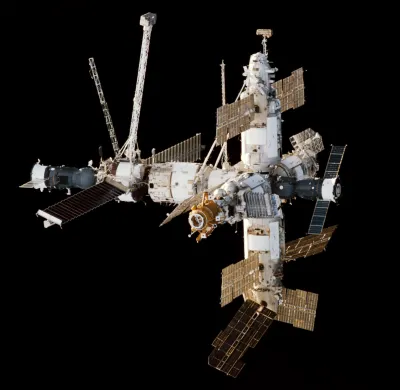
The station served as a microgravity research laboratory in which crews conducted experiments in biology, human biology, physics, astronomy, meteorology and spacecraft systems with a goal of developing technologies required for permanent occupation of space.
Mir was the first continuously inhabited long-term research station in orbit and set the record for the longest continuous human presence in space at 3 644 days until 23 October 2010 when it was surpassed by the ISS. It holds the record for the longest single human spaceflight, with Valeri Polyakov spending 437 days and 18 hours on the station between 1994 and 1995.
Mir was occupied for a total of twelve and a half years out of its fifteen-year lifespan, having the capacity to support a resident crew of three, or larger crews for short term visits.
Following the success of the Salyut programme, Mir represented the next stage in the Soviet Union's space station programme. The first module of the station, known as the core module or base block, was launched in 1986, and followed by six further modules. Proton rockets were used to launch all of its components except for the docking module, which was installed by space shuttle mission STS-74 in 1995.
When complete, the station consisted of seven pressurised modules and several unpressurised components. Power was provided by several photovoltaic arrays attached directly to the modules. The station was maintained at an orbit between 296 km (184 mi) and 421 km (262 mi) altitude and travelled at an average speed of 27,700 km/h (17,200 mph), completing 15.7 orbits per day.
Space: Mir (Space Station) — Manifesting Generator with Profile 1/3
Space: Mir (Space Station) is a Manifesting Generator in Human Design – an energy type that combines the sacral power of the Generator with the manifestation ability of the Manifestor. Manifesting Generators are multi-talented and often work on several things simultaneously.
The Manifesting Generator's strategy is to respond to impulses, inform others, and then act. Unlike pure Generators, they can skip steps and take shortcuts – this isn't a mistake but part of their design.
When Space: Mir (Space Station) lives in alignment with their design, they experience deep satisfaction and fulfillment. The not-self theme is frustration and anger – frustration when the sacral energy is blocked, and anger when the manifestation power can't flow freely.
Space: Mir (Space Station) has Sacral Authority. The Sacral Center responds with a clear physical reaction – an "uh-huh" (yes) or "un-un" (no). This gut response is spontaneous, direct, and reliable. The key is responding to the right question or impulse.
Space: Mir (Space Station) carries the profile 1/3 – Investigator / Martyr. The 1st line represents the Investigator: a deep need for a solid foundation and thorough knowledge before feeling secure. The 3rd line represents the Experimenter: learning through trial and error, embracing life as a practical experiment and growing wise through experience.
The incarnation cross "Right Angle Cross of the Sleeping Phoenix 1" describes the overarching life purpose and direction of Space: Mir (Space Station) in Human Design. It consists of the four gate activations of Sun and Earth (personality and design) and only becomes felt when one lives their strategy and authority.
Einfache Definition (Single Definition) - so ist Space: Mir (Space energetisch vernetzt.
Definiert bei Space: Mir (Space: Sakralzentrum, G-Zentrum, Kehlzentrum, Milzzentrum und Herzzentrum (5 von 9). Offen: Kopfzentrum, Ajnazentrum, Emotionalzentrum und Wurzelzentrum.
Verteilung der Kanäle: Individuell (Wissen, Integration, Zentrieren): 6 Kanäle, Kollektiv (Verstehen): 1 Kanal, Stamm (Ego): 1 Kanal. Dominanter Schwerpunkt: Individuell - einzigartige Selbstverwirklichung und Mutation.
8 Defined Channels
Incarnation Cross - Right Angle Cross of the Sleeping Phoenix 1
Solar Return
The Solar Return shows the moment when the sun returns to its exact birth position - your personal solar year.
Life Cycles
Discover the life cycles with a detailed triple view (birth chart, cycle chart, composite).
Human Design Profile
- Authority
- Sacral Authority
- Profile
- 1/3 - Investigator / Martyr
- Definition
- Single Definition
- Incarnation Cross
- Right Angle Cross of the Sleeping Phoenix 1
- Date of Birth
- 19.02.1986 21:28
- Place of Birth
- Baikonur, Kazakhstan
Frequently Asked Questions
What Human Design type is Space: Mir (Space Station)?
What Human Design profile does Space: Mir (Space Station) have?
How does Space: Mir (Space Station) best make decisions?
When and where was Space: Mir (Space Station) born?
What is Space: Mir (Space Station)'s incarnation cross?
Discover your own Human Design
Are you also a Manifesting Generator? Find out in a personal reading how to unfold your multi-talents and direct your energy wisely.
More Personalities
Back to overviewAldair

Alizée

Angeli

Arletty
Artus

Balthus