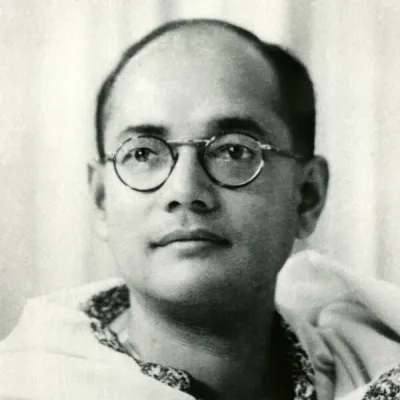
Subhas Chandra Bose
Human Design Chart
Biography
Educated at the universities of Calcutta and Cambridge, he left a career in the Indian civil service to fight for India's independence and was imprisoned a dozen times by the British. He shared leadership of India's youth and peasant societies with Jawaharlal Nehru and Mohandas Ghandi in opposition to their principals of non-violence.
He was elected the President of India's Congress Party in 1938, but in 1940-1941, fled to Germany, then to Malaya where he set up a Provisional Government of Free India in 1943.
Bose suffered third-degree burns on 18 August 1945 after his overloaded Japanese plane crashed around 2:30 PM in Taihoku (now Taipei) in Japanese-ruled Formosa (now Taiwan). He was taken to hospital for treatment but died a few hours later, between 9 and 10 pm, at age 48.
What does Generator 2/4 mean for Subhas Chandra Bose?
Generator 2/4 — Design at a Glance
Subhas Chandra Bose possessed immense endurance and the ability to achieve things in the material world. His design as a Generator indicated that his strength did not lie in initiating actions but rather in reacting to external impulses. The energy from his sacral center became effective when he responded to life signals – an approach often described as acting 'from the gut'.
This mechanism meant that success for him was achieved through responding to life impulses with concrete action. When he followed this strategy and applied his energy where his inner signal agreed, he experienced deep satisfaction and a sense of fulfillment. In contrast, deviating from this led to frustration. Two main pitfalls were evident: first, the wastage of energy on tasks that did not resonate internally, leading to exhaustion; second, suppressing the urge to continue working on his heart project despite still having energy.
The motto 'not initiating but reacting' was key to unlocking his enormous work capacity. As long as he waited for signals and then acted, nothing could stop him. Deviations from this, particularly constant initiating without an inner signal, resulted in persistent frustration or a lack of energy. His design thus clearly showed: the greatest performance arose through reactive action in harmony with his sacral power.
Sacral Authority
Subhas Chandra Bose based his decisions on his sacral authority. This internal instance served as the primary decision-making basis and replaced mental planning with a direct physical response to external stimuli. His design required waiting for impulses before acting with full vitality.
Sacral authority is specific to the Generator type and simplifies the orientation process, as strategy and inner guidance merge here. A prerequisite was an open emotions center. Signal transmission occurred through bodily resonance: sounds like grunts or a reinforcing 'hm' marked the activation of his sacral motor. Once this motor kicked in, there was a noticeable increase in life energy. In these moments, Subhas Chandra Bose possessed inexhaustible strength and completed tasks with great enthusiasm. This configuration allowed him to fully immerse himself in activities without them being bound by external purpose. The joy in the work itself was the driving element. Through this mechanism, he could react spontaneously to situations and make decisions that directly sprang from his physical well-being and instinctive perception. This immediate connection to his inner compass ensured reliable guidance in his actions.
The 2/4 Profile — Hermit / Opportunist
Subhas Chandra Bose revealed an internal tension between a deep need for withdrawal and the urge to connect with a specific network. His design suggested that he was not isolated in his solitude – marked by Line 2 of Profile 2/4 – but rather processed information from his social environment there. Gate 41 in the second line promoted a cautious, almost conservative attitude (Saturn energy), while at the same time a strong desire for recognition (Mars) existed. This combination led him to first clarify his own feelings and visions internally before stepping outwards.
The fourth line, represented by Gate 28, emphasized tenacity in holding onto these networks. Here, there was an ability not only to gather knowledge but also to use it in the interest of a higher good (Jupiter in elevation). However, there was also the danger of selfishly clinging on (Mercury in fall) if the balance between community and solitude was disrupted. Subhas Chandra Bose lived this cycle: he withdrew to gain clarity, used this time for synthesis of network knowledge, and developed brilliant ideas from it. Only when his internal need was satisfied did he actively seek exchange with his confidants. His life task consisted in clearly communicating these alternating needs – when he needed company and when he needed solitude – to transform the contradiction of his nature into productive power.
Split Definition — Defined & Open Centers
Subhas Chandra Bose was characterized by a design based on solid inner stability while being strongly influenced by external factors. His defined Sacral Center provided him with a constant source of vital energy; he had the power to master tasks persistently, given that he responded to life rather than forcing it to happen. This sacral response served as a filter for his availability and protected him from exhaustion through false commitments. This was complemented by his defined G Center, which gave him clear, reliable self-identity and a sense of personal direction. He intuitively knew who he was and where it led him without having to rely on others.
His defined Throat Center allowed for reliable manifestation; he could clearly articulate and set into the world his truth from his identity or answers. Additionally, his defined Spleen Center ensured strong body awareness and intuitive health, helping him act in the moment and recognize what was correct for his well-being.
In contrast, Head, Ajna, Heart, Solar Plexus, and Root Centers were open. This made Subhas Chandra Bose susceptible to external mental pressure, emotional waves, and stress from the environment. Without trust in his inner authority, he tended to identify with foreign confusion or emotional unrest, which could lead to exhaustion. The challenge was not to waste his defined energy by reacting to these external pressures but rather to use it purposefully for his own mission.
Channels for logical leadership and intuitive survival power.
Subhas Chandra Bose appeared as a leadership figure whose effectiveness relied on a tension-filled synthesis of collective logic and individual intuition. His design required authority that was legitimized through community trust, while his inner drive was radically self-determined and instinctive.
This dynamic shaped the Alpha Animal Channel 7-31 in his personality. This channel connected the G Center with the Throat Center and defined a leadership competency based on tested patterns and logical coherence. Subhas Chandra Bose had to earn trust by understanding trends and showing that he understood the collective context. His leadership role was not an autocratic one but an invitation to a shared future; success only occurred when the majority chose him and recognized his logical suggestions. Without this collective affirmation, his potential remained latent.
Simultaneously, Channel 34-57 of Power worked in his design as a fundamental survival mechanism. This channel connected the Spleen Center with the Sacral Center and gave him spontaneous, intuitive awareness. He responded instantly to dangers and vibrations in his environment, free from mental delay. This energy served individual self-preservation and independence; it was not attuned to others' needs but secured his physical vitality through quick, instinctive decisions here and now.
The challenge of his design lay in integrating these poles: the intuitive, defensive awareness of Channel 34-57 had to be translated into the logical, coherent structures of Channel 7-31. Only then could he gain collective trust and authentically exercise leadership. His personality sought the right pack while his design was protected by radical individuality. This configuration described a leader who both looked toward the future and reacted to the immediate reality of his body.
Collective Circuitry — Circuit Signature
Subhas Chandra Bose exhibited two parallel, separate energy pathways. The Mind Circuit connected his Throat and Identity Centers through Channel 31-7
Right Angle Cross of the Unexpected 4
Subhas Chandra Bose revealed through the Human Design characteristic 'The Right Cross of the Unexpected 4' as someone who often took unpredictable turns in his expression and actions. This configuration shaped a way that did not follow linear or predictable paths but allowed for sudden insights or impulses that could surprise those around him. It was an inner dynamic that broke through the familiar, opening up new, often unexpected perspectives.
In Human Design, this cross describes a specific energy distribution that tends to solve situations in unconventional ways or comment on them. Those who carry this structure can experience moments where the seemingly impossible or unexpected suddenly becomes reality. This is not a planned strategy but a natural expression of an energy that does not adhere to rigid patterns. For Subhas Chandra Bose, it meant his essence and way of interacting with the world were marked by this characteristic of unpredictability. He moved in a field where the surprising played a central role, characterizing his interactions and decisions. This quality ensured he was not always predictable but often chose paths or showed reactions that lay outside usual expectations. It was part of his inner architecture, setting him apart and giving him an unmistakable imprint reflected throughout his entire existence.
Saturn Return · Uranus Opposition — Life Cycles
Subhas Chandra Bose experienced his marriage to the Austrian Emilie Schenkl in 1937 at the age of 40. For his design, this step marked a typical moment of sudden realignment: The Uranus opposition in the life cycle often creates unexpected breaks in established patterns or radical changes in relationships. It represents the tension between fixed structures and the drive for freedom and change. During this period, such a shift took place that reordered the existing relationship framework. This configuration describes not gradual development but an abrupt change where old bonds or expectations were replaced by new realities. The marriage was thus more than just a biographical date; it was the concrete effect of this cyclical dynamic, placing Subhas Chandra Bose in a situation requiring spontaneous adaptation and dissolution of previous structures. The Uranus influence marked this phase through its unpredictability while the opposition geometry underscored the need for clear positioning between the known and the new. This showed as a moment of turning point where the individual was forced to establish on a new basis, far from prior routines or commitments.
Generator · Sacral Authority — Synthesis
Subhas Chandra Bose’s design shows a central continuity in the dynamic balance between inner reaction and external influence. As a Generator with sacral authority, he was destined to react to life – finding energy when his Sacral Center said 'Yes!' (Gate 57). This ability to act intuitively in the present moment was strengthened by a defined G-Center, which provided clear identity and direction. The Power Channel connected this inner reaction with the survival drive while the connection through the Alpha Channel (Gates 7 & 31) indicated that he could lead others when invited. His profile as a natural talent and networker points to a natural ability to exchange knowledge and reflect on it during phases of withdrawal.
A central paradox lay in the tension between his need for community (Line 4) and the inner drive towards isolation (Line 2). This interplay was further strengthened by open centers – especially the Heart and Solar Plexus Centers – making him susceptible to external influences while simultaneously possessing a strong internal direction. The ability to engage and collect energy stood in contrast to the necessity of protecting himself from emotional pressure and trusting his own intuition to avoid conditioning.
2 Defined Channels
Incarnation Cross - Right Angle Cross of the Unexpected 4
Solar Return
The Solar Return shows the moment when the sun returns to its exact birth position - your personal solar year.
Life Cycles
Discover the life cycles with a detailed triple view (birth chart, cycle chart, composite).
Human Design Profile
- Type
- Generator
- Strategy
- To respond - wait for something to respond to
- Authority
- Sacral Authority
- Profile
- 2/4 - Hermit / Opportunist
- Definition
- Split Definition
- Incarnation Cross
- Right Angle Cross of the Unexpected 4
- Date of Birth
- 23.01.1897 12:00
- Place of Birth
- Cuttack, India
Frequently Asked Questions
What was Subhas Chandra Bose's Human Design type?
What profile did Subhas Chandra Bose have?
What authority guided Subhas Chandra Bose?
What incarnation cross did Subhas Chandra Bose have?
When was Subhas Chandra Bose born?
Discover your own Human Design
Are you also a Generator? Find out in a personal reading how to use your sacral energy correctly and discover deep satisfaction.
More Personalities
Back to overviewAaliyah

Alexia

Angèle

Anne-Marie

Arcángel

Arno