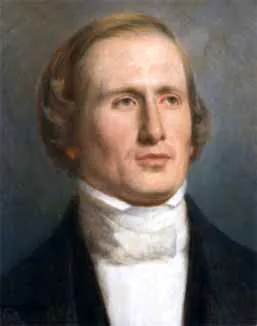
Urbain Le Verrier
Human Design Chart
Biography
Urbain Le Verrier married Lucille Clotilde Choquet in 1837 and had three children. He died on 23 September 1877 at age 66 in Paris, France. His name is one of the 72 names inscribed on the Eiffel Tower.
Urbain Le Verrier as a Generator 4/6 in Human Design
Generator 4/6 — Design at a Glance
Urbain Le Verrier was known for his immense endurance and strength, but he unleashed this power not through self-driven initiative but rather by reacting to external signals. As a Generator, he possessed abundant sacral energy that made him an extremely strong and enduring workhorse – provided he had inner consent for the task at hand. His design suggested that his effectiveness depended on responding to environmental cues rather than initiating action himself. When his sacral center responded clearly to impulses, he could become irresistible in his actions and materialize things in life.
This mechanism contained two critical pitfalls: On one hand, there was a risk of energy depletion and burnout if he engaged in activities that did not resonate with him internally for long periods. On the other hand, his strength suffered when he was prevented from working on his heart project despite still wanting to continue. If Urbain Le Verrier lived in harmony with this strategy of reacting to gut feelings, his design rewarded him with deep satisfaction and a sense of fulfillment. However, if he initiated against this inner compass or acted without such confirmation, sooner or later he faced persistent frustration along with a noticeable lack of energy. His life force was thus not an unlimited resource for free use but rather one that only fully released itself through correct responses to external impulses.
Emotional Authority
Urbain Le Verrier's design indicated a tendency towards deep emotional waves that profoundly shaped his perception of the world. As a Carrier of Emotional Authority, he experienced constant ups and downs in his feelings; his perspective was always colored by the current mood. What appeared inspiring at one moment could turn negative the next. His design pointed out that such spontaneous impressions did not represent ultimate truth but were merely snapshots. Quick decisions made from this emotional heat often proved problematic for him.
The mechanics of his inner authority required patience and time to mature in decision-making. Since the Emotional Center carried his internal guidance – a priority independent of other defined centers – he had to learn to take himself seriously and rethink decisions multiple times. Only when intense feelings subsided and an emotional distance was gained did clarity and calmness set in for him. This process of waiting and observing was essential for long-term life decisions, as only then the deeper truth beneath the surface of transient moods became visible. His inner guidance functioned not through immediate intuition but by enduring emotional cycles until internal peace was achieved.
The 4/6 Profile — Opportunist / Role Model
Urbain Le Verrier's design indicated a tendency towards late role finding. As someone with Profile 4/6, he experimented in his first three decades before Saturn’s return, much like a Profile-3 individual: intensively and diversely, especially in the realm of relationships and friendships. This early phase was marked by Line Energy 4, bringing sensitivity to social moods and tones. Le Verrier showed a media openness that eschewed formality; he gauged the right moment for new impulses by reading the mood of his surroundings. His heart was cautious not to open up to false people and get hurt.
With the entry of Line 6, this dynamic fundamentally changed. A conflict arose between the desire for community belonging (Line 4) and the urge to withdraw to contemplate life’s meaning (Line 6). This contradiction from heart and head characterized his later years. He was expected to meet the high standards of a wise role model. Gate 26, a Family Gate, demanded actions that benefited the collective materially. The process of gaining influence lasted throughout his life and required perseverance as well as strategic pauses. His authority manifested when ego acted at the right place and time to confirm insights and further develop them.
Triple Split Definition — Defined & Open Centers
Urbain Le Verrier's design was characterized by a deep inner stability in his identity and direction. His defined G Center provided him with reliable self-worth; he intuitively knew where his place was without relying on external validation for it. This stable foundation allowed him to support others on their path without needing to control them.
His expression was clear and direct through the defined Throat Center. His voice served as a pivot point, translating information from within himself into the world. Since his throat was connected to his energy sources, he spoke not just concepts but acted out of deep conviction. This communication was steady yet limited to what authentically resonated with him.
As a Generator, Urbain Le Verrier possessed an immense vital energy source in his defined Sacral Center. His drive did not come from mental planning but rather from reacting to external stimuli. His strategy involved waiting until he was asked and then responding with his sacral power—a 'Yes' or 'No'. This protected him from exhaustion and frustration that would have arisen had he initiated instead of reacted.
Emotional clarity was a process for him over time. His defined Solar Plexus as inner authority required patience; he needed to go through his emotional wave before making decisions. He avoided impulsive actions in emotional highs or lows by waiting for the deep truth to reveal itself at the end of the cycle.
In contrast, his Head Center was open. Urbain Le Verrier did not have a constant mental focus and tended to absorb doubts from others or seek inspiration to fill mental gaps. However, he understood that these thoughts were not his own truth. His open Ajna Center allowed him to flexibly take in ideas without solidifying them into personal dogmas.
His Heart Center was also open. He did not search for competition or proof of his worth through promises. Instead, he learned to perceive the willpower of others and avoid spirals of self-doubt when expectations were unmet. His defined Root and Spleen Centers ultimately provided existential security and the necessary pressure to thrive materially and remain healthy.
Channels for focused intuition, creative expression and individual power.
Urbain Le Verrier's design inclined towards exemplary leadership: he worked through the life of his individual direction. The Channel of Inspiration 1-8 connected his G Center with the Throat Center, making his unique identity publicly visible. He inspired others not primarily through words but by acting as a living example and drawing attention to himself. Simultaneously, he exhibited profound emotional intensity. The Channel of Recognition 30-41 linked the Root Center with the Solar Plexus; the drive for new experiences (Gate 41) heated his emotional waves, creating a strong desire for intense life experience. Additionally, he possessed sharp survival intuition. The Channel of Power 34-57 connected the Sacral Center with the Spleen, supporting sacral energy in intuitive perception of danger and safety. This enabled quick, spontaneous reactions to his environment to protect his well-being. Further gates like 22 (Openness), 47 (Purpose) or 38 (Boundaries) shaped his approach to mutation and resistance, but the mentioned channels formed the core framework of his energetic expression: a blend of public example, emotional drive, and intuitive self-preservation.
Individual Circuitry — Circuit Signature
Urbain Le Verrier's design inclined towards three separate, parallel functioning energy focal points. As a Triple Definition, he did not have a continuous connection throughout the system; instead, there were three isolated fields existing side by side.
The Knowledge Circuit connected his Throat and Identity Centers. Through the Channel of Inspiration (Gates 8–1), he received acoustic, pulsating impulses for new ideas. This energy served to express his unique individuality through words and initiate change without logical derivation.
Parallel to this, the Purpose Circuit operated between Solar Plexus and Root Centers. The Channel of Recognition (Gates 30–41) generated a cyclical, visually marked emotional wave. Here it was about reflecting on past experiences. Urbain Le Verrier sought meaning behind events and shared these felt insights with the collective to learn together from the past.
The third isolated field formed the integration over Sacral and Spleen Centers. The Channel of Power (Gates 34–57) connected intuitive knowledge carriers with life energy. This allowed him to draw power from reacting to life and make it effective through proper behavior in the present moment. This highest individuality secured his survival through spontaneous, acoustically marked adaptability.
All three areas—expression of identity, emotional purpose finding, and intuitive survival security—functioned independently of each other. There was no common flow between these groups; they were anchored as separate, side-by-side forces in his system.
Right Angle Cross of Rulership 1
Urbain Le Verrier's design indicated a tendency towards strategic influence that did not rely on direct confrontation but rather on clever positioning and the utilization of existing structures. This orientation aligned with the mechanics of the right-hand ruling cross 1, a configuration often associated with the ability to understand power dynamics and move effectively within hierarchies or systems without necessarily claiming official authority.
This aspect of his Human Design described a life task where influence was exerted by pressing the correct levers at the right places. It wasn't about overt rule but rather a subtler form of control, with an emphasis on understanding political or social dynamics. Urbain Le Verrier demonstrated someone who knew and used these indirect paths to achieve his goals, emphasizing wisdom and timing over brute force. This configuration shaped an approach aimed at achieving results through intelligent navigation in complex environments, characteristic of his actions.
Saturn Return · Uranus Opposition · Chiron Return · 2nd Saturn Return — Life Cycles
Urbain Le Verrier's design indicated a tendency towards structured, long-term work. In 1837, at the age of 26, he began studying celestial mechanics and married Lucille Clotilde Choquet. This marked his first Saturn return, a cycle where years of groundwork often condenses into a solid result, reinforcing fundamental life structures such as career or partnership.
Later, his chart showed a phase of upheavals and new authorities. In 1854, at the age of 43, he became director of the Paris Observatory. This fell during his Uranus opposition period, a mechanism often associated with sudden changes, breaking from old structures, or taking on new responsibilities, often unexpected. His appointment to lead a significant institution highlighted this dynamic shift in his life where established paths were left behind and higher levels of influence were entered. Thus, his design marked a path from solid foundation to expansive leadership.
Generator · Emotional Authority — Synthesis
Urbain Le Verrier lived deeply within the tension between inner perception and outer expression. As a generator with emotional authority, he needed time for feelings to mature (emotional center) before decisions could be made – a process amplified by the need for authenticity in the knowledge circuit. This inner maturity then found its way through the channel of inspiration (Gate 1/8) outwardly, sharing new perspectives and motivating others. The profile as networker/role model suggests he faced the pressure to set an example for others later in life, with Line 4 in the profile intensifying a need for belonging.
This man was marked by an internal conflict between a desire for independent thought (Line 6) and a deeply rooted need for connection and validation from others (Line 4). His sacral energy found expression through communication (defined Throat Center), yet this was always filtered through an emotional wave. The right-hand ruling cross suggests he tended to question his inner truth and adapt to the expectations of others, shaping his path from early experiments (Line 3) to that of a role model.
3 Defined Channels
Incarnation Cross - Right Angle Cross of Rulership 1
Solar Return
The Solar Return shows the moment when the sun returns to its exact birth position - your personal solar year.
Life Cycles
Discover the life cycles with a detailed triple view (birth chart, cycle chart, composite).
Human Design Profile
- Type
- Generator
- Strategy
- To respond - wait for something to respond to
- Authority
- Emotional Authority
- Profile
- 4/6 - Opportunist / Role Model
- Definition
- Triple Split
- Incarnation Cross
- Right Angle Cross of Rulership 1
- Date of Birth
- 11.03.1811 10:00
- Place of Birth
- St.Lô, France
Frequently Asked Questions
What was Urbain Le Verrier's Human Design type?
What Profile did Urbain Le Verrier have in his Human Design chart?
What Authority determined Urbain Le Verrier's decisions?
Which incarnation cross characterized Urbain Le Verrier's life path?
When was Urbain Le Verrier born?
Discover your own Human Design
Are you also a Generator? Find out in a personal reading how to use your sacral energy correctly and discover deep satisfaction.
More Personalities
Back to overviewAaliyah

Alexia

Angèle

Anne-Marie

Arcángel

Arno