
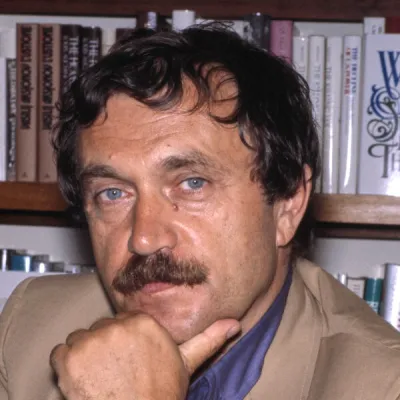
Vasily Aksyonov
Human Design Chart
Biography
His Communist parents survived nearly two decades in the Gulag and in exile. Aksyonov was raised in Kazan by his nanny and grandmother until the NKVD arrested him as a son of "enemies of the people", and sent him to an orphanage. He was rescued in 1938 by his uncle, with whose family he stayed until his mother was released into exile after serving a decade in forced labour. In 1947, Vasily joined her in exile in the notorious Magadan, Kolyma prison area, where he graduated from high school.
Aksyonov attended Kazan University, graduated in 1956 from the First Pavlov State Medical University of St. Peterburg, then worked as a doctor for three years.
His first novel, Colleagues (1961), was based on his experiences as a doctor. He published 25 more novels from 1961 to 2007.
After The Burn was published in Italy in 1980, Aksyonov and his wife accepted an invitated to move to the USA. He was soon stripped of his Soviet citizenship, regaining it only 10 years later during Gorbachev's perestroika.
Aksyonov spent 24 years in Washington, D.C., and Virginia, where he taught Russian Literature at George Mason University. In 2004, he settled in Biarritz, France, and split his time between France and Moscow.
Vasily Aksyonov died on 6 July 2009 at the age of 76 in Moscow.
What does Generator 3/5 mean for Vasily Aksyonov?
Generator 3/5 — Design at a Glance
Vasily Aksyonov's design exhibited tremendous endurance, comparable to that of a workhorse. This strength was not available for arbitrary initiatives but was released exclusively in response to impulses from his environment. His strategy involved waiting and then responding instinctively when life gave him a signal.
This mechanism protected him from wasting energy. Actions that were not driven by intrinsic joy quickly led to burnout, as they went against his nature. Similarly, it was detrimental when he was hindered from pursuing his heart's project, even though his inner drive remained intact. Such blockages deprived him of the strength that would otherwise have been available.
The central dynamic in his life was the "yes" signal of the Sacral Center. When he responded to authentic impulses and acted accordingly, he experienced deep satisfaction and a sense of fulfillment. This state was the reward for living in harmony with his nature. Deviations from this pattern, particularly constant initiating without an external trigger, resulted in persistent frustration and a noticeable lack of energy. His success thus depended directly on how consistently he responded rather than initiated.
Emotional Authority
Vasily Aksyonov's design indicated a tendency towards emotional fluctuation that clouded spontaneous judgments. He was someone who did not make decisions based on the first impulse but needed time to gain clarity. This structure resulted from his Emotional Authority: The defined Solar Plexus Center carried his inner guiding authority, independent of other defined centers in his chart.
This configuration subjected him to a constant emotional wave, an ongoing up-and-down of feelings. The world always appeared colored by his current mood; one moment he was excited, the next surprised and disappointed by the same thing. However, his immediate feeling was only a snapshot, not yet his truth. Quick decisions made in the heat of emotion often had negative consequences.
Instead, his design required patience and reconsidering important questions multiple times. The longer he waited, the deeper he could see. Over time, intense feelings subsided, emotional distance emerged, and calmness set in. Only then was he through the process and acted from clarity. This mechanism was particularly crucial for long-term, life-defining decisions, as they had a significant impact on his life path.
The 3/5 Profile — Martyr / Heretic
Vasily Aksyonov's design inclined towards an experimental way of life characterized by a clear rhythm of personal experimentation and time-limited contributions to others. As a Profile 3/5 person, the Experimenter and Hero, he primarily learned through trial and error. Line 3 evaluated situations not theoretically but practically; inaction was often considered wiser than hasty action. This approach served self-correction and created a rich trove of experiential knowledge.
This knowledge attracted others. Line 5 projected a role as a hero where Vasily Aksyonov solved other people's problems with his hard-earned wisdom. However, this contribution was effective only when explicitly requested and strictly limited in scope. Much like a taxi driver who drops off the passenger at their destination and then continues on their way, Vasily Aksyonov had to withdraw after performing the service to avoid undermining the projection. Failing publicly was an inherent risk of early engagement. The withdrawal served not just for rest but was essential for maintaining authority and preparing for new directions. His life followed this pattern of temporary connections and group contributions, followed by necessary phases of distancing to preserve his own integrity.
Single Definition — Defined & Open Centers
Vasily Aksyonov's Design was characterized by a powerful inner motor consisting of three defined centers: Sacral, Solar Plexus, and Root. This configuration endowed him with constant vital energy (Sacral), paired with emotional depth (Solar Plexus) and a persistent existential pressure (Root). As a Generator, his primary strategy was to wait for external stimuli before responding with full force – a process steered by the immediate Yes/No response of the Sacral Center. This contrasted with his five open centers (Head, Ajna, Throat, G, Heart, Spleen), which did not offer constant internal resources for inspiration, communication, or identity.
His emotional authority required patience; he had to wait out the waves of his feelings to gain clarity rather than reacting impulsively to highs and lows. The defined Root Center provided a steady pressure that propelled him forward, yet this only worked healthily if he did not initiate against his strategy. The open centers made him vulnerable to conditioning: He tended to mentally engage with foreign questions (open Head/Ajna), unconsciously sought attention through speaking (open Throat), or felt uncertain about his identity and direction (open G). Furthermore, he was not designed for constant willpower (open Heart) but had to learn to avoid promises made from the mind. His open Spleen Center led to risky spontaneous decisions; he needed to face his survival fears rather than impulsively grasping for security from others. This architecture shaped him as someone who only effectively utilized his energy when reacting instead of initiating and exercising patience with his emotional processes.
Channels for intimacy, emotional clarity and maturation.
Vasily Aksyonov's design created a tendency towards intense, physical fusion paired with an insatiable drive for new experiences. This configuration resulted in someone who experienced relationships not just as social interaction but as deep energetic processes that required patience and emotional clarity.
Central to this was Channel 59-6. It connected the sacral sexuality of Gate 59 with the emotional wave of Gate 6. This connection rooted Vasily Aksyonov in a powerful quantum energy defined as intimacy. His drive lay in merging; his availability for closeness allowed him to quickly penetrate into others' aura and establish confidentiality. However, the emotional wave of Gate 6 determined the timing of every release of intimate feelings. He had to wait until this wave brought clarity to discern whether a connection was lasting or merely a fleeting impulse of attraction. Without this waiting period, his intensity could be misunderstood.
This need for emotional distancing in decision-making stood in tension with Channel 41-30. This channel connected the root pressure towards restlessness (Gate 41) with fantasy and feeling recognition (Gate 30). It propelled Vasily Aksyonov to embrace new experiences to quell inner unease. The longing for "the New" was strong, yet fulfillment often remained fleeting. Here lay the necessity of enjoying dreams and adventures without rigid expectations, as the pressure towards immediate action had to be tempered by the emotional wave to gain clarity.
The framework for these experiences was Channel 53-42. It connected Gate 53 (Beginnings) with Gate 42 (Growth). This mechanism emphasized that every experience needed to go through a complete cycle—from intention to completion—to generate wisdom. Vasily Aksyonov learned from these closed loops; reflecting on completed processes allowed him to translate lessons into information for others and begin new cycles at a deeper level.
As an energetic anchor, the Sun in Gate 29 (Sacral Center) gave him persistence and a life-affirming attitude towards challenges. It supported him in following his sacral response, which was crucial for the healthy expression of intimacy in Channel Pairing. Through this combination of sacral constancy, emotional wave movement, and cyclical learning, a design emerged that sought depth through complete experience and reflective transmission.
Collective Circuitry — Circuit Signature
Vasily Aksyonov's Design linked the emotional reflection of the past with ancient protective instincts. In simple terms, these energies flowed directly together without internal tensions between separate systems. The Meaning-Making Circuit connected the Sacral Center (Life Force), the Root Center (Pressure), and the Solar Plexus (Emotions). This created a cyclical wave dynamics: feelings from the past were processed to gain insights that could then be shared with others. Channels "Maturation" and "Recognition" ensured that these emotional cycles ran clearly structured—from beginning through peak to end.
Parallel, the Archer Circuit in Vasily Aksyonov connected his Sacral Center with his Solar Plexus. Here, Channel "Coupling" dominated. This connection brought instinctive forces into play: the urge for reproduction and protection of one's own genetics. It was about timeless, almost animal impulses of nurturing, caring for, and defending the family. Since both circuits used the Sacral and Solar Plexus Centers, the ability to emotionally process past experiences merged with a deep instinct to secure oneself and one’s own. Thus, Vasily Aksyonov showed a unity of meaningful remembering and fundamental survival will. His emotions were not just private but served collective learning capacity while his protective drive was directly fed from this emotional depth. This configuration marked him as someone who inseparably linked past and instinct.
Right Angle Cross of Contagion 3
Vasily Aksyonov's design revealed a profound and often unconscious ability to absorb emotional states and energies from his environment. He did not primarily manifest as a classical Initiator, actively breaking into systems but was activated through contact with others. His inner self acted like a filter for foreign patterns that he transformed. This dynamic corresponded to the right infection cross 3, which describes an alchemical transformation of received impulses.
The mechanics of this cross define the role as vulnerable yet powerful receiver and processor. It is about infection in a metaphorical sense: penetrating existing structures through absorption of their energy. For Vasily Aksyonov, this created a constant tension between the need for connection – the actual “infection” – and the necessary inner work to integrate or reject these absorbed energies. Without processing, there was a risk of being overwhelmed by foreign influences. His chart indicated that his strength did not come from self-motivation but from reacting to what reached him. He was a channel for transformation whose effectiveness depended on how well he could digest received signals and convert them into personal expressions. This configuration shaped his essence as someone who found and further processed their deepest impulses through resonance with the environment.
Saturn Return · Uranus Opposition · Chiron Return · 2nd Saturn Return — Life Cycles
Vasily Aksyonov's life path was marked by two defining cycles that structured his professional anchoring and later emigration. In 1958, at age 26, he moved to Moscow. This marked his first Saturn return cycle, a phase where years of groundwork often condenses into a solid professional foundation and strengthens individual positioning in society.
Later, his design showed another decisive turning point: in 1980, at the age of 48, he emigrated to the USA on invitation from an American university. This fell within the Chiron return cycle (approximately ages 49–51). In Human Design mechanics, this is not a healing process for old wounds but a fulfillment cycle. If a person lives according to their strategy and authority, here their incarnation cross increasingly unfolds in life; meaning and purpose become experiential and inner bloom transitions into outer reality. Aksyonov's step to America thus expressed this profound unfolding of personal purpose, not an escape or repair. Both events – arriving in Moscow as anchoring and moving to the USA as fulfillment – illustrate how planetary return phases accompany and structure massive biographical shifts.
Generator · Emotional Authority — Synthesis
Vasily Aksyonov's life was marked by a deep rhythm of reaction and emotional depth. As a Generator, he primarily reacted to impulses, with his Sacral Center providing energy for sustained activity – so long as it aligned with his innermost feeling. This corresponds to the ability to immerse oneself in experiences and learn from them, reinforced by the channel of maturation (Gate 53/42). The open definition of his G-Center points to a flexibility that allowed him to maintain identity and direction in flow, always open to new influences and experiences from his environment. He was thus not an Initiator but a recipient who navigated life by responding to external stimuli with his Sacral Center while waiting for his emotional wave.
Central in Aksyonov's design is the tension between the need for deep emotional connection (emotional center, channel of pairing) and inherent openness to external influences (open G- and Heart Centers). He was capable of intense intimacy and profound feeling, yet also vulnerable to others' energies. This dynamic might have led him to lose himself in relationships or struggle to form a stable identity while simultaneously experiencing a strong desire for authenticity and expression.
3 Defined Channels
Incarnation Cross - Right Angle Cross of Contagion 3
Solar Return
The Solar Return shows the moment when the sun returns to its exact birth position - your personal solar year.
Life Cycles
Discover the life cycles with a detailed triple view (birth chart, cycle chart, composite).
Human Design Profile
- Type
- Generator
- Strategy
- To respond - wait for something to respond to
- Authority
- Emotional Authority
- Profile
- 3/5 - Martyr / Heretic
- Definition
- Single Definition
- Incarnation Cross
- Right Angle Cross of Contagion 3
- Date of Birth
- 20.08.1932 06:00
- Place of Birth
- Kazan', Russia
Frequently Asked Questions
What was Vasily Aksyonov's Human Design type?
What profile did Vasily Aksyonov have?
What authority did Vasily Aksyonov have?
What incarnation cross did Vasily Aksyonov have?
When was Vasily Aksyonov born?
Discover your own Human Design
Are you also a Generator? Find out in a personal reading how to use your sacral energy correctly and discover deep satisfaction.
More Personalities
Back to overviewAaliyah

Alain-Fournier

Alexia

Angèle

Angeli

Anne-Marie
