
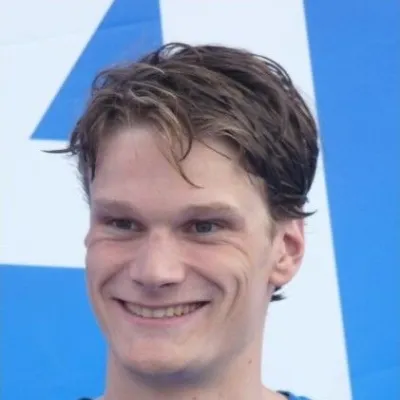
Yannick Agnel
Human Design Chart
Biography
He was twice a gold medallist at the world championship (Barcelona 2013), winning the 200 m and the 4X100 m relay (freestyle).
His parents, amateur tennis players, planned to call him Alexandre, but finally chose Yannick, inspired by Yannick Noah.
He is the French national record holder in the 200 and 400 m freestyle (long course).
He trained in Baltimore from 2013 with Bob Bowman, ex-coach of Michaël Phelps. He returned to Mulhausen, France.
In December 2021, he was accused of raping the daughter of his coach Lionel Horter in 2016, when he was 24 and she was only 13 years old.
Yannick Agnel as a Projector 2/4 in Human Design
Projector 2/4 — Design at a Glance
Yannick Agnel's aura appeared like a bright flashlight: focused and capable of immediately identifying systemic errors. This direct perception could be perceived as unpleasant in the environment, comparable to a light beam shining directly into someone's face, exposing weaknesses. Instead of presenting these insights confrontationally, it was more effective for him to lead by example – for instance, by embodying harmonious states so that others would naturally seek his solutions.
The central strategy of his design lay in waiting for an honest and respectful invitation. This waiting served as a protective mechanism against the direct projection of truths that would be rejected without consent. Through this patience, he avoided the non-self theme of bitterness that arises when one feels uninvited yet still wants to intervene.
Splenic Authority
Yannick Agnel's design exhibited a tendency towards immediate, instinctive decision-making where the first impulse was considered decisive. This attitude stemmed from his Spleen Authority, which is based on a defined Spleen Center and acts as spontaneous survival intelligence. It signaled immediately whether a situation or environment was health-promoting or not. For Yannick Agnel, this meant that decisions had to be made in the moment; the initial impulse directly served well-being and enabled rigorous demarcation against harmful influences. Since this inner indicator appeared only once and very subtly, its use required high vigilance to avoid overlooking it or having it drowned out by other voices. Long-term planning was thus less suitable than flexibility and freedom of space, as the right choice emerged only in the moment. Yannick Agnel relied on this short-term clarity to optimally care for himself and protect against potential dangers, with occasional withdrawal helpful for decision-making.
The 2/4 Profile — Hermit / Opportunist
Yannick Agnel's design showed a tendency to oscillate between the deep need for retreat and the desire for connection. As someone with Profile 2/4, he was in constant dynamics: Line 2 confers the quality of the hermit who needs time for inner processes, while Line 4 addresses the network and community. This configuration requires clear communication of availability limits – a signal to the outside world indicating when society is welcome and when silence is needed.
During his 'Me-Time', Agnel immersed himself in internal reflections to find peace and clarity. Only after satisfying this inner need did he return from his metaphorical cave to connect authentically with his favorite people. Line 4 brings sensitivity to the mood and tone of the environment; it enables open interaction without unnecessary formality.
This pattern of retreat and return is central: The retreat creates the prerequisite for emotionally aware encounters in the network. During alone time, Agnel could reflect on knowledge from his surroundings, evaluate it, and develop new insights. The tension between solitude and community was thus not a conflict but a productive rhythm stabilized through conscious demarcation and clear signals to the outside world.
Single Definition — Defined & Open Centers
Yannick Agnel's Design established a tendency towards instinctive clarity and constant existential pressure. The defined Spleen Center provided trustworthy, momentary intelligence for health and well-being that acted in the present. This vital spontaneity formed the stable basis of his decisions, independent of rational analysis. Parallel to this, the defined Root Center generated a persistent, adrenalized drive towards material existence security and survival. This internal motor propelled him continuously forward to thrive and make corrections in the world.
In contrast stood his open centers: Head, Ajna, Throat, G, Heart, Sacral, and Solar Plexus. This openness meant no constant inner source for thinking, communication, identity, willpower or emotions. Instead, Yannick Agnel was situational activatable by the environment. He tended to take on mental inspiration or confusion, amplify foreign emotionalities, and adopt borrowed identities. The challenge lay in not getting sucked into the conditioning vortex of these open areas – such as trying to force control over will or emotion or seeking answers that did not belong to him.
Instead, his Spleen Authority was the only reliable compass. By listening to this intuitive intelligence and trusting it, he could protect himself from mental noise and emotional pressure from his environment. His Design challenged him to live in the moment and follow his instincts so as not to be distracted by doubts or the need to prove himself. The wisdom of his Design lay in the ability to connect the constant energy of the Root Center with the subtle guidance of the Spleen, while using the open centers as mirrors for the environment without identifying with them.
Channels for critical judgment and pattern recognition.
Yannick Agnel was marked by a deep logical drive to question patterns and work towards perfection. His Design featured the Channel of Judgment 58-18, connecting the Root Center with the Spleen Center. This mechanism generates an insatiable energy: Gate 58 provides stability and the impulse 'better and more', while Gate 18 acts as a lookout identifying what is not healthy or balanced.
This connection nourishes the art of mastery. Yannick Agnel had a strong sense whether something was correct and executable by comparing it with past experiences. The purpose of this structure lies in all finding satisfaction within a perfect pattern. However, this logic harbors a specific trap: when critical evaluation breaks uninvited, an endless stream of data about errors emerges that no one wants to hear. This leads to inner dissatisfaction or the impression of constantly searching for mistakes.
The effective application of this gift requires patience and selection. Yannick Agnel found joy and effectiveness only when explicitly asked: 'Is something wrong here?' At this moment, listeners were open to his answer. By waiting for this invitation, he avoided wasting valuable energy and saved relationships from unnecessary conflicts. His task was to devise solutions applicable to the collective and challenge only what others were ready to correct. Thus, potentially critical logic became an instrument of peace and mutual improvement.
Collective Circuitry — Circuit Signature
Yannick Agnel's Design established a tendency towards rational, emotionless logic aimed at guiding structures and society into a better future. His focus was on sharing insights free from conditioning. This attitude was marked by the Understanding Circuit, bundling energies for strategy, structure, and intellect.
Central here was Yannick Agnel's Channel of Judgment (18-58). It connected the Spleen Center with the Root Center. The Spleen provided visual clarity and intuition about what works or not, while the Root Center supplied the necessary energy to translate these insights into concrete action. This enabled a future-oriented structuring of thoughts and projects.
As Yannick Agnel has a Simple Definition and his Spleen and Root Centers are directly connected through this channel, these two centers formed a continuous energetic flow. There were no separate groups; the entire defined energy flowed in this specific context from visual perception to impulsive implementation. This supported his ability to logically penetrate complex connections and apply them strategically without emotional disturbances from the Solar Plexus Center – which is not part of this circuit – affecting reason.
Right Angle Cross of Rulership 2
Yannick Agnel's Human Design suggests a tendency towards spontaneous and intuitive decision-making. His life strategy did not rely on logical planning or external validation but rather on direct trust in an inner compass. This approach was shaped by the configuration of his right Governing Authority 2 cross.
This specific mechanism implies an internal authority that often operates unconsciously and cannot be controlled through rational analysis. Instead, it is guided by intuitive impulses and the immediate flow of one's energy. For Yannick Agnel, true clarity emerged only in the moment of action, driven by a deep certainty beyond intellectual understanding.
The challenge was to recognize and give space to this spontaneous authority without blocking it with excessive overthinking. The design promoted a form of leadership or self-determination that was authentic because it came directly from the core of his being, free from filters imposed by others or rigid rules. It was about pure trust in this inner voice that pointed the way at the right moment. Yannick Agnel thus demonstrated strength in following these intuitive streams and making gut decisions, which gave him a certain immediacy and authenticity.
Saturn Return — Life Cycles
The raw data provided for Yannick Agnel is empty. No Human Design facts, chart configurations, or documented events have been supplied. Without these specific details, it's impossible to write a chapter that adheres strictly to the rules: no inventions, no external knowledge, only based on the delivered material.
Since the raw content is `[]`, there is no basis for characterization or mechanism explanation. Any statement about Yannick Agnel's design would be an uncontrolled invention and would violate the strict rule of not using personal training knowledge. Therefore, a valid text cannot be generated that meets the requirements. Please provide specific Human Design data (e.g., Type, Authority, Profiles, defined centers, channels or a concrete event) to compose the chapter.
Projector · Splenic Authority — Synthesis
A central red thread runs through the chart: the ability to recognize patterns and make corrections (Channel 58-18), coupled with heightened sensitivity to the environment. The defined Spleen Center provides instinctive knowledge about health and survival, while the open Solar Plexus perceives and amplifies others' emotions – a combination that allows for sensing and addressing subtle disharmonies. This perception extends to social dynamics (Gate 22), suggesting talent in recognizing potentials and necessary adjustments in relationships. The energy of the Root Center intensifies this drive towards correction by providing constant pressure to improve and adapt things.
A central paradox lies in the combination of the Projector Type with an open G Center and undefined centers like Sacral, Solar Plexus, and Heart. As a Projector, recognizing errors and ‘projecting’ light into darkness is inherent, yet the openness of many centers means high susceptibility to external influences and conditioning. This leads to tension between the need for clarity and the ability to fit into various contexts, as well as the challenge of maintaining one's own identity amidst foreign energies.
1 Defined Channel
Incarnation Cross - Right Angle Cross of Rulership 2
Solar Return
The Solar Return shows the moment when the sun returns to its exact birth position - your personal solar year.
Life Cycles
Discover the life cycles with a detailed triple view (birth chart, cycle chart, composite).
Human Design Profile
- Type
- Projector
- Strategy
- Wait for the respectful invitation
- Authority
- Splenic Authority
- Profile
- 2/4 - Hermit / Opportunist
- Definition
- Single Definition
- Incarnation Cross
- Right Angle Cross of Rulership 2
- Date of Birth
- 09.06.1992 10:00
- Place of Birth
- Nîmes, France
Frequently Asked Questions
What is Yannick Agnels Human Design type?
What Profile does Yannick Agnel have in Human Design?
What authority determines Yannicks Agnels decisions?
What incarnation cross does Yannick Agnel have?
When was Yannick Agnel born?
Discover your own Human Design
Are you also a Projector? Find out in a personal reading how to unfold your leadership qualities and recognize the right invitations.
More Personalities
Back to overviewSissy Spacek

Alain-Fournier

Aldair

Anémone

Ann-Margret

Bourvil
