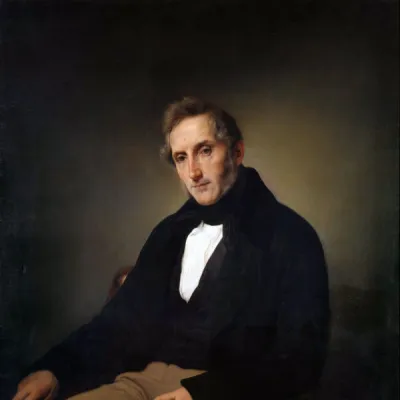
Alessandro Manzoni
Human Design Chart
Biography
Manzoni contributed to the stabilization of the modern Italian language and helped to ensure linguistic unity throughout Italy. He was an influential proponent of Liberal Catholicism in Italy. He is also considered one of the three crowns of Romanticism in Italy, along with Ugo Foscolo and Giacomo Leopardi, despite their differences. He is often associated as the moral and cultural leader of the Italian unification with his younger contemporary Leopardi, although his work and thinking often contrast with the latter.
Alessandro Manzoni as a Projector 1/3 in Human Design
Projector 1/3 — Design at a Glance
Alessandro Manzoni revealed himself as someone whose design featured a sharply focused aura. He had the ability to instantly recognize system errors in his environment, akin to a bright flashlight directed towards dark spots. However, this direct confrontation with others' weaknesses was often perceived as unpleasant. Instead, Alessandro Manzoni was most effective when he attracted his surroundings through his own harmonious radiance. This natural magnetism prompted others to seek his advice. His strategy involved waiting for an honest and respectful invitation from others before sharing his insights.
As a Projector, he lacked a defined Sacral Center, meaning that he did not have constant intrinsic life energy. His energy balance followed cycles of high productivity phases interspersed with mandatory rest periods. These pauses were essential to prevent burnout. Ignoring this need led him to experience bitterness as his Non-Self theme. Living according to his design – by waiting for invitations and respecting his energy limits – he was rewarded with success. His path did not lie in constant pushing but in targeted, invited leadership of others.
Emotional Authority
Alessandro Manzoni exhibited an internal decision-making structure that did not rely on immediate clarity but rather a necessary maturation process. His design indicated that the defined Solar Plexus Center – known as the Emotional Center in Human Design – carried his authority. This meant he was subject to constant waves of emotional highs and lows. The world appeared colored by the prevailing mood: A topic could deeply inspire him one moment, only to seem completely negative the next.
These fluctuations were not mistakes but rather the mechanism of his perception. A spontaneous decision based on a current emotional state would have been error-prone as it was merely a snapshot and not yet his deeper truth. For Alessandro Manzoni, taking time was essential. He had to let decisions “sleep” overnight to move from initial emotional coloring to clear insight. Through patience and repeated examination, intense feelings subsided; only then did he gain the necessary distance. This process led to calmness and true clarity. Especially for long-term, life-defining steps, this waiting period was indispensable to ensure that the choice was stable and authentic rather than a product of transient excitement or depression.
The 1/3 Profile — Investigator / Martyr
Alessandro Manzoni revealed himself as someone whose judgments were based on rigorous synthesis from theoretical depth and practical testing. His design set a life task that did not rest in static knowledge but in cycles of learning and active experimentation through trial and error. As a person with Profile 1/3, he was naturally an explorer who always wanted to know more (Line 1) and simultaneously carried the biological imperative to try things out to learn from them (Line 3).
This configuration created internal tension: Often, fear of not knowing enough kept him from implementation. Yet his Line 7 urged him to overcome this inhibition and accept mistakes as necessary teachers. Through Gate 22, he learned to pay attention and endure humiliation, which helped him use a subordinate position for self-awareness. Simultaneously, Gate 26 propelled him through adaptability to take influence and overcome ego rejections.
The result of this process was self-discovered insights that were both intellectually grounded and empirically validated. When Alessandro Manzoni endorsed something as good, he had previously examined it both theoretically and practically in depth. His credibility stemmed from combining the humility of Line 1 with the adaptability of Line 3, making his judgment absolutely trustworthy.
Single Definition — Defined & Open Centers
Alessandro Manzoni was marked by a deep emotional wave that served as his inner authority. His design suggested that he did not seek truth in the immediate 'now', but rather it revealed itself over time. He tended to delay decisions, waiting for emotional highs and lows until a clear calm set in, instead of impulsively reacting to the first impulse. This patience was essential for him to avoid chaos and gain deeper insights.
At the same time, he was driven by a defined Root Center, which provided constant inner pressure and stress. This drive served to move him forward in the world and overcome existential challenges. The combination of this persistent energy and emotional depth created dynamic tension: the root pressure demanded action while his emotional authority required waiting until the wave movement led to clarity.
In contrast, Head, Ajna, Throat, G Center, Heart, Sacral, and Spleen were open. This meant that Alessandro Manzoni lacked a constant mental inspiration or personal identity. He was prone to getting entangled in foreign thoughts or seeking answers not of his own making. His open G Center left him without a firm self-image; he adapted to the environment and often sought direction given from outside. The open Heart Center made him sensitive to questions of value and willpower, tending to prove his worth through achievement rather than simply accepting it.
His open Sacral Center lacked constant vitality; he could easily become exhausted when taking on others' energy without setting boundaries. His open Spleen Center allowed him to intuitively sense health and danger, but this intuition was often clouded by fear and not a reliable basis for decision-making. Alessandro Manzoni had to learn not to be conditioned by these open fields, instead trusting his emotional clarity and the inner pressure of his Root Center to find the right path in life.
Channels & Gates
Alessandro Manzoni's personality was marked by a deep emotional wave movement. His design connected the root pressure with the sensitivity of the Solar Plexus, steering his moods and attachments through inner resonance rather than rationality.
The Synthesis Channel 19-49 defined his relationship life through tribal loyalty. This gate pair linked survival pressure to emotional principles. For Alessandro Manzoni, the question 'Who belongs?' was central. He sought relationships based on acceptance or rejection, not logic. The code of love, honor, and obedience served as glue for his bonds. He felt fulfilled only when needed and protected territory and resources within a community. This mechanism ensured he valued traditions and rituals that strengthened cohesion.
Simultaneously, the Channel of Emotional Release 39-55 influenced him. This channel connected the Gate of Provocation with the Gate of Mind. It generated a pulsing wave between joy and melancholy. Alessandro Manzoni was destined to not suppress this moodiness but use it as creative power. His moods served to explore the truth of his mind. He acted most effectively when in the right mood; coercion only led to frustration for him. Through provocation, he could inspire others towards spiritual clarity by addressing their own emotions.
The prioritized gates of his character complemented this picture. Gate 22 promoted openness and calm listening, while Gate 47 supported drawing collective meaning from past experiences. Together with the influence of Gate 26 (innovation in the tribe) and Gate 45 (hierarchical energy), as well as personality gates 30 (awareness of feelings), 60 (acceptance of limitations), 54 (connection between success and mysticism), and 53 (pioneer spirit for new cycles), a complex pattern emerged. Alessandro Manzoni lived in the tension between the necessity to belong to the tribe and his individual drive to express his own truth through emotional alchemy. His moods were not mistakes but instruments of his spiritual and social navigation.
Circuit Signature
Alessandro Manzoni was marked by a design that showed two separate energetic focal points. With a simple definition, and his Solar Plexus Center directly connected to the Root Center, these two centers formed one continuous unit. Both active circuits – the Knowledge as well as the Ego Circuit – exclusively linked this pair in him.
In the Knowledge Circuit, the channel 'Emotional Release' shaped him through pulsing acoustic energy and a deep emotional wave. It was about expressing his individual identity and transforming knowledge, carried by melancholy and creativity. His emotions served as the engine for this unique path.
Parallel to this, the Ego Circuit worked via the channel 'Synthesis'. This belonged to the tribe group and focused on cooperation and creating resources together. Since this circuit lacked a connection to the Sacral Center, constant life force was missing. This made timeless resting periods necessary to regenerate energy for mutual support within the tribe. The conservative traditional aspects of this circle stood in tension with the pulsing change drive of the Knowledge Circle. Alessandro Manzoni thus moved between the urge for individual mutation and the need for traditional rest.
Right Angle Cross of Rulership 1
Alessandro Manzoni revealed himself as someone who brought structure to apparent chaos through clear communication. His design showed a tendency to show others paths to unity and encourage them to find their own direction. This attitude stemmed from the right authority cross, a configuration that shapes deeper life architecture. It grants the ability to instill order through words and guide collective impulses. Instead of just giving instructions, Alessandro Manzoni used this mechanism to create a framework in which others could discover their own authority. His goal was to create clarity so communities could come together and stabilize. This role as a structuring communicator was no coincidence but an integral part of his energetic alignment. By pointing out connections, he helped people reduce uncertainties and move forward collectively. Thus, his words served not only for exchange but also for laying the groundwork for collective action. In this way, his influence was lasting: He set the tone for how structure can emerge through dialogue without suppressing individual freedom. Instead, he empowered others to take on their own responsibility within this clear framework and contribute to the overall structure.
Saturn Return · Uranus Opposition · Chiron Return · 2nd Saturn Return — Life Cycles
Alessandro Manzoni lived through a life path marked by prominent astrological transits. At the age of 42, in 1827, he experienced the Uranus opposition. This transit often brings sudden changes or breaks. During this period, his most famous work "I Promessi Sposi" appeared. The success of this work was a direct result of this dynamic phase, during which years of hard work suddenly matured and became publicly recognized.
Six years later, in 1833 at the age of 48, he reached his Chiron return. This cycle marks not healing old wounds but rather a point of fulfillment and finding one's life purpose. For Manzoni, however, this period coincided with a deep crisis: the death of his wife, several children, as well as his mother. These losses shaped his later development significantly and presented a harsh test that proved to be fateful in the context of this fulfillment cycle.
The second Saturn return followed in 1844 when he was 59 years old. This transit often condenses life experiences into stable recognition. In this year, Manzoni was admitted as an honorary member to the German Order Pour le Mérite for Science and Arts. This honor confirmed his status and the viability of his previous work after having endured the preceding turbulent phases.
Projector · Emotional Authority — Synthesis
Alessandro Manzoni was a Projector whose life was marked by a profound need to recognize patterns and make them accessible to others. His defined Emotional Center (and the time-based authority associated with it) indicates an inner dynamic where clarity did not lie in the immediate moment but arose through waiting out emotional waves. This corresponds with the Profile of the Researcher and Experimenter – a researcher who only deemed insights valid after thorough testing.
The connection between Gate 19 (Claims) and Gate 49 (Principles) in the Synthesis Channel underscores a sensitivity to others' needs paired with a strong tendency to orient oneself towards ideals and reject the incongruent.
A central paradox in his design lay in the tension between the Projector impulse to uncover flaws in the system (and shine light into darkness) and the necessity of emotional maturation through the Solar Plexus. Successes, such as the publication of a noted work (1827) or being awarded an order (1844), alternated with crises – for example, the loss of loved ones (1833) – indicating a deep emotional range. This dynamic was evident in how he applied his knowledge and insights: always tested and filtered through time to achieve an authentic and lasting impact.
2 Defined Channels
Incarnation Cross - Right Angle Cross of Rulership 1
Solar Return
The Solar Return shows the moment when the sun returns to its exact birth position - your personal solar year.
Life Cycles
Discover the life cycles with a detailed triple view (birth chart, cycle chart, composite).
Human Design Profile
- Type
- Projector
- Strategy
- Wait for the respectful invitation
- Authority
- Emotional Authority
- Profile
- 1/3 - Investigator / Martyr
- Definition
- Single Definition
- Incarnation Cross
- Right Angle Cross of Rulership 1
- Date of Birth
- 07.03.1785 08:00
- Place of Birth
- Milano, Italy
Frequently Asked Questions
What is Alessandro Manzoni's Human Design type?
What Profiles did Alessandro Manzoni have in Human Design?
What Authority did Alessandro Manzoni possess?
What is Alessandro Manzoni's incarnation cross?
When was Alessandro Manzoni born?
Discover your own Human Design
Are you also a Projector? Find out in a personal reading how to unfold your leadership qualities and recognize the right invitations.
More Personalities
Back to overviewSissy Spacek

Alain-Fournier

Anémone

Angeli

Ann-Margret

Bourvil