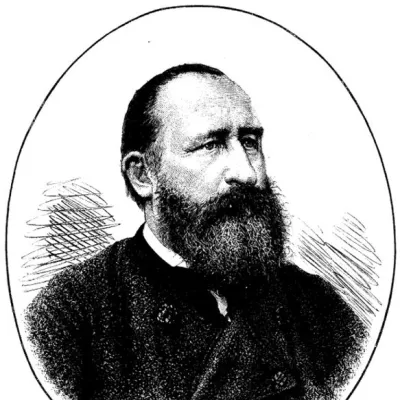
Alfred Brehm
Human Design Chart
Biography
On 31 May 1847 Brehm joined the African expedition organized by Johann Wilhelm von Müller, a well-known ornithologist. The expedition took him to Egypt, the Sudan, and the Sinai peninsula; the discoveries made were so important that, at the age of only 20, he was made a member of the German Academy of Natural Scientists Leopoldina.
In 1856, After studying natural sciences at Jena, he went on a two-year journey to Spain with his brother Reinhold. Afterwards he settled down in Leipzig as a freelance writer and wrote many scientific popularizations for various magazines. Apart from this, he undertook an expedition to Norway and Lapland in 1860.
In May 1861 Brehm married his cousin with whom he had five children. Since he wanted to travel, in 1862 he accepted the invitation of Duke Ernst II of Saxe-Coburg-Gotha to accompany him on a trip to Abyssinia. Afterwards, Brehm travelled to Africa as well as to Scandinavia and Siberia. His essays and expedition reports from the animal world were well received, because of this, he was commissioned by the editor of the Bibliographisches Institut, Herrmann Julius Meyer, to write a large multivolume work on the animal world.
Brehm's life was full with writing, scientific expeditions and lecture tours. Despite this, in 1862, he accepted the post of first director of the Zoological Garden of Hamburg and kept this position until 1867. Afterwards he went to Berlin, where he opened an aquarium. In the winter of 1883 to 1884 Brehm planned a lecture tour to the USA. Shortly before his departure, his four children contracted diphtheria. Since he could not afford to break his contract, Brehm, a widower since 1878, went ahead with his tour. At the end of January he received word of his youngest son's death.
What does Manifesting Generator 6/3 mean for Alfred Brehm?
Manifesting Generator 6/3 — Design at a Glance
Alfred Brehm revealed himself as someone who possessed hybrid energy: the constant power of a Generator paired with the lightning-fast execution power of a Manifestor. His design suggested that he did not simply react but pulled things into his life by skipping steps and advancing multiple projects in parallel. This speed, however, was a double-edged sword. Often, he moved too quickly, neglected important intermediate steps, and had to return later to fill gaps – a process that frustrated him because his non-self theme lay precisely in fighting this natural rhythm.
The mechanics of his Manifesting Generator required a precise strategy: He could not initiate but had to react to impulses. Only when his Sacral Center responded with a clear "yes" was the path open for his swift implementation. As soon as this inner confirmation was missing or he tried to tackle everything simultaneously without this resonance, his creative enthusiasm quickly turned into overload. If the alignment worked, however, deep satisfaction ensued. Alfred Brehm then lived in a "play mode," where variety and parallel work were not sources of exhaustion but driving forces of his fulfillment. His success thus depended less on linear planning than on learning to channel his speed through constant verification of inner agreement.
Emotional Authority
Alfred Brehm's design laid a tendency towards emotional wave movements that significantly shaped his perception and decision-making. As the carrier of Emotional Authority, he was subject to constant ups and downs in his feelings; the world always appeared colored by his current mood. At one moment, he could be totally enthused about something, only to completely negate it in the next instant. However, his immediate feeling was merely a snapshot, an initial impression that did not necessarily reflect his deepest truth yet. Quick, spontaneous decisions based on such emotions often had negative consequences for him.
The mechanics of his inner authority required patience: The more time he took to let a decision mature, the deeper and more comprehensive his understanding became. This involved sleeping on questions multiple times. He should take his time, hesitate, and repeatedly ask himself. Over time, intense feelings subsided, he gained emotional distance, clarity emerged, and calmness set in. Only then had he gone through the process. For him, this rule was absolute: Whenever the Emotional Center was activated, it also functioned as inner authority, regardless of which other centers were defined in his chart. This priority of Emotional Authority over all other defined areas shaped his approach to long-term life decisions that could have a significant impact on his life course.
The 6/3 Profile — Role Model / Martyr
Alfred Brehm's design inclines towards continuous experimenting paired with the desire for an extraordinary life far from common standards. As a person with Profile 6/3, he lived his first thirty years like a pure adventurer: through numerous self-experiments and learning from trial and error. This phase deeply marked him as the line of the experimenter remained active throughout his entire life.
The mechanics of this profile describe very old souls who often felt internally restless because they did not seek ordinary perfection but something unique. Alfred Brehm used his unusual experiences to later become a wise and humorous role model. Responsibility and wisdom became self-evident for him after the age of thirty.
Additionally, Gate 19 with the line of seclusion influenced him. This meant a spiritual path that began with the understanding that nature is ensouled. Alfred Brehm showed phases of devotion and withdrawal, often retreating from material everyday life to overcome the ego. This combination of adventurous spirit and spiritual solitude shaped his basic attitude: he sought what was right but rarely found it in conventionality, instead finding it through a deep engagement with himself and his surroundings.
Split Definition — Defined & Open Centers
Alfred Brehms' design inclined towards clear, identity-driven communication characterized by deep emotional reflection. His defined Throat Center connected to the G Center, indicating that he spoke from his personal identity and direction – a consistent 'I', articulating his truth honestly. However, this voice was not set impulsively but filtered through his defined Solar Plexus as an inner authority: He patiently waited for the emotional wave to clear before acting or judging.
This combination of defined Sacral and Root Centers endowed him with immense vital endurance and a constant internal pressure that propelled him forward in the material world. As a Generator, he had a reliable energy source, but it was only correctly activated through reaction – not initiation. His system was designed to respond to what life offered, with his defined Solar Plexus ensuring these responses were emotionally mature and not impulsive.
Simultaneously, his design revealed specific vulnerabilities. His open Head and Ajna Centers meant he lacked a consistent mental focus; he tended to lose himself in the questions and concepts of others or be overwhelmed by doubts that weren't his own. His open Heart Center made him vulnerable to the pressure of proving his worth through promises or competitive behavior – a trap he had to avoid to escape frustration. Additionally, his open Spleen was sensitive to external health and safety frequencies; it often drew him to people with defined Spleens for a sense of well-being, which carried the risk of unhealthy dependencies if he didn't trust his own authority. Alfred Brehm thus emerged as someone who unleashed his strength through patient waiting and authentic speaking from within while learning to observe mental confusion and ego pressure without following them.
Channels for restlessness, rhythmic power and quiet reflection.
Alfred Brehms' design inclined towards innovative, materially grounded directional shifts. The Beat channel 14-2 connected the Sacral Center with the G Center via Gate 14 (Power Competence) and Gate 2 (Higher Knowledge). This configuration served as a key custodian for resources necessary to transform mutative impulses into tangible reality. Brehm was not shown as a seeker of destiny but rather someone who reinforced himself through honest reactions to his own life; his aura helped others find their direction by remaining open and trusting the flow of life.
Parallel to this, the Lost Son channel 13-33 between G and Throat Centers worked. Here, Gate 13 (Listener) connected with Gate 33 (Withdrawal). This connection promoted a stance of reflection: Brehm gathered information, secrets, and memories before withdrawing to sort these experiences out. Only after this patient categorization did he share the truths gained. This process underscored the value of continuity and stability through the sharing of life stories and collective knowledge.
On a personal level, the channel of Recognition 30-41 between Root and Solar Plexus Centers drove an intense longing for new experiences. Gate 41 (Restriction) generated a drive through restlessness, while Gate 30 (Recognition of Feelings) emotionally heated this impulse. This created a strong desire to embrace the unknown, with the challenge being to give the emotional wave time before acting.
Additionally, individual gates shaped his profile: Gate 19 emphasized the need for secure resources and territory for spiritual approach. Gate 1 brought unique, restriction-free creativity into the here and now. Gate 56 enabled mental processes to be translated into pictorial narratives, while Gate 9 promoted detailed perfection through repeated experiments. Gate 46 stood for full dedication to the physical process as a temple of the body, Gate 31 for the energetic transmission of leadership, and Gate 54 linked worldly success with mystical insight.
Collective Circuitry — Circuit Signature
Alfred Brehms' design inclined towards rhythmic expressive strength and emotional reflection. As a person with shared definition, his energetic system consisted of two parallel, non-directly connected blocks. The first block connected Identity and Sacral Center via the Knowledge Circuit. Here, the channel 'The Beat' (Gates 2–14) created a pulsating, acoustic quality of one's individuality. Alfred Brehm was shown as someone who walked his unique path through rhythmic affirmation and brought new impulses into the world. The second block encompassed Throat with Identity Center and Solar Plexus with Root Center in the Meaning Circuit. Through the channels 'The Lost Son' (33–13) and 'Recognition' (30–41), he reflected past experiences wave-like. This part of his design served to order emotional insights from the past and share them with the collective. Both systems existed side by side: on one hand, the powerful, innovative projection of self; on the other, the cyclical, often melancholic processing of experience. Alfred Brehm lived these dual forces – creating new knowledge and deep contemplation about meaning – as separate but equally important aspects of his existence.
Left Angle Cross of Refinement 2
Alfred Brehm's design indicated a tendency towards refinement and precision. He was someone who did not accept the rough or unrefined but rather strived to grasp and represent things in their purest form. This attitude stems from the influence of the left cross of refinement 2. In Human Design mechanics, this configuration represents the drive to separate the essential from the non-essential. It was not superficial criticism but a deep inner compass seeking quality and authenticity. Alfred Brehm lived with this demand on himself: he filtered information and experiences until only what was truly true remained. This process of refinement shaped his way of working. He brought clarity into chaos by sharpening details and making structures clearer. For those around him, this often meant that Alfred Brehm took a role promoting order and refinement. He helped others to filter out the noise and recognize the core of things. His energy served to transform raw materials of life – whether knowledge, relationships or projects – into something valuable and sustainable. It was not passive observation but an active process of purification. Alfred Brehm carried this responsibility by using his own life as an example of refinement. He demonstrated through his presence that quality arises when one is willing to remove the superfluous and focus on what truly matters. This mechanism worked continuously in his daily life, without him having to consciously control it; it was simply part of his natural aura and actions.
Saturn Return · Uranus Opposition · Chiron Return — Life Cycles
Alfred Brehm's design set a tendency towards expansive reformative impulses that condensed into concrete public structures. This dynamic showed itself in 1869 at the age of 40 when he opened the Berlin Aquarium according to his own ideas. This event marked the Uranus opposition cycle, a phase of deep transformation and individual differentiation. Here long-held visions not only became theoretical but entered the world as tangible reality, which is typical for this cycle: old patterns are broken to give space to new, independent forms.
Later in 1877 at age 48, the Chiron return occurred, accompanied by the death of his mother Bertha Brehm. In Human Design mechanics, this cycle does not signal healing in a medical sense but entering into the bloom time of one's life purpose. If Alfred Brehm had lived according to his strategy and authority up until then, his incarnation cross now condensed into an experienced meaningfulness. The loss of his mother coincided with this transition towards full realization. It was not an end but a marked shift towards maturity: the outer structuring of life (like the aquarium) increasingly gave way to inner confirmation of what he was there for. Both cycles shaped his second half-life as phases of anchoring and finding meaning.
Manifesting Generator · Emotional Authority — Synthesis
Alfred Brehm lived a path deeply driven by exploration and transformation. The combination of manifesting generator typology and defined sacral center points towards someone who had constant energy available (sacral center) but did not use it linearly. Rather, he used his ability to skip steps – a characteristic of the manifesting generator – to quickly open up new areas and advance innovations. This was evident in the initiation of projects challenging existing norms, such as the event of opening an aquarium according to his own ideas. The knowledge circuit amplified this process by encouraging him always to seek out new insights and forms of expression.
A central paradox in his design lay in the interplay between quick initiation and emotional authority. While the manifesting component allowed for rapid steps, the emotional center required time for decision maturation. This likely led to an internal tension between the impulse to act immediately and the necessity to fully experience and understand emotions first. The Uranus opposition cycle at age 40 and the Chiron return with his mother's death show the processing of deeper emotional processes and transformations that took place in his life.
3 Defined Channels
Incarnation Cross - Left Angle Cross of Refinement 2
Solar Return
The Solar Return shows the moment when the sun returns to its exact birth position - your personal solar year.
Life Cycles
Discover the life cycles with a detailed triple view (birth chart, cycle chart, composite).
Human Design Profile
- Strategy
- To respond - wait for something to respond to
- Authority
- Emotional Authority
- Profile
- 6/3 - Role Model / Martyr
- Definition
- Split Definition
- Incarnation Cross
- Left Angle Cross of Refinement 2
- Date of Birth
- 02.02.1829 07:00
- Place of Birth
- Renthendorf, Germany
Frequently Asked Questions
What was Alfred Brehm's Human Design type?
What Profile did Alfred Brehm have in Human Design?
What Authority did Alfred Brehm have?
What incarnation cross did Alfred Brehm have?
When was Alfred Brehm born?
Discover your own Human Design
Are you also a Manifesting Generator? Find out in a personal reading how to unfold your multi-talents and direct your energy wisely.
More Personalities
Back to overviewAldair

Alizée

Angeli

Arletty
Artus

Balthus