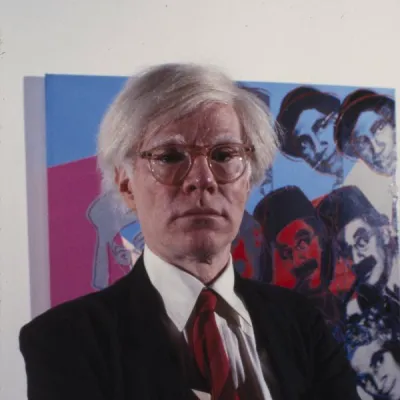
Andy Warhol
Human Design Chart
Biography
Born to working-class Rusyn immigrant parents in Pittsburgh, Warhol began his career as a commercial artist in New York before transitioning to fine art. Among his best-known early silkscreen paintings are Campbell's Soup Can (1962) and Marilyn Diptych (1962), and Coca-Cola (3) (1962). In the mid-1960s, Warhol began devoting his attention to creating experimental films such as Blow Job (1964) and Empire (1965). He subsequently directed a number of underground films—including Chelsea Girls (1966), Four Stars (1967), and Blue Movie (1969)—featuring a shifting group of personalities known as Warhol superstars. His studio, the Factory, became a hub for avant-garde experimentation, bringing together drag queens, poets, bohemians, musicians, and wealthy patrons.
What does Generator 1/3 mean for Andy Warhol?
Generator 1/3 — Design at a Glance
Andy Warhol revealed himself as someone whose immense endurance and productivity were inseparably linked to his response to external impulses. His Generator design established an underlying attitude that was not characterized by independent initiative but rather by reacting to signals from life. Like a workhorse, he possessed abundant sacral energy, yet this energy only reached its full potential when it encountered a concrete stimulus. The strategy involved waiting and responding instead of anticipating.
This mechanism created a clear contrast in his experiential world: When Andy Warhol listened to an inner 'yes' from his Sacral Center and acted accordingly, deep satisfaction ensued. Conversely, ignoring these impulses or forcing initiatives led to frustration and energy loss. The danger lay in choosing tasks that did not resonate internally, which could lead to burnout over time. Similarly problematic was being hindered on his heart project despite having the energy available. His effectiveness relied on responding from the gut, thereby aligning the materializing power of his sacral energy with his design.
Sacral Authority
Andy Warhol demonstrated decision-making that occurred not in rational thought but through an immediate physical response to external stimuli. His Generator design established that his strategy – waiting for a signal – was simultaneously his inner authority. This alignment simplified his process: He did not need complex analysis but could trust the direct reaction of his body.
This sacral authority manifested as an 'inner voice' or palpable surges of energy. Andy Warhol learned to pay attention to specific bodily signals like grunting, humming, or a soft 'mm-hm'. These sounds indicated whether his internal engine had started up. When resonance occurred, he felt vital and alive; seemingly inexhaustible energy was at his disposal with which he carried out tasks with great enthusiasm. His life was designed for engaging in actions with joy and satisfaction without being bound to external purpose.
Additionally, his activated Spleen Center served as a supportive instance to the sacral authority, enabling particularly quick and spontaneous reactions. He had immediate access to his instinctive perception and physical well-being, which he relied on reliably. The distinction between genuine, vital resonance and mere reaction was central: Only authentic bodily response counted as guidance for his actions.
The 1/3 Profile — Investigator / Martyr
Andy Warhol revealed himself as someone who combined theoretical thoroughness with an unshakable drive towards practical experimentation. His design established a tendency to legitimize authority not through mere assertion but through self-earned and tested knowledge. This aligned with Profile 1/3, the Researcher and Experimenter. Line 1 in his design established a foundation for leadership through careful research; it sought stability and deep understanding before acting. Simultaneously, Line 3 demanded bold experimentation through trial and error. For Andy Warhol, this synthesis was central: He acted like a scientist who is also an adventurer – similar to the archetype of Indiana Jones. When he chose something or deemed it valuable, he had previously analyzed it intellectually as well as empirically tested it thoroughly. His judgment carried high credibility since it emerged from the connection between studied theory and lived practice. The energy of Line 1 could make him feel that he did not yet know enough to move forward; however, Line 3 urged him to use mistakes as learning opportunities and patiently wait for mutations. Thus, his insights arose through a cyclical process of learning and doing, enabling him to exercise clear authority based on genuine experience.
Split Definition — Defined & Open Centers
Andy Warhol revealed through his design as someone with a constant, unchanging presence in communication and identity. His defined Throat Center gave him a reliable voice; he did not speak from fleeting thoughts but transmuted all kinds of information into clear actions or words. This expressive ability came directly from his motor centers: The defined Sacral Center generated constant vital energy that was only available for reactions – his “yes” or “no” determined whether he had the strength for a task. Parallel to this, the defined G Center offered a firm sense of self-love and direction; he intuitively knew who he was and where he was going without needing to prove it. The permanent pressure of his defined Root Center propelled him forward existentially, structured his handling of stress, and ensured movement in material life.
In contrast, his open centers functioned as mirrors of the environment. His open Head and Ajna Centers meant that inspiration and mental clarity were situational; he tended to pick up on other people’s thoughts or get lost in doubts when not trusting his inner authority. The open Heart Center indicated that he did not have a constant willpower and therefore should not make promises – attempting to prove worth through performance led only into cycles of failure. His open Solar Plexus absorbed foreign emotions like a barometer; he intensely felt the mood of his surroundings without these feelings being his own. Finally, his open Spleen Center made him vulnerable to dependencies on others’ “feel-good frequency” and spontaneous decisions risky as intuition here did not serve as a reliable decision-making source.
Channels for logical leadership, creative inspiration and mature growth.
Andy Warhol revealed himself as someone who combined individual inspiration with collective leadership. His design included Channel of Inspiration 1-8, which expressed mutative creativity through personal presence. This required the courage to stand out and gain attention not through words but by living an exemplary life of his unique identity. At the same time, Personality Channel Alpha Animal 7-31 defined his role: logical, collective leadership based on tested patterns. Gate 7 provided the rational position to lead society – often as "the power behind the throne" – while Gate 31 represented the influence of the collective leader who first had to earn trust and be invited by the majority. This synthesis created a tension between individual exemplary effect and the need to fit into existing social structures. Warhol lived his individuality to inspire others, but he also sought recognition within collective frameworks. His impact arose from acting as an individual (Channel 1-8) while his personality embodied the logic of group leadership (Channel 7-31). This meant that his success depended on staying authentic and waiting for the right moment to engage in collective dynamics. The Channel of Maturation 42-53 underscored this: every experience had to be fully lived through and reflected upon to gain wisdom. Warhol sought new cycles not with fixed expectations but for the sake of experience, thereby gaining depth that he then passed on to others. His energy followed the rhythm of Gate 5 in the Sacral Center, which required patience and cultivating the right timing so that his individual radiance could be effective.
Collective Circuitry — Circuit Signature
Andy Warhol revealed himself as someone whose creative expression was closely linked to impulsive energy. His design featured a split definition: one group connected the Throat and Identity Centers, while another connected the Sacral and Root Centers. These two areas were energetically separate; they existed as parallel forces, not as a continuous flow.
In the Knowing Circuit, Channel "Inspiration" (Gates 1–8) was active. It linked the Throat to the Identity Center and promoted the expression of unique individuality through emotional waves. This generated a pulsating, acoustic energy based on inspiration.
The Understanding Circuit also activated the Throat and Identity Centers via Channel "The Alpha Animal" (Gates 31–7). Here it was about focused, visual sharing of logical insights toward the future, free from emotional conditioning. Both circuits utilized the same connection between identity and expression but with different qualities: once inspired-emotionally, once rational-focused.
Completely separate, the Meaning Circuit operated. Channel "Maturation" (Gates 42–53) connected the Sacral to the Root Center. This involved cyclical visual reflection of past experiences with a downward emotional wave. Since this group was not linked to the Throat-Identity group, the process of finding meaning from the past remained energetically isolated from direct expression through the Throat Center.
Thus, Andy Warhol lived with two distinct energy areas: one for identity expression and another for internal processing of past and impulse.
Right Angle Cross of the Sphinx 3
Andy Warhols design carried the signature of the right cross of Sphinx 3. This configuration established a specific inner dynamics that was reflected in how he interacted with the world. It was a pattern often associated with a deep, sometimes unconscious search for meaning or a particular spiritual orientation. The energy of this cross worked in the background, shaping his perception and the themes that occupied him without always being obvious on the surface. It was about an inner compass highlighting certain areas of life while putting others into shadow. For Andy Warhol, this meant that his actions and reactions were shaped by this underlying structure. It created a framework within which his personality developed and expressed itself. Sphinx 3 traditionally represents a connection between the spiritual and the material, often seen through the filter of one's own identity or social environment. In him, this was shown as an ongoing struggle or flow between these poles. It was not a static state but a living force influencing his decisions and creations. This mechanical foundation explained parts of his life path, not just through external circumstances, but through the internal logic of his design. It determined where he found energy and lost it, how he approached challenges, and what answers he sought. It was a silent yet powerful presence in his life.
Saturn Return · Uranus Opposition · Chiron Return · 2nd Saturn Return — Life Cycles
Andy Warhols design set a tendency towards structural turning points marked by recurring astrological cycles. These phases served as career milestones where long-term developments condensed or new directions were taken.
In 1956, at the age of 28, he experienced his first Saturn return. This cycle often signals the crystallization of years of work into a solid result. Indeed, this was evident in his exhibition at the Museum of Modern Art in New York, a clear testament to this consolidating power.
Ten years later, in 1968 at age 40, he faced the Uranus opposition. This cycle often brings unexpected changes or the breaking of old structures. Warhol participated in documenta in Kassel, reflecting this impulse towards openness and reorientation.
At age 49 in 1977, he reached his Chiron return. This fulfillment cycle marks a blooming time when one's incarnation cross unfolds and meaning becomes experiential – provided one lives according to their strategy. His participation in Documenta 6 underscores this phase of self-realization and purposeful unfolding.
Finally, in 1985 at age 57, his second Saturn return followed. It demands a re-evaluation of life structure and responsibility. Warhols involvement in the 'Global-Art-Fusion' project shows how he faced this structural realignment and redefined his role within the larger context.
Generator · Sacral Authority — Synthesis
He was a Generator with sacral authority who found energy through constant experimentation and testing (Profile Researcher/Experimentor). This process of learning and experimenting seemed central to his life approach – an ongoing search for the 'right' expression, manifesting in repeated career peaks where he presented already developed insights. The sacral energy fueled an unrelenting drive as long as work on a project filled him with joy and was not interrupted by external influences.
A fundamental paradox shaped his design: the need for public recognition and expression (Channel 1-8) stood in tension to potential vulnerability resulting from open communication and transformation (defined Throat Center). He seemed to navigate throughout life between the desire to express his unique perspective and inspire others, and the necessity of protecting himself from the effects of this openness. This creative expression was closely tied to the knowledge circuit that drove him to create new things and change the world through his art.
3 Defined Channels
Incarnation Cross - Right Angle Cross of the Sphinx 3
Solar Return
The Solar Return shows the moment when the sun returns to its exact birth position - your personal solar year.
Life Cycles
Discover the life cycles with a detailed triple view (birth chart, cycle chart, composite).
Human Design Profile
- Type
- Generator
- Strategy
- To respond - wait for something to respond to
- Authority
- Sacral Authority
- Profile
- 1/3 - Investigator / Martyr
- Definition
- Split Definition
- Incarnation Cross
- Right Angle Cross of the Sphinx 3
- Date of Birth
- 06.08.1928 06:30
- Place of Birth
- Pittsburgh, United States
Frequently Asked Questions
What was Andy Warhol's Human Design type?
What Profile did Andy Warhol have in Human Design?
What Authority did Andy Warhol have?
What incarnation cross did Andy Warhol have?
When was Andy Warhol born?
Discover your own Human Design
Are you also a Generator? Find out in a personal reading how to use your sacral energy correctly and discover deep satisfaction.
More Personalities
Back to overviewAaliyah

Alexia

Angèle

Anne-Marie

Arcángel

Arno