
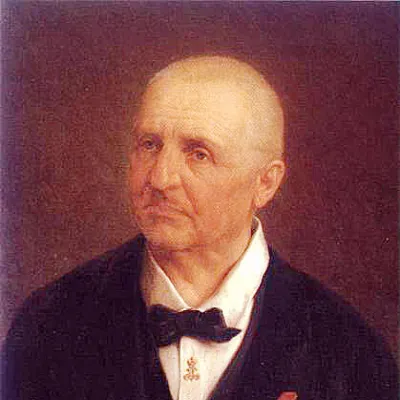
Anton Bruckner
Human Design Chart
Biography
He died on 11 October 1896, Vienna, Austria.
The Human Design of Anton Bruckner: Projector 1/3
Projector 1/3 — Design at a Glance
Anton Bruckner's design suggests a tendency towards focused and penetrating perception. As a projector, he did not have an intrinsic source of life energy but worked in phases of high intensity followed by necessary rest periods for regeneration. His undefined Sacral Center meant that he could not define himself through constant productivity but rather drew his strength from the quality of his attention.
His aura acted like a bright flashlight, directing itself precisely towards weaknesses in systems or others. He immediately saw where something was 'in the dark' or did not function properly. The challenge lay in expressing this insight without being direct and confrontational, which often triggered resistance in others. Instead, he was most effective when simply radiating his own clarity – similar to someone living a harmonious relationship who attracts others through it.
The strategy for his design was to wait for a respectful invitation from others before offering advice. Only then could he give guidance without being perceived as preachy or unpleasant. If this strategy was followed, he was rewarded with success. Ignoring it and trying to impose his insights led sooner or later to his non-self theme: bitterness over not being understood. His influence therefore did not rely on his own perseverance but rather on the ability to light others' way once they were ready to accept it.
Splenic Authority
Anton Bruckner showed a marked tendency for immediate, intuitive decision-making. His design placed authority in the Spleen Center, meaning that his health and alarm system served as the central instance for directional decisions. This configuration required open emotional and sacral centers, classifying him as either a projector or manifestor. The spleen authority endowed him with fine survival intelligence: A spontaneous inner impulse immediately signaled whether a situation, environment, or society was beneficial or harmful to his well-being. This first impulse was the reliable indicator of what was right and enabled him rigorously to distance himself from detrimental influences. However, this subtle spleen impulse appeared only once in the moment and there was a risk that it could be drowned out by external advice or excessive deliberation. This required Anton Bruckner to maintain high vigilance; temporarily withdrawing could help him hear this fine voice again. Since knowledge of what is right always arose in the present moment, long-term commitments were difficult and often counterproductive. His design favored flexibility and freedom over rigid plans that might prove inappropriate in the short term. Spontaneous action and trust in the current body impulse characterized his strategy for preserving health and inner integrity.
The 1/3 Profile — Investigator / Martyr
Anton Bruckner's design points towards intense research and experimental learning. As a person with Profile 1/3, the Researcher and Experimenter, his life was an ongoing process of learning through trial and error. His internal dynamics were marked by the tension between the need for solid theoretical knowledge and the urge to practical experimentation.
The first line of his profile sought the foundation, the pivotal point amidst confusion. Without a clear theoretical basis, he often felt blocked; pressure sometimes led to rash actions that only intensified this confusion. At the same time, the third line required development through chaos and crises. This line needed other people as mirrors in contexts of boredom and progress. Only by personal experience and living through setbacks could Anton Bruckner achieve forward-directed changes.
His judgments were therefore particularly trustworthy because they rested on a double test: theoretical and practical. When he deemed something good, he had previously tested it both mentally and practically to the core. This configuration described a life task of uncovering hidden connections through personal experience and only passing them on once proven in the crucible of experimentation. His path was not a straight line but a spiral ascent from mistakes and insights.
Triple Split Definition — Defined & Open Centers
Anton Bruckner's Human Design profile revealed a persistent mental intensity. His defined Head and Ajna centers created an ongoing pressure to question and form concepts continuously. This internal process was relentless; he thought constantly, regardless of external influences. However, this mental energy lacked the direct power to implement ideas. While his defined Throat center allowed him to clearly express his thoughts and make them available to others, intellect alone could not force physical results. Attempting to realize ideas through sheer will or patience often led to frustration. Instead, he served as an inspiration for others who possessed the necessary energy to bring his concepts into reality. His defined G-, Spleen-, and Root centers endowed him with a firm identity and a strong intuitive survival instinct. He knew his direction and reacted spontaneously to what was healthy in the moment. Simultaneously, his undefined Heart, Sacral, and Solar Plexus centers revealed his vulnerability. Without consistent willpower, he tended to want to prove his worth through performance, which could lead to cycles of promises and disappointment. His open Sacral center made him susceptible to absorbing foreign energies, leading to exhaustion if he did not pause. Additionally, his undefined Solar Plexus absorbed the emotions of those around him, often leaving him emotionally overwhelmed or unstable despite these feelings not being his own. This configuration described a person of profound inner clarity and intuition who needed to learn how to protect himself from the pressure of validating his worth externally or carrying others' emotional burdens. His strength lay in serving as a resonant instrument for inspiration and intuitive truth rather than fighting against the flow of his design.
Channels for inspiration, critical judgment and mental abstraction.
Anton Bruckner was someone who, through his blore existence and authentic expression, encouraged others to live their unique individuality. This effect stems from Channel Inspiration 1-8, which connects the G Center with the Throat Center. Here, creativity (Gate 1) is not expressed through words but through a life example as a transformative perspective. Bruckner was designed to gain attention by showcasing his individual direction; his contribution lay in giving others the courage to stand out from the crowd. This kind of leadership requires deep inner authority rather than social adaptability and patience for the right timing, so that the co-creation between his individuality and recognition by others can succeed.
Parallel to this, there was an insatiable drive within him to perfect and correct patterns. Channel Judgment 58-18 connected the Root Center with the Spleen Center, driven by Gate of Vitality (58) and Gate of Correcting (18). This mechanism functioned as a sentry checking whether something was in balance or needed correction. Bruckner sought logically disputable answers to regain joy lost in conditioned structures. His effectiveness only showed when he brought his critical solutions upon request – a strategy to conserve energy and ensure the environment was open for his corrections.
Furthermore, Bruckner underwent a constant mental process of finding meaning. Channel Abstraction 64-47 connected the Head Center with the Ajna Center, where Gate of Confusion (64) met Gate of Understanding (47). His mind filtered every experience through kaleidoscopic mental images to find a story that made sense. Although this process often led to inner unrest, it was not meant to steer his own life. Instead, waiting for clarity rewarded him with unique perspectives and
Collective Circuitry — Circuit Signature
Anton Bruckner's Human Design profile presented itself through three separate but parallel energetic streams. In the Knowledge Circuit, Channel Inspiration connected the Throat Center with the Identity Center. This promoted the expression of a unique individuality; new insights were not only thought but directly spoken into the world, often accompanied by a pulsating, acoustic quality.
Parallel to this, in the Understanding Circuit, Channel Judgment ran between Spleen and Root Centers. Here, sharing logical, rational insights was paramount, free from emotional coloring. This connection served strategic future improvement through focused visual analysis and clear structuring of information.
A third independent stream flowed in the Meaning Circuit over Channel Abstraction from Head to Ajna Center. This area dealt with emotions and experiences from the past. The energy ran cyclically and wave-like, reflecting on past events to learn together with others. As Anton Bruckner had a Triple Definition, these three areas – individual expression, rational strategy, and emotional reflection of the past – existed side by side without direct connection. They formed separate, independent force fields within him.
Right Angle Cross of Consciousness 3
Anton Bruckner's design indicated a tendency towards inner dissonance that manifested in a constant back-and-forth between two opposing impulses. This configuration, known as the right cross of consciousness 3, described a conflicted state: on one hand, he was driven by the desire for immediate intuitive action, while on the other, it pulled him into the depths of reflection and waiting. Instead of a clear line, he developed a pattern of impulsive starts followed by hesitation. The mechanics of this cross highlighted that his consciousness often oscillated between the urge to simply do something and the need to think things through thoroughly. This shaped his approach to challenges: he did not move forward in a linear fashion but rather went through phases of indecision, followed by sudden decisions that would then turn into doubts again. For Anton Bruckner, this meant that his inner compass rarely stood still; he was constantly searching for the right moment or answer, leading to a characteristic oscillation between activity and passivity. This dynamic tension formed the core of his psychological landscape, where consciousness itself became the stage of an ongoing dialogue between action and inaction.
Saturn Return · Uranus Opposition · Chiron Return · 2nd Saturn Return — Life Cycles
Anton Bruckner's design indicated a tendency towards cyclical phases of condensation and transformation. The first Saturn return often marked the moment when years of groundwork solidified structurally. In 1850, at age 26, he attended an advanced course in Linz – a step that carried this inner consolidation outward.
The Uranus opposition represents a phase of deep restructuring and breaking away from the known. Here, there was a need to break old patterns to create new space. In 1863, at age 39, Kitzler recognized Bruckner's studies as successfully completed. This success signaled the successful transformation and recognition of his newly found direction.
The Chiron return is a fulfillment cycle in which one's incarnation cross unfolds and meaning becomes tangible – provided that one lives according to their strategy. It is not about healing but blooming. In 1873, at age 49, Symphony No. 2 in C minor was met with disapproval from music critics. This external crisis contrasted with the inner completion of the cycle; rejection was part of the friction that sharpened his own expression without diminishing its essence.
The second Saturn return brought another phase of stabilization and confirmation. In 1880, at age 56, Bruckner embarked on a concert tour in Switzerland. This success underscored the viability of his previous development and showed that the structures he had worked on were now widely recognized. Thus, the mechanics of his design followed a clear rhythm of inner condensation, external change, and final confirmation.
Projector · Splenic Authority — Synthesis
Anton Bruckner was a projector whose life was marked by a profound drive for understanding and the need to bring light into darkness for others (Design). Through his defined Head Center, he experienced constant mental pressure to ask questions and understand things (Centers), which manifested in an unceasing urge to research (Profile 1/3). This desire for knowledge was amplified by the Knowledge Channel, driving him to explore new paths and initiate transformation – a process accompanied by creativity and emotional depth. The Spleen Authority ensured that he instinctively knew when an environment or situation would be beneficial for his work (Authority).
At the same time, Anton Bruckner lived in a tension field between the need for recognition and the risk of encountering rejection through his direct approach (Channels/Gates). Inspiration from Channel 1-8 drew attention, yet the subtle Spleen voice required boundaries and caution. This was evident in cycles: successes such as the recognition of his studies alternated with crises when his works were criticized (Cycles). Thus, he was a seeker who needed others' light to validate his knowledge while also possessing the ability to become an illuminating example himself.
3 Defined Channels
Incarnation Cross - Right Angle Cross of Consciousness 3
Solar Return
The Solar Return shows the moment when the sun returns to its exact birth position - your personal solar year.
Life Cycles
Discover the life cycles with a detailed triple view (birth chart, cycle chart, composite).
Human Design Profile
- Type
- Projector
- Strategy
- Wait for the respectful invitation
- Authority
- Splenic Authority
- Profile
- 1/3 - Investigator / Martyr
- Definition
- Triple Split
- Incarnation Cross
- Right Angle Cross of Consciousness 3
- Date of Birth
- 04.09.1824 04:15
- Place of Birth
- Ansfelden, Australia
Frequently Asked Questions
What is Anton Bruckner's Human Design type?
What Profile did Anton Bruckner have in Human Design?
Which Authority guided Anton Bruckner's decisions?
Which incarnation cross determined Anton Bruckner's life path?
When was Anton Bruckner born?
Discover your own Human Design
Are you also a Projector? Find out in a personal reading how to unfold your leadership qualities and recognize the right invitations.
More Personalities
Back to overviewSissy Spacek

Aaliyah

Alain-Fournier

Alexia

Alizée

Anémone
