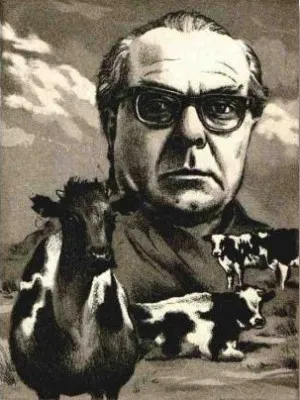
Arno Schmidt
Human Design Chart
Biography
Death 3 June 1979, cause of death: stroke.
Human Design Analysis: Arno Schmidt as Manifesting Generator 2/4
Manifesting Generator 2/4 — Design at a Glance
Arno Schmidt was someone who could quickly draw things into his life. As an Manifesting Generator, he had constant sacral energy that gave him immense creative power. However, this speed carried risks: He tended to skip important steps or take on multiple projects simultaneously. If strategy and inner authority were not aligned, his initial enthusiasm would quickly turn to frustration – his specific Non-Self theme.
To remain effective, the strategy for Generators applied to him: He reacted to impulses rather than initiating himself. Only when the sacral center gave a clear 'yes' after an initial test did he apply his energy. With correct application of this reactive tactic, he drew deep satisfaction from his work. Then it was no problem for him to work on different tasks simultaneously; in fact, variety and playful mode were essential to maintain his creative power. The advice to finish one thing before starting another would have harmed rather than helped him. His energy flourished in diversity and rapid change as long as he did not ignore the inner impulse.
Emotional Authority
Arno Schmidt's design showed a tendency towards emotional delay: He made no quick, impulsive decisions but let them mature consciously. This stance resulted from his inner authority located in the defined Emotional Center. In Human Design mechanics, this means that the Emotional Center always takes precedence over all other defined centers – regardless of which additional structures were active in his chart.
His internal orientation followed a wave motion of constant emotional ups and downs. The world appeared to him colored by his current mood; a topic could be totally exciting one moment and negative the next. His immediate feeling was only a snapshot, not a final judgment. Quick decisions made from this emotional heat often proved wrong.
Instead, his system required patience and conscious delay. He had to take time to let a decision 'sleep' several times over. Only when intense feelings subsided and he gained emotional distance did true clarity and calm set in. This cooling process was essential for him, especially with long-term life decisions of great significance. Only through this waiting could he recognize his deeper truth rather than reacting to superficial emotional impulses.
The 2/4 Profile — Hermit / Opportunist
Arno Schmidt's design showed a polarity tendency between withdrawal and connection. As a 2/4-Profile, he constantly oscillated between the need of Line 2 to be alone and that of Line 4 to spend time with his closest community. This tension required clear communication: He had to signal when he sought company and when he wanted solitude. In his withdrawal phases, he immersed himself in internal processes to gain clarity. Once this need was satisfied, he returned from his 'cave' to seek the network of Line 4. There he reflected on collected impressions and developed new ideas.
This dynamic was shaped by specific line properties. Line 2 (Gate 60) radiated limitations and showed a high adaptability to constraints, even if they no longer existed – similar to someone who maintains old routines despite changed external conditions. At the same time, Line 4 brought the essence of the Gate outward to externalize values. But this line was corruptible; it indicated that enriching values could be missing and based on weak societal norms. The Saturn in elevation gave here a malevolent gift: Success could arise despite mediocre value materials by acting egoistically or offensively. Arno Schmidt used this mechanism to evaluate knowledge from his network and brilliantly process it during his alone time.
Split Definition — Defined & Open Centers
Arno Schmidts Design inclined towards constant, clear communication that arose from a deep inner resonance. His defined Throat Center served as a direct channel for this expressive ability; it did not speak from fleeting thoughts but rather from the reliable source of his energy and identity. This voice was honest and precise, supported by its connection to his motor centers.
The power behind this expression came from his defined Sacral Center. As a Generator, he possessed an enormous vital energy source that was only effective when he responded to external impulses rather than initiating action himself. His strategy involved waiting until life asked him something before deciding with a clear yes or no answer from the gut. This protected him from exhaustion and frustration that would have arisen if he had tried to push his will where there was no available energy.
His defined Solar Plexus Center added emotional depth to this dynamic. It functioned as an inner authority for decisions that required time. Arno Schmidt tended to wait for the emotional wave to pass before acting. This patience allowed him to distinguish between impulsive emotional outbursts and true clarity, enriching his judgments with a special sensitivity.
In contrast, his open G Center revealed a flexibility of identity. Without a fixed self-image, he adapted to environments and gathered directions from outside influences. This did not lead to loss but rather to an open exploration of various life paths as long as he surrounded himself with the right places and people. His open Head Center made him receptive to inspirations from the environment without having to compulsively interpret them as his own answers. This openness allowed him to observe mental pressure moments instead of being overwhelmed by them, contributing to the overall clarity of his design.
Channels for evolutionary change and emotional transformation.
Arno Schmidt's design indicated a tendency towards evolutionary change, which was however marked by internal limitations and melancholic phases. The Channel of Mutation 60-3 connected the Root Center with the Sacral Center. Gate 60, the pivot point for all evolutionary possibilities, required acceptance of limitation while Gate 3 attempted to realize new orders. This combination generated a powerful, pulsating energy that fluctuated between chaos and order. Arno Schmidt showed himself as someone who did not argue against this mutative process but patiently waited for the reaction from the Sacral Center until the new mutation was established. The accompanying melancholy was not a lack but rather a sign of internal pressure during standstill phases before a new beginning.
In addition to this profound transformative power, the Channel of Transience 36-35 also played a role. It connected the Solar Plexus Center with the Throat Center and drove the search for new emotionally charged experiences. Gate 36 perceived inexperience as inadequacy and provoked crises to generate movement, while Gate 35 manifested the desire for change. Arno Schmidt lived out this restless longing by fully immersing himself in new situations to gain emotional depth and wisdom. This quest for experience served not only him but also inspired others through his "heroic tales" to participate in similar ventures.
Additionally, specific Gates shaped his Profile: Gate 50 fostered conscious traditions and values as a protective reflex, while Gate 56 translated mental processes into figurative narratives. In the design, Gate 39 supported mutation through provocative analysis, and Gate 6 regulated emotional waves within the context of fertility. Gate 33 allowed reflective withdrawal, Gate 53 marked the beginning of new cycles as a pioneer spirit. Gate 38 set boundaries to preserve integrity under pressure, and Gate 45 expressed tribal willpower. Finally, Gate 41 focused on specific evolutionary experiences and crises as sources of feeling.
Individual Circuitry — Circuit Signature
Arno Schmidt's Design established a tendency towards isolated but intense energetic poles. Due to his split definition, there were two independent power fields existing side by side that did not communicate directly with each other. The first field connected the Sacral Center with the Root Center through the Knowledge Circuit. Here, the Channel of Mutation (Gates 3–60) carried an energy for deviation from the known and creation of new identity. This was a pulsing, acoustic impulse that followed its innate path.
The second field linked the Throat Center with the Solar Plexus Center in the Sense-making Circuit. The Channel of Transience (Gates 35–36) channeled cyclical emotions and experiences from the past into expression. This energy followed a wave-like structure with a beginning, middle, and end, driven by the need to share felt insights and learn collectively from them.
Both systems worked in parallel: On one hand, there was the driving force for individual transformation and reinvention through Root and Sacral energies; on the other hand, there was the reflective emotional processing of past experiences that were felt through the Solar Plexus and articulated through the Throat Center. There was no direct flow between these two areas; they remained as separate, coexisting mechanisms that shaped Arno Schmidt's inner landscape – once through mutative impulses, and at another time through emotionally carried sense-making.
Right Angle Cross of Laws 4
Arno Schmidts Design featured a specific structure known as the right cross of Law Four. This configuration combined inner discipline with clear external orientation. It was not an arbitrary trait but a fixed pattern in his Human Design chart. The mechanics of this cross described a life task where personal principles and outer realities had to intersect. Arno Schmidt revealed himself as someone who had to endure this tension. His design suggested that he navigated between inner truth and outer expectations. This was not a choice, but a given structure. Law Four in the right cross often emphasizes the need to establish and consistently live by one's own rules. Arno Schmidts chart reflected this requirement. He faced the challenge of bringing his inner order into the world without losing himself in the process. This dynamic profoundly shaped his essence. There was no escape from this constellation; it was part of his fundamental architecture. The connection between Law and Cross created a framework within which Arno Schmidt operated. His energy flowed through these specific channels, favoring certain behaviors. He had to learn how to handle the forces that activated this cross. This did not always happen easily but was unavoidable due to his chart configuration.
Saturn Return · Uranus Opposition · Chiron Return · 2nd Saturn Return — Life Cycles
Arno Schmidts Design shows a tendency towards deep structural breaks that manifest in his life phases as crises or breakthroughs. This dynamic is triggered by planetary cycles, which confront inner maturity with external demands.
In 1940, at the age of 26, he experienced his first Saturn Return. This cycle often marks the transition to full responsibility and tests the viability of one's previous life path. For Schmidt, this pressure manifested as a crisis: He was drafted into light artillery by the Wehrmacht in Hirschberg. The mechanical tension between individual development and collective coercion strongly characterized this phase, as the Saturn Return requires accepting or renegotiating personal boundaries in real life.
Years later, in 1953 at age 39, the Uranus Opposition came into play. This aspect often demands breaking free from established patterns towards individual authenticity and innovation. For Schmidt, this energy was evident through the publication of "Aus dem Leben eines Fauns." The work represented a creative breakthrough that shattered old forms and brought his specific voice to the forefront – a typical expression of Uranus influence, which promotes change and independence.
His second Saturn Return arrived in 1971 when he was 57 years old. This cycle often solidifies long-term life achievements and brings recognition for consistent work. He was nominated by then Swedish Academy member Lars Gyllensten for the Nobel Prize in Literature. In his design, this signalled confirmation of his position and impact after decades of pursuing his strategy. The Saturn Returns thus formed the cornerstones of his development: from external compulsion to inner sovereignty and public recognition.
Manifesting Generator · Emotional Authority — Synthesis
Arno Schmidt lived a life profoundly marked by an intricate interplay between drive and reflection. As a Manifesting Generator (MG), he possessed the ability to quickly initiate things (Sacral Center), yet his emotional center required careful maturation of decisions. This combination led to a dynamic tension: He could take initiatives and act swiftly, but simultaneously needed time to fully grasp the consequences – a pattern that manifested in recurring phases of deep reflection and creative outbursts (Channel of Mutation). The Profile as a Natural Talent and Networker amplified this trait by oscillating between a desire for isolation for inner clarity and the need for exchange with a chosen community.
A central paradox in his design lay in the connection between quick action and emotional depth. The ability to transform and transmit messages through the defined Throat Center (Communication/Manifestation) stood in contrast to the necessity of filtering these impulses through the emotional wave. This led to an internal tension between the urge to create and express new things (Knowledge Circuit) and the careful consideration of whether this expression truly aligned with his truth. Events such as being called up for military service (Saturn Return 1) or receiving recognition through the Nobel Prize (Saturn Return 2) showed that despite quick decisions, he was repeatedly confronted with their consequences and needed time to process them.
2 Defined Channels
Incarnation Cross - Right Angle Cross of Laws 4
Solar Return
The Solar Return shows the moment when the sun returns to its exact birth position - your personal solar year.
Life Cycles
Discover the life cycles with a detailed triple view (birth chart, cycle chart, composite).
Human Design Profile
- Strategy
- To respond - wait for something to respond to
- Authority
- Emotional Authority
- Profile
- 2/4 - Hermit / Opportunist
- Definition
- Split Definition
- Incarnation Cross
- Right Angle Cross of Laws 4
- Date of Birth
- 18.01.1914 14:30
- Place of Birth
- Hamburg, GER
Frequently Asked Questions
What was Arno Schmidt's Human Design type?
What profile did Arno Schmidt have in Human Design?
Which authority guided Arn Schmidt's decisions?
What incarnation cross did Arno Schmidt have?
When was Arno Schmidt born?
Discover your own Human Design
Are you also a Manifesting Generator? Find out in a personal reading how to unfold your multi-talents and direct your energy wisely.
More Personalities
Back to overviewAlain-Fournier

Aldair

Alizée

Angeli

Arletty

Artus