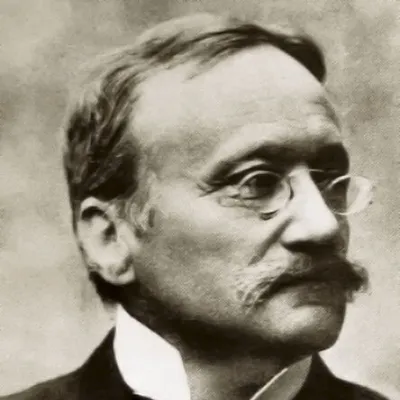
Arrigo Boito
Human Design Chart
Biography
He died 10 June 1918
Arrigo Boito — Manifestor with Profile 6/3
Manifestor 6/3 — Design at a Glance
Arrigo Boito revealed himself as a pioneer and visionary whose design was geared towards leading the world into new futures. His role resembled that of an emperor in ancient Rome: He possessed great vision but left the concrete implementation to others, much like a ruler sending soldiers for conquest. This kind of leadership inevitably polarized; while some loved his big dreams and followed him, he encountered rejection or hatred from others. The greatest pain point lay in the misunderstanding arising from the fact that his thinking often exceeded that of his surroundings.
To minimize this polarization and find the right followership, it was essential for Arrigo Boito to inform his environment early and precisely about his intentions. This strategy served not only communication but also created the necessary framework for his actions. If he followed this path of informing in harmony with his inner authority, his design rewarded him with a deep sense of inner peace. Conversely, if he lived against this natural alignment and failed to provide the necessary information, it was marked by persistent, deep anger. This emotional contrast between peace and anger functioned as a direct feedback mechanism that guided him back onto his path or confirmed that he was flowing in his own energy.
Emotional Authority
Arrigo Boito exhibited a decisive tendency towards restraint at crucial decision points: He did not make immediate judgments but waited patiently. His inner authority lay in the defined Solar Plexus Center, meaning he was constantly under the influence of an emotional wave. His perception of the world was always colored by his current mood; something could appear inspiring in one moment and negative in another. This up-and-down of feelings was not a mistake but a process. A first impression was never considered final truth. Spontaneous decisions based on a momentary mood often risked negative consequences due to incomplete information.
Instead, Arrigo Boito used time as a tool for clarification. He allowed decisions to mature, which required patience and multiple nights of reflection. Through this waiting, intense feelings gradually subsided. Only when emotional distance was gained did calmness set in. This state marked the end of the process and signaled the true reality of the situation. This strategy was particularly crucial for long-term decisions as it provided a deep and comprehensive insight beyond fleeting moods. Emotional authority always took precedence over other defined centers in his design, regardless of which additional mechanisms were active.
The 6/3 Profile — Role Model / Martyr
Arrigo Boito revealed himself as someone who sought an extraordinary life far from conventional standards. His Human Design Profile 6/3 shaped this attitude: In the first three decades, he primarily lived according to the line of the experimenter. This led to numerous self-experiments and a search for the perfect path, often accompanied by inner restlessness, as the goal always seemed unattainable.
This phase was marked by a permanent drive towards change. Only with the return of Saturn, around age 30, did his orientation fundamentally shift. The line of wisdom and responsibility came to the forefront. Arrigo Boito now used the experiences of his early years to become a visionary role model. Yet, the experimental spirit remained intact; testing new paths never fully stopped but was complemented by maturity and humor.
Especially relevant was his configuration in the emotional center. Gate 55 on line six highlighted transition and mutation. It became clear that individual development only became possible after material needs were met. This created a foundation for his later influence. Simultaneously, Gate 9 on line three influenced him. Here, it was about learning from mistakes and the 'drop-in-the-bucket' principle, where small details could significantly impact large processes. This mechanism required high concentration on details to ensure security while also learning to benefit from failures. Thus, his chaotic adventurer instinct in the second phase of life transformed into a humorous, wise leadership figure who inspired others through their unconventional experiences.
Single Definition — Defined & Open Centers
Arrigo Boito was characterized by a persistent, independent mental field. His defined Ajna Center ensured continuous concept formation that was hardly influenced from the outside; his mind processed data and creativity in a specific, trustworthy way. These thoughts flowed directly into his communication as his also defined Throat Center served as a reliable anchor point. It allowed him to express what he conceptualized clearly and consistently in the world without this expression being impulsive or uncontrolled.
The true depth of his decisions, however, came from his defined Solar Plexus Center, which acted as his inner emotional authority. Here lay the necessity to practice patience: He had to wait out the ups and downs of the emotional wave before acting or committing. This mechanism generated passion and spiritual sensitivity but also required the discipline not to react on the first impulse. The truth revealed itself for him only over time, at the end of the emotional cycle where clarity reigned.
At the same time, Arrigo Boito was vulnerable through several open centers to external conditioning. His open Head Center tended to suffer under mental pressure or get entangled in other people's questions rather than forcing his own answers. The open G Center meant that he did not carry a fixed identity but reflected it through the environment and relationships; he did not actively seek direction but waited to be initiated. His open Heart Center was vulnerable to trying to prove worth through promises or competition, often ending in frustration as he lacked consistent willpower. Additionally, his open Sacral Center absorbed others' energy, which could lead to exhaustion if he did not trust his own authority and set boundaries. Also, the open Spleen and Root Centers made him sensitive to fear signals and external stress, which he might interpret as personal problems rather than environmental factors.
Channels for insatiable curiosity and emotional openness.
Arrigo Boito appeared as a searching storyteller whose expression was strongly guided by the inner emotional wave. His design combined an insatiable desire for new perspectives with mood-driven communication skills that only worked at resonance.
The Channel of Curiosity 11-56 fueled this search. It connects Gate of Ideas (11) in Ajna Center with Gate of Inspiration (56) in Throat Center. This configuration forces a constant search for new viewpoints, not to find a fixed result but to continue sharing the discoveries themselves. Arrigo Boito used this energy to transform information into magical stories and philosophical parables. He filled gaps of pure logic with imagination to influence listeners through emotional stimulation. His portrayals served less as personal guidance than passing life wisdom on to future generations.
Parallel, Channel of Openness 22-12 worked, connecting Solar Plexus Center (Gate of Openness, 22) with Throat Center (Gate of Caution, 12). His social presence and emotional impact depended entirely on the ebb and flow of his mood. Gate 12 exercised necessary restraint that limited openness to moments when mutative potential was greatest. Authentic communication thus required patience and precise timing; only when Arrigo Boito felt it could he deeply touch others or inspire change through voice and words. Coercion led instead to harshness and misunderstanding.
Additionally, individual Gates shaped his profile: Gate 55 brought extreme mood swings while Gate 59 embodied a genetic strategy of bonding without personal preference. Gate 9 enabled detailed work in Sacral Center, Gate 16 promoted mastery through experimentation, Gate 17 stood for logical teaching and succession, and Gate 36 used crises as cyclical movement towards development.
Individual Circuitry — Circuit Signature
Arrigo Boito oscillated between the pulsing drive for individual innovation and the wave-like need to reflect on past experiences. His design connected Throat Center with Solar Plexus through Channel 12-22 (Openness) in Knowledge Circuit. This created an acoustic, present-focused energy that allowed him to express his unique identity and new insights directly. The emotional wave from Solar Plexus propelled this expression forward, making transformation along his path possible.
Parallel, Channel 11-56 (Curiosity) in Meaning Circuit connected Ajna Center with Throat Center. Here flowed a cyclical visual energy aimed at reflecting past experiences and grasping the meaning therein. These insights were not only processed privately but should be shared with the collective to enable communal learning from history.
Though both circuits used Throat Center, they formed due to simple definition two separate yet coexisting streams: on one hand, pulsing innovative identity discovery and on the other, descending emotional sense-making from the past. Arrigo Boito's expressive power emerged from this tension field – he articulated both the new and the past without these two energy sources directly merging.
Left Angle Cross of Spirit 1
Arrigo Boitos Human-Design profile indicated a tendency towards a deep, archetypal identification with the spiritual essence core. He was someone whose inner orientation was less influenced by external dogmatic structures and more by a direct, intuitive connection to his soul. This configuration describes the fundamental task of recognizing and integrating one's own spiritual self without relinquishing it to external authorities.
The left cross of Spirit marks the beginning of a cyclical process of spiritual identification. It is not about intellectual understanding or religious dogma but rather experiencing one's existence as an expression of higher truth. For Arrigo Boito, this meant constant confrontation with who he was at his core and how this inner essence could manifest outwardly. The energy of this cross fostered a stance of humility towards the unknown, coupled with the courage to find his own spiritual voice. It was a process of becoming where identity was not fixed but sharpened through experience and reflection. This structure shaped his life as a search for authenticity in the spiritual realm, far from superficial conventions.
Saturn Return · Uranus Opposition · Chiron Return · 2nd Saturn Return — Life Cycles
Arrigo Boitos development unfolded in two distinct phases: an early trial period and a later peak. In 1868, at age 26, he experienced the premiere of his first opera *Mefistofele* at La Scala in Milan as a crisis. This corresponded to his first Saturn Return, a cycle that often tests years of groundwork and requires sturdy structures. The tension of this moment was evident in confronting the reality of his creative work.
Later, in 1893, at age 51, came the premiere of *Falstaff*, his last great triumph. This fell during his Chiron Return, a fulfillment cycle between ages 49 and 51. During this phase, one's Incarnation Cross increasingly unfolds in life; meaning and purpose become experiential if lived according to strategy and authority. It was not about healing old wounds but rather a bloom time when deeper life tasks fully manifested their effect. The journey from early crisis to later confirmation profoundly shaped Arrigo Boitos cyclical development.
Manifestor · Emotional Authority — Synthesis
Arrigo Boito led a life marked by deep inner tension between creative vision and emotional depth. His profile as a Manifestor with emotional authority points to someone destined to pioneer new paths and express ideas—yet only after fully experiencing the emotional wave. The connection of Ajna Center (mental consciousness) and Throat Center (communication) enhanced his ability for conception and expression, while an open Solar Plexus required constant engagement with feelings and their influence on decisions. This interplay led to a life full of experiments and a search for authentic self-actualization, typical of Profile 6/3.
Central in Boitos design is a paradox between the drive for innovation (Channel of Curiosity) and the necessity of emotional maturity (open Solar Plexus). He was destined to generate new ideas and express them through his voice, yet simultaneously had to learn not to be overwhelmed by moods. Openness to other energies combined with the need for inner clarity created a dynamic where creative impulses were always connected to an ongoing process of emotional confrontation—a constant oscillation between inspiration and reflection.
2 Defined Channels
Incarnation Cross - Left Angle Cross of Spirit 1
Solar Return
The Solar Return shows the moment when the sun returns to its exact birth position - your personal solar year.
Life Cycles
Discover the life cycles with a detailed triple view (birth chart, cycle chart, composite).
Human Design Profile
- Type
- Manifestor
- Strategy
- To inform others before acting
- Authority
- Emotional Authority
- Profile
- 6/3 - Role Model / Martyr
- Definition
- Single Definition
- Incarnation Cross
- Left Angle Cross of Spirit 1
- Date of Birth
- 24.02.1842 17:00
- Place of Birth
- Padua, Italy
Frequently Asked Questions
What was Arrigo Boito's Human Design type?
What profile did Arrigo Boito have?
What authority did Arrigo Boito have?
What incarnation cross did Arrigo Boito have?
When was Arrigo Boito born?
Discover your own Human Design
Are you also a Manifestor? Find out in a personal reading how to use your initiation power peacefully and dissolve resistance.
More Personalities
Back to overviewAaliyah

Alexia

Alizée

Angèle

Anne-Marie

Arcángel