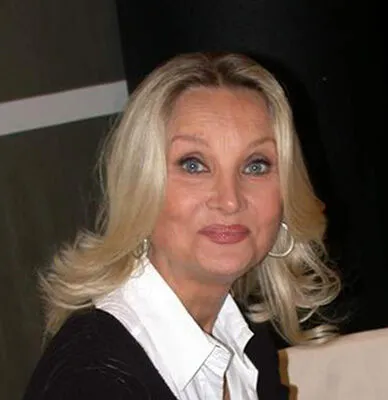
Barbara Bouchet
Human Design Chart
Biography
She has acted in more than 80 films and television episodes and founded a production company that has produced fitness videos and books. She also owns and operates a fitness studio. Some of her roles include Miss Moneypenny in "Casino Royale," Kelinda in the episode "By Any Other Name" of the original "Star Trek," as Patrizia in "Don't Torture a Duckling" and as Mrs. Schermerhorn in Martin Scorsese's "Gangs of New York."
In 1974, Barbara Bouchet married Luigi Borghese, a producer, with whom she has two sons: Alessandro (b. 1976), a TV chef and Massimiliano (b. 1989), a bartender. Her husband subsequently produced some of her later films. They separated in 2006, citing different aspirations.
Barbara Bouchet — Projector with Profile 4/6
Projector 4/6 — Design at a Glance
Barbara Bouchet's design showed a tendency towards sharp system analysis. Her aura acted like a bright flashlight, focusing on areas in the environment that were still in darkness or not functioning optimally. This dense, focused projection allowed her to immediately identify errors in a system and bring 'light into the dark' for others.
However, this direct confrontation with flaws could trigger resistance from others, similar to shining directly into someone's face. Barbara Bouchet's effective strategy did not lie in addressing deficiencies immediately but rather in attracting others through her own harmony. When she set an example of a functioning system, people would automatically seek out her advice. The crucial protective mechanism was waiting for a respectful and sincere invitation. This prevented overexertion and ensured the acceptance of her leadership.
Physiologically, Barbara Bouchet did not have a defined sacrum, meaning she lacked a constant intrinsic source of life energy. Instead, she experienced cycles: phases of high activity and rapid productivity alternated with necessary rest periods. These recovery times were essential to prevent burnout, as societal structures often failed to accommodate this rhythmic need. Living according to her design – through invitation and rhythm – rewarded her with success. Deviations from it tended to lead to bitterness as an expression of not living true to herself.
Self-Projected Authority
Barbara Bouchet's design showed a tendency towards extreme openness, coupled with the risk of being distracted by external motoric energies. As a projector with rare authority in self, her inner truth was anchored in her identity. This configuration required a clear distinction between true essence and intellect.
For her, decision-making occurred through spontaneous self-conversations or conversations when invited to do so. Crucial was listening to herself and recognizing when the true essence spoke – marked by spontaneous, unreflective statements. This expression made her uniqueness recognizable to others. Alternatively, a physical feeling that geographically or thematically guided her steps directed her actions.
The greatest challenge lay in not sinking into this openness and constantly chasing energy. However, her specific potential for success precisely lay here: When Barbara Bouchet recognized and followed her own inner direction, she could act as a guide for others. Her authority in self was thus not an isolated mechanism but the foundation for showing others the way through authenticity, provided she remained true to her inner voice rather than losing herself in the external world.
The 4/6 Profile — Opportunist / Role Model
Barbara Bouchet's design set up a lifelong internal conflict: between the heart's desire for belonging (Line 4) and the intellectual drive for wise distance (Line 6). In the first thirty years, before Saturn's return, Line 6 still acted like a Line 3. This shaped an experimental, often frivolous behavior, especially in relationships. Gate 4 represents 'play' and the danger of holding fantasies as truths or getting entangled in youthful foolishness.
After Saturn's return, the focus shifts to Line 6. Here, synthesizing complex knowledge is paramount (Hexagram 23). Barbara Bouchet showed herself as someone whose task was to clearly communicate this knowledge and create individuality along with collective value through synthesis. The 'great heart' of Line 4 remains cautiously open; it selectively opens to avoid being hurt by false people. Thus, the tension lies between protecting one's emotional life and the necessity to convey complex insights in a way that makes them effective. She was expected to act as a wise role model who realized this synthesis through cooperation with others.
Single Definition — Defined & Open Centers
Barbara Bouchet's design is characterized by a stable and independent inner structure that contrasts with her high receptivity to external influences. Her defined mental triad, consisting of Ajna Center (conceptual thinking), G Center (identity and direction) as well as Throat Center (communication), created a consistent authority: She thought independently, knew her inner alignment, and expressed this clearly. This gave her the ability to develop concepts and directly translate them into words or actions without relying on external confirmation.
At the same time, however, a strong vulnerability to the environment was revealed through six open centers: Head (inspiration), Heart (willpower), Sacral (vital energy), Solar Plexus (emotions), Spleen (intuition/survival) and Root (stress). This configuration meant that Barbara Bouchet did not have constant inner inspiration, willpower, or vital endurance but instead absorbed and amplified these energies from her surroundings. The challenge lay in not falling into the trap of interpreting foreign mental pressure (Head), emotional waves (Solar Plexus), or adrenalized stress (Root) as her own reality. Instead of identifying with a need for proof (Heart) or fear of survival concerns (Spleen), her mechanics were designed to merely observe and reflect these "borrowed" states while remaining anchored in her stable inner voice (Throat/Ajna/G). Thus, she could serve as a mirror for the energies of others without losing herself or being hindered by conditioned reactions such as overworking or emotional instability.
Channels for logical leadership and structured insight.
Barbara Bouchet's design indicated a tendency towards collective leadership based on logical pattern recognition. She was someone who formulated innovative insights to increase efficiency but only became effective when invited and her timing was right.
This character trait resulted from Channel 7-31, which connects the G Center with the Throat Center through Gate of the Role of Self (7) and Gate of Leading (31). It describes logical, collective leadership looking towards the future. Barbara Bouchet had the energy to recognize tested patterns and use them as an "Alpha" for safety. Gate 7 provided the logical role, often described as power behind the throne, while Gate 31 represented the collective leader. Crucial was that such leadership competence first needed to gain trust and be invited by the majority before it could demonstrate satisfaction to society. It was less about absolute authority than influence from a powerful position, where the duration of its effect depended on how the community assessed her performance.
At the same time, Channel 43-23 shaped her way of communicating. This channel connects the Ajna Center with the Throat Center through Gate of Insight (43) and Gate of Assimilation (23). It enabled mutative efficiency through structured insight. Barbara Bouchet possessed the potential to formulate unique perspectives and more efficient ways that could change others' thinking. Gate 43 received spontaneous breakthroughs, while Gate 23 processed and expressed them. This gift led to acceptance only when clearly communicated at the right time; otherwise, she risked being perceived as an outsider. Her task was to let go of control and allow her mind to process knowledge at its own pace to explain it simply and clearly.
Additionally, Gates like the Gate of Formulating (4), which develops logical processes for future security, and the Gate of Transformation (49), which requires sensitive reaction to principles, were influential. Gate 62 promoted patience and pattern recognition through details, while Gate 16 encouraged experimentation to improve new things. These configurations underscored the necessity of connecting logical clarity with innovative expression, always dependent on the right invitation and appropriate moment.
Individual Circuitry — Circuit Signature
Barbara Bouchet's design shows a tendency towards a dual expression: on one hand, pulsating, emotional creativity, and on the other, focused, rational strategy. Both streams converged in the Throat Center, the place of external expression. This manifested as the need to bring both inner transformations and logical future plans into the world.
Her Knowledge Circuit connected Ajna and Throat Centers through the Channel of Structuring (Gates 43–23). This connection allowed creative impulses and emotional waves from the Solar Plexus—though this center was not directly in the circuit, the energy of the Knowledge Circuit is emotionally charged—to be poured into structured forms. It was about expressing a unique identity through new insights.
Parallel to this, her Understanding Circuit connected the Throat Center with the Identity Center (Channel 31–7, "The Alpha Animal"). Here, emotionless reason took center stage: logical strategies and future-oriented visions were communicated clearly and focused. Since it is a simple definition, these energies flowed together. Barbara Bouchet could thus articulate both the melancholic depth of creative mutations and the cool clarity of strategic planning without these poles colliding internally but rather working as complementary expression tools.
Right Angle Cross of Explanation 3
Barbara Bouchet's design points to a tendency towards a profound spiritual mission of enlightenment and understanding. She was someone whose existence was marked by an inherent inclination to seek truth and bring clarity to complex or dark areas. This fundamental stance stems from the right cross of explanation (Cross 15), which in Human Design describes a specific archetypal orientation. This aspect of her chart indicates a life task that goes beyond personal achievements, instead aiming at uncovering connections often hidden or misunderstood. Barbara Bouchet's chart thus signals a focus on reducing confusion and establishing order through explanation. It is not a random trait but a structural imprint influencing her actions and perception of the world. The mechanics of this cross emphasize the need to present things in such a way that they become comprehensible for others, thereby making complex matters accessible. This impulse towards clarification was central to her expression and work.
Saturn Return · Uranus Opposition · Chiron Return · 2nd Saturn Return — Life Cycles
Barbara Bouchet's design marked around age 30 as a turning point: the transition from experimental searching to binding, structural life decisions. This phase served as the first major test of maturity, where identity consolidated and adult responsibility became tangible.
This process corresponds to the first Saturn return. In Human Design mechanics, this cycle signals the end of a long learning period and entry into an era of stability. It is no longer about trying out various roles but anchoring what has proven sustainable. The energy focuses on consolidation and creating lasting structures.
Concretely, this was seen in 1974 at age 30 when Barbara Bouchet married producer Luigi Borghese. This relationship was not a mere coincidence but an expression of the underlying mechanics: choosing a partner and marriage served as a tool for structuring her own life. Through this binding decision, what had previously been fluid became fixed. The Saturn return demanded exactly such clarity – not through inner insight alone, but through tangible facts like marriage. With this, Barbara Bouchet laid the foundation for a life less about change and more about reliability and defined conditions. The marriage was proof that the phase of searching was over and now the time of responsibility had begun.
Projector · Self-Projected Authority — Synthesis
Barbara Bouchet's chart reveals a thread of authentic leadership through inner clarity and the ability to recognize patterns (Gate 4, Alpha Animal Channel). Her defined G Center as an anchor for identity, combined with a mental center that structures and formulates knowledge (Channel 23/43), points to someone who not only gains personal insights but also communicates them clearly. This ability is strengthened by her open connection to centers of energy and emotion – she perceives moods and can thereby develop a fine sense for the collective field. Crucial, however, is that this influence is effective only when invited, underscoring her projector strategy.
A central paradox in her design lies in the interplay between clarity and openness. While she has an acute ability to recognize errors and offer solutions (Gate 4), her open emotional and sacral centers are vulnerable to external influences. This creates a tension field between the urge to share knowledge and the need to protect against overstimulation and conditioning. The challenge is to use her own inner authority to discern when it's time to speak out – and when it's better to retreat into silent reflection.
2 Defined Channels
Incarnation Cross - Right Angle Cross of Explanation 3
Solar Return
The Solar Return shows the moment when the sun returns to its exact birth position - your personal solar year.
Life Cycles
Discover the life cycles with a detailed triple view (birth chart, cycle chart, composite).
Human Design Profile
- Type
- Projector
- Strategy
- Wait for the respectful invitation
- Authority
- Self-Projected Authority
- Profile
- 4/6 - Opportunist / Role Model
- Definition
- Single Definition
- Incarnation Cross
- Right Angle Cross of Explanation 3
- Date of Birth
- 15.08.1944 11:30
- Place of Birth
- Prague, Czech Republic
Frequently Asked Questions
What is Barbara Bouchet's Human Design type?
What Profiles does Barbara Bouchet have in Human Design?
Which Authority guides Barbara Bouchet?
Which incarnation cross is active for Barbara Bouchet?
When was Barbara Bouchet born?
Discover your own Human Design
Are you also a Projector? Find out in a personal reading how to unfold your leadership qualities and recognize the right invitations.
More Personalities
Back to overviewSissy Spacek
Alain-Fournier

Anémone
Ann-Margret
Bourvil
Christian-Jaque